

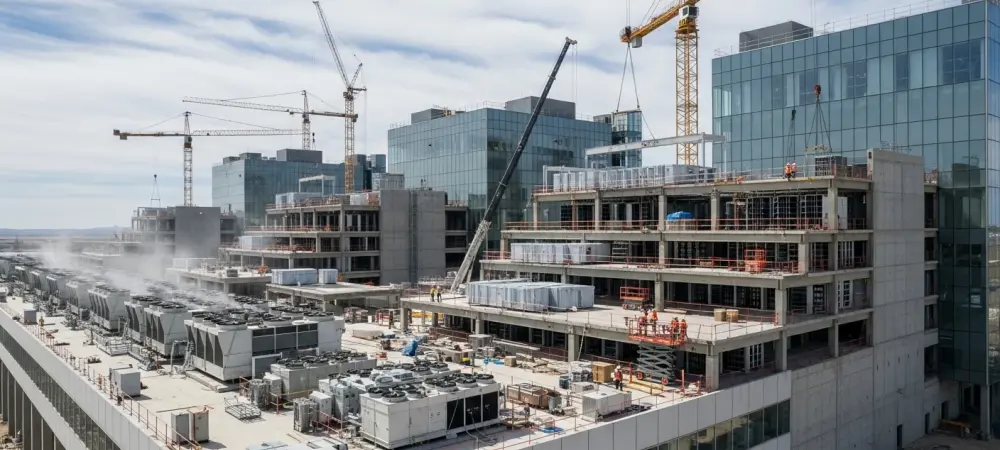
The global digital landscape is undergoing a tectonic shift as tech giants transition from localized server rooms to “gigawatt-scale” power hubs that redefine industrial infrastructure. In an era dominated by generative AI and massive cloud computing, hyperscale data centers have become the vital organs of the global economy, dictating the pace of technological sovereignty and innovation. This article explores the surge in hyperscale capacity, using Microsoft’s recent expansion in Texas as a primary case study to examine growth drivers and the future of massive-scale computing.
The State of Hyperscale Infrastructure Growth
Market Trajectory and Capacity Statistics
Hyperscalers are bringing unprecedented capacity online, highlighted by Microsoft’s expansion of 2GW throughout 2025. This momentum reflects a shift toward massive 700MW+ individual site leases to meet the rigorous energy demands of high-density AI workloads. Consequently, specific hubs like Abilene, Texas, and Wisconsin are becoming the new epicenters for digital infrastructure due to land and power availability.
Real-World Applications: The Abilene Campus Case Study
Microsoft recently secured 700MW of capacity at the Crusoe campus in Abilene, filling the gap left by Oracle and OpenAI. This move signifies a strategic pivot, as companies move from the proposed “Stargate” framework to multi-state developments. Moreover, Microsoft is eliminating nondisclosure agreements to foster community transparency and streamline local approvals, signaling a shift in management paradigms.
Industry Perspectives: Consolidation and Competition
Infrastructure analysts note that the industry is gravitating toward centralized, massive campuses rather than fragmented sites to optimize efficiency. This has sparked an “arms race” for power between Microsoft, Meta, and Oracle, where site acquisition serves as a critical competitive moat. However, managing gigawatt-level power sites presents complex challenges in cooling, grid stability, and logistics.
The Future of Hyperscale Expansion: Risks and Opportunities
The rapid scaling of infrastructure creates a tension with the environmental necessity for renewable energy integration. Next-generation AI chips will necessitate even higher power densities and specialized liquid cooling infrastructure. While these hubs drive local job creation, they also strain regional utility grids. The long-term outlook suggests a transition toward true gigawatt-scale dominance as existing tech hubs face a “power ceiling.”
The industry moved toward massive capacity leases and the strategic consolidation of power by leaders. This shift proved that the ability to scale infrastructure became the primary bottleneck for AI advancement. Stakeholders focused on grid modernization and liquid cooling to ensure that the hyperscale foundations of today could support the intelligence of tomorrow.