

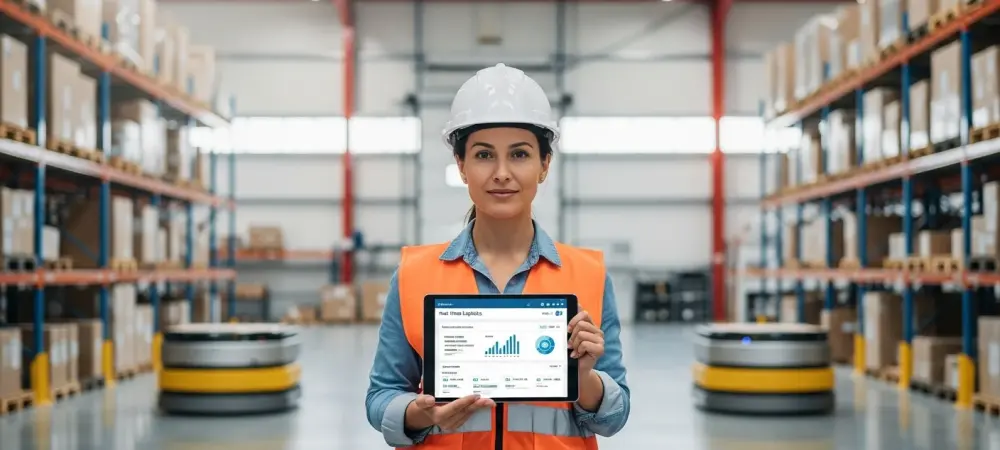
Across the grease-stained floors of America’s industrial heartland, a silent transformation is taking hold as digital entities move beyond simple automation to manage the complex administrative burdens that have long throttled production speed. This shift is not about robots replacing the steady hands of machinists, but rather about “Agentic AI” dismantling the invisible barriers of paperwork and data entry that keep factories from reaching their true potential. In this new landscape, the most significant productivity gains are found not in the speed of the lathe, but in the speed of the quote.
The transition toward autonomous agents represents the next logical step in the evolution of manufacturing. While physical processes have been refined for decades, the cognitive side of operations remained stubbornly manual. Today, the industrial sector stands at a crossroads where the ability to process information autonomously determines which facilities thrive and which ones succumb to administrative bloat. By integrating digital teammates capable of making decisions and executing workflows, the modern factory is fundamentally changing how it interacts with customers, data, and its own human workforce.
The High-Stakes Balancing Act: Navigating the Modern Quoting Trap
For many plant managers, the most grueling part of the daily routine is the “gymnast’s balancing act” required to navigate the Request for Quote (RFQ) process. When a potential client requests pricing for a complex component, such as a custom run of 10,000 precision ball bearings, it triggers a frantic wave of activity. Highly paid engineers are often forced to abandon their primary design tasks to perform “pre-work,” which essentially involves designing half the product simply to determine if the requested price is even feasible. This administrative friction creates a massive drain on human capital, where thousands of skilled hours are burned every week on work that may never generate a single cent of revenue. If the engineering team moves too slowly, a competitor captures the contract; if they move too fast, they risk committing the factory to a project that is financially unsustainable. The sheer volume of these “contingency” tasks often results in a front-office bottleneck that limits the total number of opportunities a company can even consider, effectively capping growth before the machines even start spinning.
Bridging the Gap: Overcoming Physical Lean and Cognitive Waste
While the 20th-century revolution of “Just-In-Time” (JIT) manufacturing successfully optimized the movement of physical parts and eliminated warehouse bloat, it left the “cognitive” side of the factory largely untouched. The transition from the post-war “buffer stock” model, which relied on massive inventories to mitigate risk, to the sleek Toyota Production System solved the problem of excess metal. However, modern factories have now hit a new ceiling where the movement of data has become the primary constraint. Today’s industrial challenge is no longer just about moving metal faster; it is about moving the information required to handle orders without overwhelming the front office. Despite having high-speed assembly lines, many manufacturers find their growth stifled by a “cognitive waste” that mirrors the physical waste eliminated decades ago. The information bottleneck persists because, until recently, there was no digital equivalent to the assembly line for administrative tasks. The emergence of agentic systems finally offers a way to bridge this gap by treating data processing with the same lean precision once reserved for the factory floor.
Deconstructing the Workflow: The Precision of Atomic Steps
To overcome these pervasive bottlenecks, forward-thinking factories are now adopting a strategy of breaking complex industrial processes into “atomic steps,” which are the smallest possible units of digital labor. Rather than attempting to automate an entire department at once, this method isolates specific tasks such as verifying email specifications or extracting machine requirements from dense technical documents. By identifying these 15 to 20 discrete units within a process like quoting, manufacturers can delegate the repetitive, information-heavy chores to AI agents. This shift allows the human workforce to “move up the stack,” transitioning from the drudgery of data entry and clerical verification to high-level strategic planning and engineering innovation. When an agent handles the initial data prep for a Computer-Aided Design (CAD) professional, that professional can focus entirely on the nuances of the build rather than searching for missing dimensions in a PDF. This granular approach to automation ensures that technology serves as a force multiplier for human expertise, rather than a clumsy replacement that requires constant intervention.
The Agentic Ladder: A Six-Tier Framework for AI Maturity
The transition from basic automation to true industrial autonomy is defined by the “Agentic Ladder,” a hierarchy that tracks how artificial intelligence evolves from a tool into a teammate. Most factories are currently operating at the L1 “Collaborator” phase, utilizing AI as a glorified search engine or a drafting assistant that requires constant human babysitting for every single output. At this level, the technology provides minor speed improvements but does not fundamentally alter the workload of the staff who must still verify every line of text. The real economic breakthrough occurs at L3 and above, where “True Agents” begin to operate based on specific triggers and use digital tools autonomously. By the time a system reaches L4 “Observer” status, it functions like a department manager, running entire functions against set guardrails and reporting on Key Performance Indicators (KPIs) rather than individual tasks. At the pinnacle, the L5 “Investor” status describes a self-improving leader where the AI monitors its own outcomes and rewrites its own operational playbooks to improve factory performance, effectively becoming a self-optimizing engine of productivity.
Implementing the Micro Enterprise Model: The Rise of Hybrid Labor
Building a modern, agentic factory requires a fundamental shift toward the “Micro Enterprise Model,” where human-machine hybrids operate with unprecedented efficiency and agility. Organizations can begin this transition by identifying their most significant contingency-based work—those tasks performed in the mere hope of a result, such as scheduling or quoting—and assigning them to digital agents. This model treats Agentic AI as a hirable teammate rather than just a software installation, allowing the factory to scale its administrative capacity without a linear increase in overhead.
By embracing this hybrid labor force, manufacturers can finally reclaim the rarest luxury on the factory floor: the time needed to focus on long-term growth rather than just keeping up with the paperwork. The integration of these systems allows for a more responsive production cycle where the front office can match the speed of the shop floor. As digital agents take over the “dull and information-heavy” tasks at the bottom of the to-do list, the manufacturing sector is poised to enter a new era of dominance characterized by high-speed decision-making and renewed industrial innovation.
The path to operational excellence was secured when leadership teams identified the specific clerical tasks that functioned as hidden tax on human creativity. The implementation of agentic workflows provided the necessary relief to engineers, who then redirected their focus toward high-value prototyping and client relationship management. By treating digital agents as hirable assets, the enterprise successfully dismantled the quoting trap and established a more resilient supply chain. These early adopters recognized that the solution resided in the harmony between human intuition and autonomous data execution, which eventually redefined the global standard for industrial productivity.