

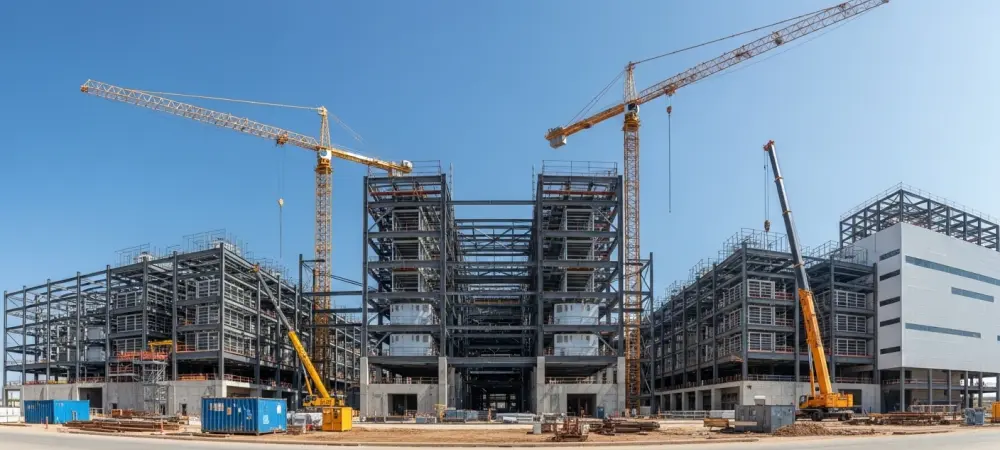
The relentless transformation of the Texan landscape continues as massive cranes and steel frameworks rise above the horizon of Ellis County, signaling a new chapter in the state’s industrial evolution. Google has officially advanced its infrastructure strategy by filing plans for a fifth major facility at its Midlothian campus. Operating through its subsidiary, Sharka LLC, the technology giant is committing approximately $880 million to develop “Sharka Data Center – Building 5,” a move that reinforces its long-term vision for the region.
A Multi-Billion Dollar Bet: The Lone Star State
This latest investment signifies a massive scale-up for a site that began as a modest entry into the local market. Since its inception, the Midlothian campus has evolved into a 540-acre powerhouse, reflecting a steady accumulation of land and capital. The development of Building 5 follows the successful addition of a fourth structure earlier this year, proving that the company’s appetite for Texas real estate remains unsated.
The project timeline reflects the urgency of modern digital needs. Construction, which commenced in early 2024, is currently on track for a completion date in February 2027. This multi-year roadmap ensures that the facility will be ready to handle the next generation of computing tasks, providing a stable foundation for the company’s expanding presence in the southern United States.
Fueling the Global Appetite: Artificial Intelligence
Physical infrastructure serves as the silent engine behind the rapid proliferation of generative artificial intelligence and high-performance computing. As global users transition toward more complex AI-driven tools, the demand for localized processing power has skyrocketed. Google’s strategic choice to anchor its $40 billion nationwide infrastructure commitment in Texas highlights the state’s unique ability to support the massive energy and space requirements of modern Cloud services.
Texas provides a geographic advantage that few other regions can match, offering a central location for data routing across North America. This expansion is not merely about storage; it is about latency and the speed at which billions of data points are processed every second. By doubling down on its Texan footprint, the company ensures it can meet the soaring expectations of both enterprise clients and individual consumers.
Inside the Expansion: Scale, Scope, and Strategic Location
The technical specifications of the new 288,000-square-foot facility are as impressive as its price tag. The project encompasses everything from the initial core and shell construction to the intricate interior finish-out required for high-density server racks. This comprehensive approach to development ensures that the “Sharka LLC” investment yields a turnkey solution for the ever-growing digital load of the Dallas-Fort Worth metroplex.
Beyond the walls of the data center, the economic ripple effect on the Ellis County economy has been profound. This growth is part of a broader mapping of the company’s Texas footprint, which now extends far beyond Midlothian. With secondary campuses and upcoming developments in Red Oak, Armstrong, and Haskell Counties, the tech giant is effectively creating a distributed network of computing power that blankets the state.
Redefining Infrastructure: Sustainable Energy
As the scale of these facilities grows, so does the focus on environmental responsibility and the transition toward clean-energy-powered sites. In Wilbarger County, the commitment to sustainability is taking a physical form through projects designed to offset the heavy electrical demands of high-performance computing. Balancing capital-intensive growth with long-term ecological goals has become a cornerstone of the company’s modern development philosophy.
Joint ventures have also played a critical role in securing a reliable and green power grid. The Abernathy project serves as a prime example of how strategic partnerships can facilitate the delivery of renewable energy to energy-hungry data hubs. These initiatives demonstrate that rapid industrial expansion does not have to come at the expense of the environment, provided that infrastructure and energy production grow in tandem.
Navigating the Future: Digital Hub Development
The aggressive scaling seen in Midlothian serves as a definitive blueprint for big tech infrastructure in the coming decade. Strategic land acquisition, such as the 540-acre accumulation in Ellis County, provides a lesson in foresight, allowing for modular growth that can adapt to shifting technological trends. As these facilities become more integrated into the local landscape, Texas is solidified as a central pillar of the global digital economy.
Stakeholders and urban planners began looking toward the integration of smarter grid technologies and community-focused infrastructure investments. Future developments will likely prioritize even higher levels of automation and liquid cooling systems to manage the heat generated by advanced AI chips. Industry leaders recognized that the successful integration of these massive hubs required a balance between technical capacity and local resource management.