

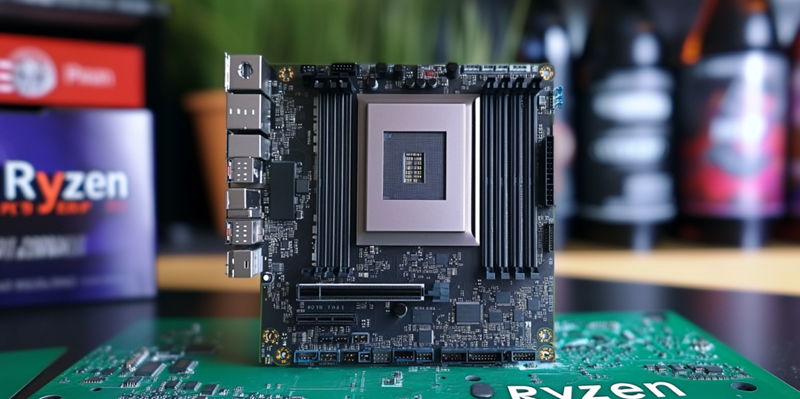
GMK is making headlines with its latest offering, the EVO-X1 Mini PC, a compact yet powerful gaming and productivity solution boasting the AMD Ryzen AI 9 HX370 APU. This unit claims to deliver GPU performance on par with NVIDIA’s RTX 2060, leveraging the advanced capabilities of the AMD Strix Point APU. Specifically, the Ryzen AI HX370 boasts an impressive configuration of 12 cores and 24 threads, supported by clock speeds reaching up to 5.1 GHz. With a combination of 4 Zen 5 and 8 Zen 5c cores, supplemented by RDNA 3.5-based Radeon 890M graphics with 16 Compute Units and a 2900 MHz clock speed, the EVO-X1 positions itself as a high-performance mini PC designed for modern gaming and multifaceted productivity.
Enhanced Performance with AMD Strix Point APU
One of the standout features of the GMK EVO-X1 is its operating thermal design power (TDP), which has been significantly increased from the usual range of 15-54W to a robust 70W. This substantial boost in power capacity is a critical element GMK highlights as enabling the EVO-X1 to potentially match the performance figures attributed to the RTX 2060. Nevertheless, industry experts remain circumspect regarding these claims; while superior to the GTX 1060, integrated GPU (iGPU) performance generally falls short of the 166W RTX 2060 in real-world applications.
Despite some skepticism, the EVO-X1’s enhanced TDP suggests significant strides in power efficiency and thermal management, which are essential for a mini PC format. The higher TDP affords greater headroom for sustained performance and more intensive graphics processing tasks. Enthusiasts and casual gamers alike may find its performance sufficient for a variety of mainstream and less demanding gaming titles, while those requiring additional graphics horsepower beyond the built-in Radeon 890M will appreciate the system’s capability for upgrades.
Design and Connectivity
The EVO-X1 is engineered to cater to tech-savvy users who seek a portable and efficient alternative to traditionally bulky desktop systems. By focusing on essential components, GMK has created a mini PC that maintains a lightweight yet robust build without compromising on performance. For users needing enhanced graphics capabilities, the inclusion of an OCulink connection stands out, enabling the attachment of an external discrete GPU for boosted performance, thus mitigating any inherent limitations of the onboard Radeon 890M.
In terms of connectivity, the EVO-X1 does not fall short. It features multiple USB Type-C and USB 3.2 ports, ensuring seamless connections for peripherals and accessories. Additionally, it includes a 3.5mm headphone jack, meeting the audio needs of most users. Effective heat dissipation is another key consideration in the EVO-X1 design, evidenced by its significant exhaust vents to maintain optimal operating temperatures and performance stability during extended use.
Market Position and Pricing
GMK is making waves with its newest product, the EVO-X1 Mini PC, which is a small but formidable machine suited for both gaming and productivity. This compact powerhouse is equipped with the AMD Ryzen AI 9 HX370 APU, a unit that promises GPU performance comparable to NVIDIA’s RTX 2060. The advanced capabilities of the AMD Strix Point APU really shine in this device. The Ryzen AI HX370 features an impressive configuration with 12 cores and 24 threads, achieving clock speeds up to 5.1 GHz. This APU combines the strengths of 4 Zen 5 and 8 Zen 5c cores, and includes RDNA 3.5-based Radeon 890M graphics, boasting 16 Compute Units and a 2900 MHz clock speed. The EVO-X1 Mini PC is designed to meet the demands of contemporary gaming and varied productivity tasks, offering users a robust, miniaturized computing solution that doesn’t compromise on performance. This latest addition to GMK’s lineup clearly illustrates their dedication to pushing the boundaries of what a mini PC can achieve.