

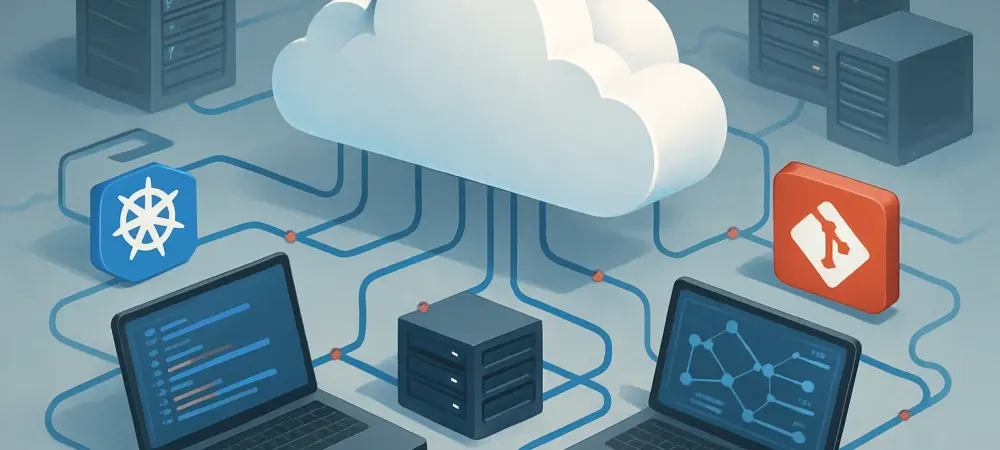
The realm of IT infrastructure management faces an unprecedented challenge with hybrid cloud environments becoming the norm for over 80% of enterprises today, creating a pressing need for effective solutions. As organizations juggle on-premises systems alongside public cloud platforms, the complexity of maintaining consistency, security, and speed in software delivery has skyrocketed to levels that demand innovative approaches. Enter GitOps, a methodology that promises to streamline this chaos by leveraging Git as the single source of truth for declarative configurations. This review dives deep into how GitOps transforms continuous delivery in hybrid setups, evaluating its core mechanisms, benefits, challenges, and real-world impact. The goal is to uncover whether this DevOps evolution truly delivers on its potential to simplify distributed system management.
Core Features and Mechanisms of GitOps
Declarative Power and Git Centrality
At the heart of GitOps lies its reliance on declarative configurations stored in Git repositories. Unlike traditional approaches where manual scripts or imperative commands dictate changes, this methodology defines the desired state of applications and infrastructure in code, ensuring every change is versioned and auditable. Git serves as the central hub, enabling teams to track modifications, roll back errors, and maintain a consistent view of system states across environments. This setup fundamentally reduces discrepancies that often plague hybrid cloud deployments, where disparate platforms can diverge without a unified reference point.
The pull-based reconciliation model further distinguishes GitOps from conventional push-based pipelines. Instead of external tools forcing updates, environments continuously pull their desired state from Git, minimizing manual intervention and the risk of human error. This mechanism ensures that even in sprawling hybrid architectures, systems remain aligned with predefined configurations, providing a robust foundation for automation and reliability.
Automation Through Specialized Tools
Tools like ArgoCD and Flux are pivotal in operationalizing GitOps, acting as continuous monitoring agents that synchronize environments with Git-defined states. These platforms detect configuration drift—unauthorized or unintended changes—and automatically correct them, ensuring operational integrity across hybrid cloud setups. Their ability to operate in real time means issues are flagged and resolved before they escalate, a critical feature for maintaining uptime in distributed systems.
Beyond synchronization, these tools offer visibility into deployment health, allowing teams to monitor reconciliation status and pinpoint failures swiftly. In hybrid environments where workloads span multiple clouds and on-premises servers, such automation is indispensable. It bridges the gap between diverse platforms, ensuring that whether a workload runs on AWS or a local data center, it adheres to the same Git-defined policies.
Performance in Hybrid Cloud Environments
Governance and Compliance Simplified
One of the standout strengths of GitOps is its capacity to enforce unified governance across fragmented hybrid cloud landscapes. By centralizing configurations in Git, organizations can define security policies, compliance standards, and operational rules in a single repository, ensuring uniform application regardless of platform or region. This centralized model is a game-changer for enterprises dealing with stringent regulatory requirements, as it eliminates the patchwork of manual adjustments often seen in traditional setups.
The auditability provided by Git history adds another layer of value. Every change, from infrastructure tweaks to application updates, is logged with timestamps and author details, making it straightforward to trace actions during compliance reviews. For industries like finance or healthcare, where audits are frequent and rigorous, this transparency reduces preparation time and mitigates the risk of non-compliance penalties.
Operational Resilience and Efficiency Gains
GitOps significantly boosts resilience in hybrid cloud systems through features like drift detection and automated reconciliation. When unauthorized changes occur—whether due to manual tinkering or security breaches—the system identifies and reverts them to the desired state, slashing recovery times. This capability is vital in environments where downtime can cost millions, ensuring that disruptions are minimized even across complex, multi-platform setups.
Efficiency is another area where GitOps excels, particularly in deployment frequency and error reduction. By automating state management, teams can push updates more frequently without the fear of misconfigurations derailing operations. The result is a streamlined delivery pipeline that accelerates time-to-market for new features, a competitive edge for businesses operating in fast-paced sectors. This performance metric underscores why many organizations view GitOps as a cornerstone of modern IT operations.
Challenges and Limitations at Scale
Architectural and Security Complexities
Scaling GitOps to enterprise levels introduces intricate architectural challenges, particularly in repository design. Choosing between a monorepo, which centralizes all configurations for visibility, and a multi-repo approach, which grants teams autonomy, impacts governance and collaboration. A poorly structured repository can lead to merge conflicts or fragmented policies, undermining the consistency GitOps aims to achieve in hybrid setups.
Security risks also escalate as Git becomes a critical asset. Repositories housing infrastructure and application states are prime targets for attackers, necessitating robust access controls and secrets management. Without proper safeguards, a single compromised credential could propagate malicious changes across clusters, highlighting the need for stringent protective measures like role-based access control and encrypted storage.
Cultural and Tooling Obstacles
Adoption of GitOps often faces resistance from teams accustomed to traditional workflows, creating a cultural barrier. Developers and operators may view the shift to Git-driven processes as restrictive, slowing implementation if not addressed through training and change management. Overcoming this inertia requires fostering a collaborative mindset, emphasizing the benefits of automation over manual control.
Tooling maturity presents another hurdle, especially in multi-cloud scenarios. While platforms like ArgoCD and Flux are powerful, they often require customization to fully handle the nuances of hybrid environments. Gaps in out-of-the-box support for certain cloud providers or governance models mean organizations must invest in tailoring solutions, adding complexity to deployment efforts. This limitation underscores that GitOps is not a plug-and-play solution but a framework demanding strategic adaptation.
Real-World Impact and Emerging Trends
Case Studies Demonstrating Value
In practice, GitOps has proven transformative for industries navigating hybrid cloud challenges. Take the example of a financial services firm, referred to here as FinServe Global, which grappled with inconsistent deployments and compliance issues across regional data centers and public clouds. By adopting GitOps with a hub-and-spoke repository structure, the company achieved a 35% increase in deployment frequency and halved its mean time to recovery, while simplifying audit processes through traceable Git logs. Such outcomes are not isolated. Sectors like healthcare have similarly leveraged GitOps to meet data residency mandates, ensuring configurations align with local laws across multi-region deployments. These real-world applications highlight how the methodology addresses not just technical but also regulatory pain points, making it a versatile tool for enterprise IT.
Innovations Shaping Scalability
Looking at current trends, GitOps is evolving with innovations like policy-as-code, which embeds governance rules directly into configurations for automated compliance checks. Integration with observability tools provides real-time insights into deployment health, crucial for preempting issues in distributed systems. Additionally, architectural models such as hub-and-spoke are gaining traction, balancing central control with team flexibility for scalable operations.
Cultural alignment is also emerging as a key focus, with organizations investing in training to ease the transition to Git-driven workflows. These advancements suggest that GitOps is moving toward broader enterprise adoption, supported by community-driven standards and open-source contributions that address existing gaps. The trajectory points to a maturing ecosystem poised to handle increasingly complex hybrid cloud demands.
Final Thoughts and Next Steps
Looking back, the evaluation of GitOps in hybrid cloud contexts revealed a methodology that excelled in delivering consistency, auditability, and resilience through its declarative, Git-centric approach. Its performance in unifying governance and enhancing operational efficiency stood out, as did the tangible benefits observed in real-world implementations. However, challenges around scalability, security, and cultural adoption underscored that success hinged on strategic planning and customization. For organizations considering GitOps, the path forward involves starting with a pilot project to test its fit within existing workflows, focusing on a specific hybrid cloud use case. Investing in robust security practices to protect Git repositories proves essential, as does training programs to align teams with the new operational model. Exploring emerging tools and community resources offers a way to stay ahead of limitations, ensuring adaptability as needs evolve. By taking these deliberate steps, enterprises position themselves to harness GitOps as a transformative force in continuous delivery.