

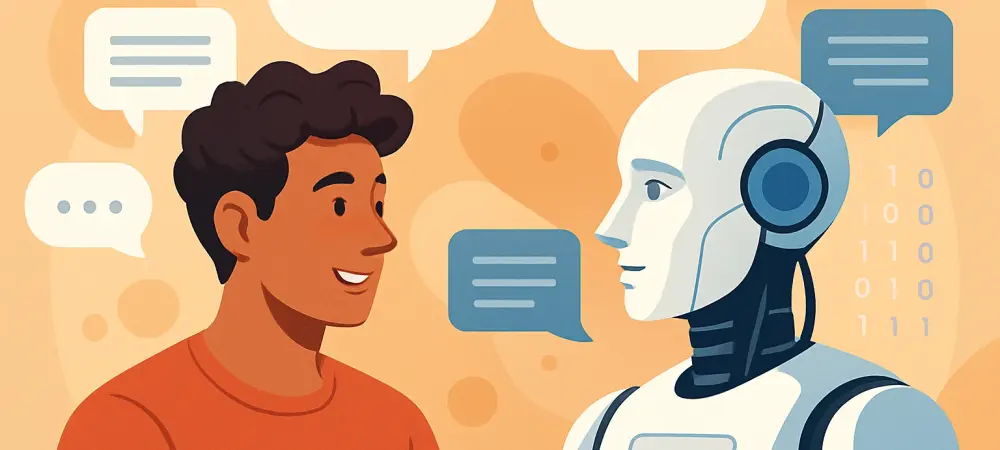
Imagine a world where a simple text prompt can yield a thoughtful response, a creative story, or even a personalized learning plan, all crafted by a machine in mere seconds, transforming the very nature of human-computer interaction. This is no longer the realm of science fiction but the reality brought forth by generative AI chatbots, which have revolutionized communication, automation, and engagement across diverse sectors. This review delves into the evolution, mechanisms, and real-world impact of these chatbots, offering a comprehensive analysis of their capabilities and the challenges they face in today’s tech-driven environment.
Understanding Generative AI Chatbots
Generative AI chatbots represent a pinnacle of artificial intelligence, leveraging natural language processing and machine learning to produce human-like text responses. At their core, these systems are trained on vast datasets of human language, enabling them to generate contextually relevant content based on user input. Their ability to mimic conversational patterns has made them indispensable in various applications, from customer support to creative writing.
The journey of these chatbots traces back to early AI systems that relied on rigid, rule-based scripts, evolving dramatically into dynamic platforms like ChatGPT and Google Gemini. This progression reflects significant advancements in computational power and algorithmic design, allowing for more nuanced and adaptive interactions. Over time, the technology has shifted from basic response generation to complex dialogue management, marking a notable leap in AI sophistication.
In the broader technological landscape, generative AI chatbots play a pivotal role in enhancing communication and streamlining automation. Their integration into everyday tools has redefined user engagement, making interactions with machines more intuitive and seamless. As these systems continue to evolve, their influence on digital ecosystems and user expectations becomes increasingly profound, setting the stage for deeper exploration of their inner workings.
Core Mechanisms and Features
Pattern Recognition and Predictive Algorithms
Central to the functionality of generative AI chatbots is their reliance on pattern recognition, a process where algorithms analyze extensive datasets to identify linguistic trends and structures. By sifting through billions of text samples, these systems predict the most probable responses to a given input, ensuring relevance and coherence. This mechanism underpins their ability to engage users in meaningful exchanges without requiring hardcoded rules.
The significance of predictive algorithms lies in their capacity to maintain conversational flow. By anticipating user intent based on prior interactions and training data, chatbots can deliver replies that align with the context, often appearing remarkably human-like. This feature is critical for applications where consistency and accuracy in dialogue are paramount, such as in customer service or educational tools.
Moreover, the continuous refinement of these algorithms enhances the precision of predictions over time. As chatbots interact with more users, they adapt to diverse linguistic styles and preferences, further improving their responsiveness. This iterative learning process ensures that the technology remains relevant amid rapidly changing communication norms.
Conversational Simulation and Modeling
Beyond prediction, generative AI chatbots excel in simulating human-like conversation through sophisticated modeling techniques. These systems employ chained predictions, where each response builds on the previous one, creating a thread of dialogue that feels natural and engaging. Such simulation is achieved through adaptive models that adjust to the tone, style, and intent of the user.
The technical foundation of this capability involves complex neural networks designed to emulate reasoning patterns. While lacking true cognition, chatbots can replicate logical progression in dialogue, making interactions appear thoughtful and deliberate. This mimicry is particularly effective in scenarios requiring empathy or personalization, even though it stems purely from computational processes.
Adaptability is another hallmark of conversational modeling, as chatbots learn to tailor their responses to individual user behaviors. Whether matching a formal tone for professional queries or adopting a casual style for friendly chats, this flexibility enhances user comfort and trust. The result is a conversational experience that often blurs the line between machine and human interaction, despite its algorithmic nature.
Recent Developments and Trends
The field of generative AI chatbots has witnessed remarkable advancements, particularly in the refinement of language models that power these systems. Improved architectures now enable deeper contextual understanding, allowing chatbots to handle intricate queries with greater accuracy. This progress reflects a broader push toward creating AI that can sustain longer, more meaningful conversations.
Emerging trends also point to the increasing integration of chatbots into everyday tools and services, from virtual assistants in smartphones to embedded support systems in enterprise software. Their conversational sophistication continues to grow, driven by innovations in training methodologies and data diversity. Such developments signal a shift toward ubiquitous AI presence in both personal and professional spheres.
A notable shift in user behavior accompanies these advancements, as individuals increasingly anthropomorphize chatbots, treating them as confidants or companions. This tendency to attribute human qualities to AI underscores the technology’s persuasive conversational design, while also highlighting the need for user education on its computational limits. The blurring of these boundaries remains a critical area of focus as adoption widens.
Real-World Applications and Use Cases
Generative AI chatbots have found practical utility across a spectrum of industries, demonstrating their versatility and impact. In customer service, they handle inquiries and resolve issues around the clock, reducing operational costs for businesses while enhancing user satisfaction. Their ability to provide instant responses has become a cornerstone of modern support frameworks.
In education, these chatbots serve as virtual tutors, offering personalized learning experiences and answering student queries in real time. Platforms integrating AI-driven conversational tools help bridge knowledge gaps by adapting content to individual learning paces. This application showcases the potential of chatbots to democratize access to tailored educational resources.
Unique use cases further illustrate their breadth, such as aiding in creative writing by generating ideas, drafting content, or even co-authoring stories. Additionally, in mental health support, chatbots provide preliminary conversational assistance, offering a safe space for users to express concerns. These diverse implementations highlight the transformative role of AI in addressing both niche and broad-scale needs.
Challenges and Limitations
Despite their advancements, generative AI chatbots face significant challenges, particularly in managing user misconceptions about their capabilities. Many users overestimate the emotional depth or understanding of these systems, leading to misplaced trust or reliance. Addressing this gap requires clear communication about the technology’s purely computational nature.
Technical limitations also persist, notably in context retention during extended conversations, where chatbots may struggle to maintain coherence. Issues such as biased or inaccurate responses, stemming from flawed training data, further complicate their reliability. These shortcomings necessitate ongoing improvements in data curation and algorithmic design to ensure consistent performance.
Ethical concerns add another layer of complexity, as over-reliance on AI for emotional support raises questions about mental health implications. The societal impact of treating chatbots as human-like entities calls for robust guidelines and user education to prevent dependency. Balancing innovation with responsibility remains a pressing challenge for developers and stakeholders in this space.
Future Outlook and Potential
Looking ahead, the trajectory of generative AI chatbots promises breakthroughs in natural language understanding, potentially bridging current gaps in contextual awareness. Innovations in emotional simulation, while still computational, could further refine user interactions, making them more intuitive and supportive. Such advancements may redefine how industries leverage AI for complex tasks.
The long-term impact on society and various sectors appears substantial, with deeper integration into daily life on the horizon. From healthcare to entertainment, chatbots could evolve into indispensable tools, reshaping human-AI relationships. This evolution will likely demand new frameworks for interaction, ensuring that technology complements rather than replaces human connection.
Speculation on future innovations suggests solutions to existing limitations, such as enhanced algorithms for bias mitigation and improved memory functions for sustained dialogue. These developments could pave the way for more responsible and advanced AI systems, prioritizing user trust and ethical considerations. The path forward holds immense potential for redefining the boundaries of machine communication.
Final Thoughts
Reflecting on this exploration, the journey of generative AI chatbots reveals their impressive capacity to mimic human dialogue, driven by intricate pattern recognition and conversational modeling. Their applications across industries have already demonstrated tangible benefits, from streamlining customer service to personalizing education. Yet, the challenges of technical limitations and ethical dilemmas underscore the need for cautious advancement.
Moving forward, stakeholders need to prioritize user education, ensuring clarity on the distinction between AI simulation and human cognition. Developers are encouraged to focus on refining context retention and addressing biases in training data to bolster reliability. As a next step, fostering interdisciplinary collaboration between technologists, ethicists, and educators could guide the responsible evolution of chatbots.
The broader consideration is to establish guidelines that balance innovation with societal well-being, preventing over-reliance on AI for emotional needs. By investing in transparent communication and robust frameworks, the tech community can ensure that generative AI chatbots remain valuable tools rather than sources of misunderstanding. This path promises a future where human-AI interaction thrives on mutual understanding and trust.