

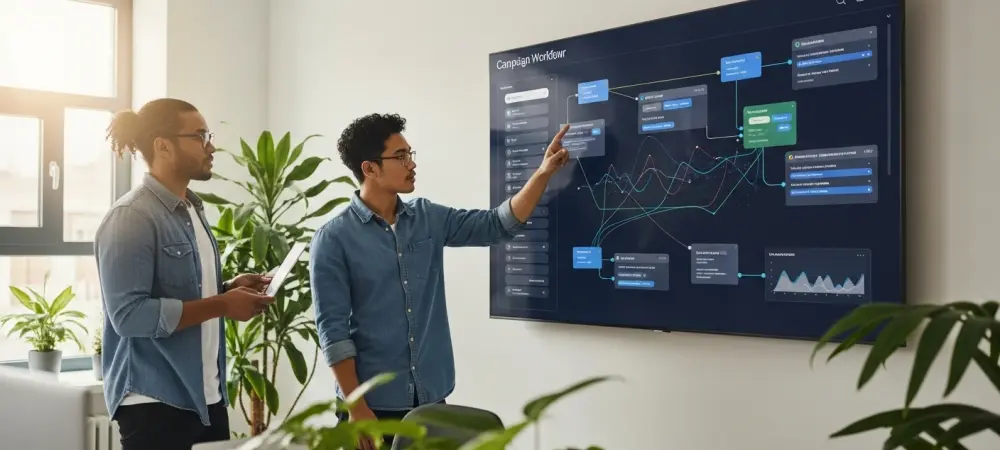
The relentless demand for high-volume, multi-platform content has pushed traditional marketing teams to a breaking point, creating a chasm between strategic ambition and operational capacity. In this high-pressure environment, the linear, human-gated process of content creation—where copywriters, designers, video editors, and strategists work in a sequential chain—has become a significant liability. This fragmentation not only slows production to a crawl but also introduces inconsistencies that dilute brand messaging and undermine campaign effectiveness. A new technological paradigm known as Flow AI has emerged to directly address this inefficiency. It represents a fundamental evolution beyond simple task automation, offering an integrated system that collapses the entire creative and strategic workflow into a single, intelligent engine. This technology is not merely an upgrade to existing tools; it is a re-imagining of how marketing campaigns are conceived, created, and deployed, democratizing access to professional-grade output for businesses of any size.
Beyond the Assembly Line Is Your Marketing Workflow Built for Yesterdays Internet
The conventional approach to producing a marketing campaign closely resembles a factory assembly line. An idea moves from the strategy department to the copywriting team, then proceeds to graphic design for visual assets, and finally lands with video editors for motion content before a social media manager schedules its deployment. Each handoff represents a potential point of failure—a miscommunication, a deviation from the brand guide, or a simple delay that compounds over the project’s lifecycle. This model, while functional in a slower-paced media landscape, is ill-suited for the dynamic, always-on demands of the current digital ecosystem, where speed and consistency are paramount.
Flow AI challenges this entire structure by posing a transformative question: What happens when the entire multi-specialist workflow is synthesized into a single, intelligent, automated process? The answer marks a paradigm shift from a sequential production line to a holistic creation engine. Instead of managing a disjointed chain of human and software inputs, a marketer provides a high-level objective, such as a product description or a campaign goal. The AI then orchestrates the entire creative process simultaneously—writing the script, generating the visuals, producing the video, composing the audio, and creating supplementary assets—all in a unified, cohesive manner. This shift re-engineers the marketing workflow from a series of discrete tasks into a singular, fluid act of creation.
The Hidden Friction in Modern AI Marketing
The initial integration of artificial intelligence into marketing brought a wave of single-function tools designed to optimize specific tasks. Businesses gained access to standalone copy generators, separate AI image creators, and rudimentary video editing assistants. While each of these tools offered localized efficiency gains, they inadvertently created a new layer of complexity. The modern marketer found themselves acting as a digital courier, manually shuttling assets between a dozen disconnected applications, a process that introduced significant friction and opportunity for error.
This siloed approach has tangible, negative consequences that undermine the very promise of AI-driven efficiency. Manually transferring text from a language model to a design platform, then uploading that design into a video tool, creates numerous bottlenecks. At every step, there is a risk of brand inconsistency, whether through the use of incorrect fonts, off-brand color palettes, or misaligned messaging. For small to medium-sized businesses, this friction is particularly damaging. It inflates production time, drives up operational costs associated with managing multiple software subscriptions, and erects a formidable barrier to achieving the professional-quality, cohesive campaign output necessary to compete with larger enterprises.
Deconstructing the Flow AI Engine an Integrated Creative Ecosystem
The fundamental transition offered by Flow AI is the evolution from viewing “AI as a tool” to embracing “AI as a collaborator.” Where previous technologies provided a digital hammer or screwdriver for a specific job, Flow AI acts as an autonomous project manager that oversees an entire campaign from a single prompt. This system is built on a unified synthesis of core creative capabilities, all working in concert to produce a cohesive set of marketing assets without the need for manual intervention between stages.
At the heart of this ecosystem is AI-powered video generation. Advanced platforms can transform a simple text description into a complete video production, intelligently selecting dynamic visuals, determining strategic pacing to maintain viewer engagement, and embedding effective calls-to-action at optimal moments. This is complemented by automated audio engineering, a capability that generates natural-sounding voiceovers in a variety of languages and styles. The AI also selects and professionally mixes background music and sound effects, ensuring a polished audio experience that aligns with the video’s tone. Natively integrated with these functions is cohesive image production, where the system generates a full suite of on-brand visual assets—such as thumbnails, social media graphics, and ad creatives—that are thematically and aesthetically aligned with the core video content, guaranteeing brand consistency across all channels.
The Rise of the AI Strategic Partner
The most significant long-term trend in marketing automation is the shift from simple content creation to integrated strategic intelligence. Flow AI platforms are at the vanguard of this movement, evolving beyond content factories to become indispensable strategic partners. This leap is powered by their ability to ingest and analyze vast datasets, including current market trends, competitor advertising strategies, and granular audience preferences. The result is a system that does not just execute commands but provides data-driven recommendations to inform the entire campaign strategy.
This analytical power manifests in several game-changing ways. For instance, the AI can map out a complete campaign schedule, suggesting a varied mix of content formats and posting times optimized for maximum engagement on different platforms. It moves beyond simple execution to provide expert insight on what content to create in the first place. Furthermore, the integration of predictive performance analytics allows marketers to forecast the likely impact of a piece of content before it is even published. This capability facilitates rapid and low-cost A/B testing of entire creative concepts, not just minor elements like headlines. Such a feedback loop dramatically accelerates the campaign optimization cycle, enabling teams to refine their approach based on predictive data and improve return on investment at a previously unimaginable speed.
A Practical Framework for Adopting Workflow Automation
Successfully adopting this new technology requires a corresponding shift in mindset and process. The first step involves redefining inputs, moving away from providing specific, task-oriented instructions toward defining high-level strategic goals. Instead of writing a detailed video script and shot list, a marketer provides a campaign objective, a target audience profile, or a key product benefit. This reframes the user’s role from a hands-on technician to a strategic director, entrusting the AI with the tactical execution.
This approach allows marketers to leverage the AI for strategic planning, not just content creation. By utilizing the platform’s analytical insights, teams can make more informed decisions on content themes, distribution channels, and target demographics before any assets are generated. Once the strategy is set, the system facilitates the scaling of multichannel campaigns with guaranteed cohesion. A unified set of video, image, and audio assets can be deployed across all platforms, ensuring a consistent brand experience for the consumer at every touchpoint. Finally, this framework enables a culture of rapid iteration and optimization. Using AI-driven analytics to test content variations and refine campaign strategy in near real-time, marketing teams can operate with an agility and data-backed confidence that was previously unattainable.
The analysis of Flow AI and its integrated workflow automation capabilities concluded that this technology represented a pivotal moment in the evolution of digital marketing. By unifying the once-disparate functions of video generation, audio engineering, image production, and strategic planning into a single, seamless engine, it effectively dismantled the operational bottlenecks that had long plagued creative teams. The primary impact observed was the profound democratization of professional-grade marketing. Small businesses and startups gained access to the creative and strategic firepower previously reserved for large corporations with extensive resources, leveling the competitive landscape. Ultimately, the rise of Flow AI did not signal the replacement of marketers but rather a fundamental evolution of their role, elevating them from tactical executors to high-level strategists who could direct and oversee sophisticated, AI-powered marketing systems to achieve business objectives with unprecedented efficiency and impact.