

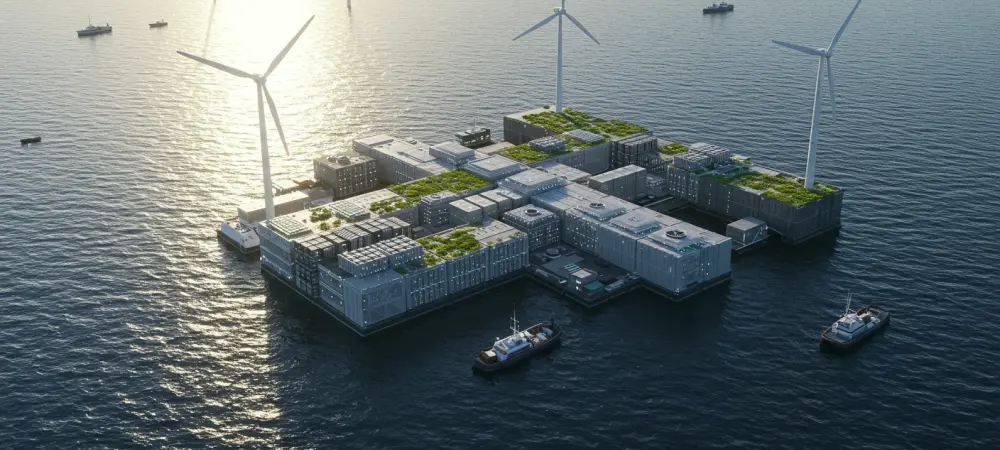
Amid ever-growing global connectivity, a critical question arises: how can the digital world expand without exhausting Earth’s finite resources? Traditional data centers, the bedrock of our online ecosystem, face increasing challenges such as land scarcity, power constraints, and lengthy permitting processes. Meanwhile, digital demand shows no signs of slowing down, posing significant hurdles that require innovative solutions. In the quest for sustainable expansion, Mitsui OSK Lines and Kinetics have joined forces to pioneer a revolutionary concept—floating data centers. This ambitious project promises to redefine how data centers are designed, constructed, and deployed. By utilizing a combination of renewable energy sources such as offshore wind and solar power, these floating entities aim to provide an agile, scalable, and eco-friendly alternative to their land-based counterparts.
Bridging Maritime Expertise and Renewable Innovation
Mitsui OSK Lines, a global leader in maritime logistics, and Kinetics, a trailblazer in mobile energy infrastructure, form a groundbreaking alliance. Together, they are developing a state-of-the-art data center poised to anchor the digital infrastructure landscape by 2027. Their combined expertise drives a new model of modular, flexible, and renewable power-driven digital resources that can be swiftly deployed, regardless of geographic limitations.
Leveraging their resources and know-how, the partnership envisions floating data centers as vessels retrofitted with cutting-edge technology, capable of seamlessly integrating with land-based grids when necessary. This adaptability provides an exciting glimpse into the future where data centers can quickly respond to global needs with minimal environmental impact.
Voices from the Vanguard
Industry leaders have weighed in on this transformative venture, expressing optimism about its promise to shake up digital infrastructure. Experts in renewable energy and maritime logistics emphasize the potential of this innovation to meet escalating demands while ensuring sustainable practices. Quotes from executives involved in the project underscore the importance of forward-thinking models in overcoming current roadblocks faced by traditional data centers.
Reflecting on Karpowership’s success in floating power solutions, industry veterans draw parallels to affirm the project’s feasibility. With over two decades of operational experience, Karpowership provides a strong foundation for this ambitious enterprise, demonstrating that floating infrastructure is not only plausible but also practical.
Transformative Pathways for Deployment
The blueprint for these floating data centers entails innovative steps, starting with the conceptual design phase and leading to the transformation of existing vessels. Emphasizing rapid deployment, this approach minimizes delays often associated with land-based data centers. By reimagining the use of marine resources, stakeholders have a compelling template for envisioning similar solutions globally.
With industry and governmental support, strategic frameworks can facilitate widespread adoption. These frameworks, built on collaboration and innovation, lay the groundwork for a new era where digital infrastructure overcomes traditional limitations.
Navigating Forward
As the future of digital infrastructure continues to unfold, the pioneering floating data center initiative stands as a beacon of innovation. It has the potential to reshape how data needs are met, paving the way for a more dynamic and sustainable approach to digital expansion. The collaboration of Mitsui OSK Lines and Kinetics exemplifies how interdisciplinary partnerships can drive progress, offering valuable insights into improving scalability and efficiency in digital infrastructure. Embracing such transformative ideas, stakeholders can look forward to a future where technology meets the demands of connectivity without compromising environmental integrity.