

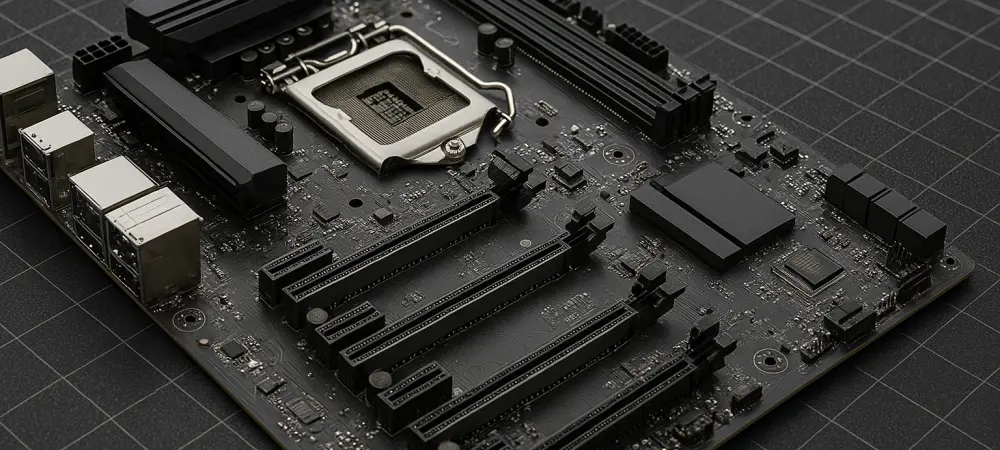
Early motherboard schematics for the LGA 1954 socket suggest that high-end consumer Z-series boards will eventually offer more sophisticated power delivery than these industrial models. This revelation comes following the public emergence of the M26-NVLS-ATX09, a specialized motherboard manufactured by Decenta that serves as the first concrete glimpse into the upcoming Intel Nova Lake-S ecosystem. While enthusiasts often look toward flagship gaming brands for hardware leaks, this industrial-grade ATX model provides a critical baseline for what the new platform entails. The transition to the LGA 1954 socket marks a significant departure from previous designs, indicating a physical and electrical restructuring required to support the next generation of silicon performance. This board is specifically engineered for enterprise applications, including industrial automation and embedded systems, which explains its utilitarian aesthetic and focus on long-term reliability over visual flair. It signals that the supply chain is already maturing in preparation for a broader rollout.
Industrial Design: The M26-NVLS-ATX09 Architecture
Memory Management and Expansion Standards
The architectural foundation of this new board relies on the Q970 and B960 chipsets, which are historically positioned for business-class stability rather than the aggressive overclocking found in enthusiast-grade hardware. Despite its industrial focus, the memory specifications are impressively modern, featuring four DDR5 U-DIMM slots that support dual-channel configurations with speeds reaching up to 6400MT/s. The total capacity of 256GB is particularly noteworthy, as it suggests that Nova Lake will cater to memory-intensive professional workloads that were once the exclusive domain of high-end workstation platforms. Expansion capabilities remain robust, with the inclusion of two PCIe 5.0 x16 slots alongside multiple PCIe 5.0 x4 slots. Interestingly, the board retains a legacy PCI slot, a common requirement for industrial environments where specialized older hardware must remain operational. This blend of cutting-edge speed and backward compatibility defines the current transitional phase of professional computing.
Building on these expansion features, the motherboard differentiates itself through chipset-specific lane allocations that will likely mirror consumer-tier segments. The Q970 variant offers superior high-speed connectivity, enabling PCIe 5.0 speeds across a wider array of slots and allowing for the integration of PCIe 4.0 SSDs in secondary storage positions. Conversely, the B960 version introduces certain limitations, restricting these secondary lanes to PCIe 4.0 and SATA speeds, respectively. This tiered approach suggests that Intel is maintaining a clear distinction between high-performance workstations and entry-level industrial controllers. For users operating in data-heavy environments from 2026 to 2028, the ability to utilize multiple high-bandwidth expansion cards will be essential. The presence of two M.2 M-Key slots for primary storage ensures that even these utility-focused boards can leverage the fastest NVMe drives available on the market today, matching the throughput requirements of modern data processing tasks.
Comprehensive I/O and Security Features
Connectivity on the LGA 1954 platform has been modernized to meet the demands of a wireless-centric professional landscape. The inclusion of an M.2 E-Key slot provides native support for Wi-Fi 7 and Bluetooth 6, ensuring that industrial machines can maintain high-speed network connections without the congestion typical of older standards. This is complemented by a versatile display array, featuring VGA, HDMI, and DisplayPort outputs to support triple-monitor configurations out of the box. Such a layout is indispensable for control rooms and monitoring stations that require extensive screen real estate. Security is another pillar of this design, as evidenced by the integrated TPM 2.0 module. This hardware-based encryption provides a necessary layer of protection for enterprise data, aligning with the stringent security protocols mandated by modern operating systems and corporate IT policies. These features collectively represent a platform that is ready for the rigors of decentralized and secure computing.
Beyond the internal headers, the physical I/O reflects a commitment to both modern and traditional interface standards, ensuring the board fits into diverse professional ecosystems. The presence of dual-channel memory support up to 6400MT/s ensures that data bottlenecks are minimized during complex computations. Furthermore, the inclusion of specific M.2 slots for both storage and wireless modules highlights a move toward modularity within industrial chassis designs. This approach allows technicians to swap or upgrade components without replacing the entire motherboard, a key consideration for reducing downtime in manufacturing or server environments. The engineering team clearly prioritized uptime and versatility, creating a board that can act as a bridge between older peripheral standards and the high-speed networking requirements of the current year. This balance ensures that the Nova Lake platform can be deployed in a variety of settings, from simple digital signage to complex automated assembly lines that require low-latency communication.
Next-Gen Capabilities: Processor and Socket Innovation
Graphics Performance and AI Processing Power
While this industrial motherboard acts as the vessel, the true innovation lies in the Nova Lake-S processors it is built to house. Rumors surrounding the platform indicate that these CPUs will feature 3rd-generation Intel Xe graphics, a significant leap forward for integrated visual performance. This improvement is expected to reduce the dependency on discrete GPUs for basic CAD work and industrial visualization tasks. Perhaps more importantly, the integration of a dedicated Neural Processing Unit (NPU) capable of delivering 74 TOPS suggests that AI acceleration is now a core component of the desktop experience. This level of performance facilitates local AI inferencing, which is becoming increasingly vital for real-time data analysis and predictive maintenance in industrial settings. While Intel has yet to officially confirm these exact figures, the hardware readiness of the M26-NVLS-ATX09 lends significant weight to the claim that Nova Lake is designed with an AI-first philosophy in mind. The 74 TOPS threshold represents a major milestone for integrated silicon, potentially tripling the AI performance seen in previous processor iterations. This surge in processing power enables the platform to handle sophisticated machine learning models directly on the chip, reducing the latency associated with cloud-based AI services. For industrial applications, this means that automated systems can make split-second decisions based on visual input or sensor data without external processing. This evolution is not limited to the enterprise sector; it sets a high bar for what consumer applications will eventually demand. The 3rd-generation Xe graphics architecture will likely provide enough graphical horsepower to drive multiple high-resolution displays smoothly, even when executing background AI tasks. This synergy between the GPU and NPU ensures that the Nova Lake architecture remains competitive in an era where software increasingly relies on heterogeneous computing to maintain performance and efficiency across diverse workloads.
Mechanical Evolution: The LGA 1954 Socket Design
One of the most discussed aspects of the LGA 1954 reveal is the physical mounting mechanism of the socket. While some technical leaks previously suggested the implementation of a complex dual-lever retention mechanism, known as 2L-ILM, this specific Decenta board utilizes a standard single-lever design. This discrepancy indicates that the more advanced, high-pressure cooling mounts may be reserved exclusively for high-end Z-series enthusiast boards designed for extreme thermal loads and overclocking. The industrial model’s reliance on a traditional lever suggests that the Nova Lake-S processors can operate within standard thermal envelopes when not pushed to their limits. However, the sheer size and pin density of the LGA 1954 socket confirm that any upgrade to this platform will necessitate a completely new cooling mounting kit. This mechanical shift is a clear indicator of the increased power delivery and signal integrity requirements of the new architecture.
The decision to stick with a single-lever design on an industrial board highlights a focus on ease of maintenance and compatibility with existing server-style cooling solutions. In professional environments, reliability and standardized parts are often preferred over the marginal performance gains offered by exotic mounting hardware. Nevertheless, the transition to 1954 pins represents a substantial increase in contact points compared to previous generations, which is necessary to support the expanded PCIe lanes and enhanced power phases. Builders and system integrators must take note of these physical changes, as they represent a point of no return for compatibility with older chassis or heatsinks. As the industry moves forward, the divergence between the robust, simple designs of industrial boards and the sophisticated, feature-rich consumer models will likely widen. This motherboard serves as a baseline, confirming that the electrical infrastructure for Nova Lake is finalized and ready for the various cooling and power delivery challenges.
Strategic Roadmap: Preparing for the Platform Shift
The emergence of the M26-NVLS-ATX09 established a clear timeline for the arrival of the next generation of desktop computing. Industry experts noted that the readiness of industrial-grade boards usually preceded the consumer launch by several months, suggesting that the ecosystem reached a high level of maturity. Builders recognized that the transition to Nova Lake required a comprehensive hardware overhaul, as the LGA 1954 socket was fundamentally incompatible with previous mounting brackets and motherboards. The data suggested that those seeking the highest AI performance and memory capacity needed to prepare for a total system migration rather than a simple component swap. The reveal further clarified that while industrial boards focused on longevity, the upcoming consumer Z-series would likely push the boundaries of power delivery and aesthetics. Consequently, the consensus among analysts was to monitor official manufacturer announcements before investing in current-gen platforms that lacked a clear upgrade path.
Future considerations for this platform involved assessing the true impact of the integrated NPU on daily workflows and professional software suites. As the 74 TOPS capability became the new standard for desktop AI, software developers began optimizing their tools to leverage this local processing power, moving away from cloud-dependent models. Professionals were advised to evaluate their specific needs for high-speed I/O and memory density, as the Q970 chipset offered a glimpse into the high-bandwidth future of the platform. The strategic takeaway from this reveal was that Intel had successfully navigated the complexities of a major socket transition, providing a stable foundation for both industrial and eventually enthusiast users. The focus shifted toward ensuring that cooling solutions and power supplies were capable of meeting the demands of the new architecture. Decision-makers in the tech sector utilized this early hardware data to plan their procurement cycles for the coming years, ensuring they remained at the forefront of the technological curve.