

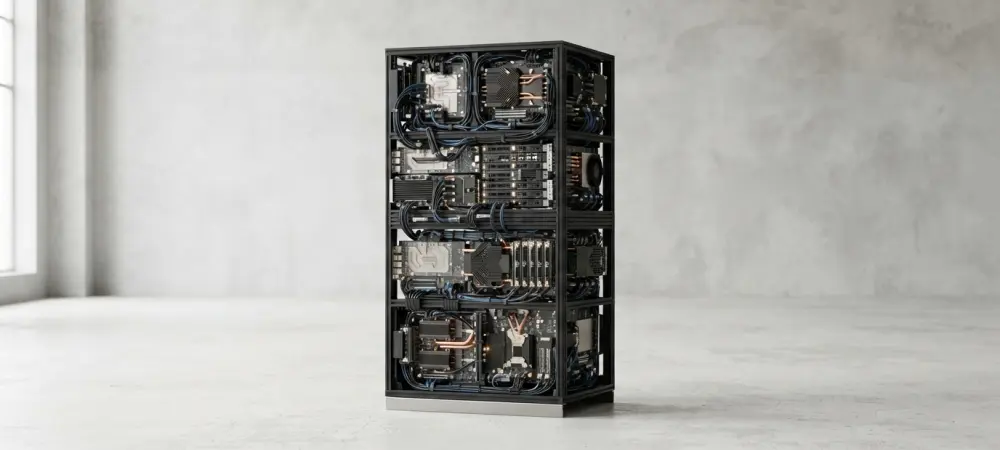
The rapid transition from raw megawatt capacity to refined architectural intelligence signals a fundamental maturation in how global society constructs and scales its digital nervous system. As the industry moves deeper into 2026, the focus has pivoted away from the brute-force expansion of hardware toward a more nuanced integration of specialized silicon and sustainable energy management. This review examines the shift toward a heterogeneous data center environment, analyzing how modular designs and diverse processing units are replacing the monolithic GPU clusters of the early AI boom. By exploring the evolution of these systems, the analysis highlights a move toward efficiency that prioritizes long-term operational viability over sheer computational volume.
Understanding the current state of infrastructure requires recognizing the interplay between hardware performance and the physical limitations of modern power grids. While the previous decade was defined by a centralized model of massive server farms, the current landscape favors a distributed approach that balances high-end training with low-latency inference. This transformation is not merely a technical upgrade but a necessary adaptation to a world where energy is a finite resource and data sovereignty is a legal mandate. Consequently, the modern data center is becoming a highly specialized facility designed to support specific workloads rather than a one-size-fits-all warehouse for generic compute power.
Transitioning From Raw Power to Architectural Efficiency
The “raw power” philosophy that dominated the early stages of the artificial intelligence revolution is rapidly giving way to a new era of architectural efficiency. Previously, the primary metric for data center success was the total megawatt capacity available for large-scale GPU clusters, often leading to massive, energy-hungry facilities that strained local resources. Today, the focus has shifted to the “performance-per-watt” metric, as operators realize that throwing more electricity at a problem is no longer a sustainable or cost-effective strategy. This change is driven by the rising costs of specialized silicon and the increasing difficulty of securing new grid connections in major metropolitan areas. Modern infrastructure now emphasizes a heterogeneous computing model where different types of processors work in tandem to optimize specific tasks. Rather than relying solely on high-consumption graphics units, designers are integrating a mix of hardware that includes energy-efficient central processors and specialized accelerators. This modular approach allows data centers to handle a broader spectrum of digital workloads, from complex reasoning to massive data processing, without exceeding the thermal or electrical limits of the facility. By prioritizing how power is utilized rather than how much is consumed, the industry is evolving to meet the demands of a more diverse and sophisticated digital economy.
Core Pillars of Modern Data Center Architecture
High-Density Acceleration and Custom Silicon
The reliance on generic, off-the-shelf graphics processors is being challenged by a wave of custom-designed silicon tailored for specific mathematical operations. Companies are increasingly turning to Application-Specific Integrated Circuits (ASICs) and custom accelerators to achieve higher performance within a tighter energy envelope. These chips are designed to execute the narrow functions required by modern transformer models much more efficiently than general-purpose hardware. This shift allows data center operators to maintain high throughput while significantly reducing the heat signature and power draw of each individual rack.
Custom silicon also offers a level of vertical integration that was previously impossible, enabling a tighter link between software frameworks and hardware execution. By designing chips specifically for their own proprietary models, hyperscalers can bypass the inefficiencies inherent in general-purpose silicon. This trend is creating a more fragmented but optimized hardware landscape where the choice of processor is dictated by the specific software it will run. Consequently, the data center is transforming into a collection of specialized zones, each optimized for different stages of the AI lifecycle.
The Resurgence of CPU-Centric Orchestration
As agentic AI gains traction, the role of the central processing unit is expanding from simple system management to complex reasoning and tool orchestration. In previous configurations, the CPU was often an afterthought, serving merely as a “traffic cop” for massive banks of GPUs. However, the rise of autonomous agents that must plan, reason, and call upon external databases requires a much higher degree of logic processing. This has led to a significant increase in the CPU-to-GPU ratio within modern rack configurations, as the demand for sequential logic and planning grows alongside parallel processing needs.
This resurgence is changing the physical layout of the data center, favoring hardware that excels in complex planning rather than just brute-force calculation. Engineers are finding that robust CPU clusters are essential for managing the intricate workflows associated with multi-step reasoning tasks. This transition helps mitigate some of the extreme power demands of GPU-heavy setups, as CPUs typically operate at a lower thermal design point. As a result, the “brain” of the data center is becoming more balanced, reflecting a shift from simple token generation to sophisticated autonomous problem-solving.
Software Neutrality and Ecosystem Decoupling
The erosion of proprietary software moats is perhaps the most significant catalyst for hardware diversity in the modern data center. For years, specific software platforms locked developers into a single hardware vendor, creating a monopoly on high-end AI compute. However, the maturation of open-source frameworks and alternative platforms has enabled a more flexible infrastructure where software can run across a variety of hardware architectures. This decoupling allows data center operators to mix and match components from different vendors without being penalized by software incompatibility.
This movement toward software neutrality fosters a more competitive market and reduces the risks associated with supply chain bottlenecks. Operators can now integrate hardware from a wide range of providers, including those using alternative instruction sets like Arm or specialized architectures from emerging startups. By removing the barriers to hardware switching, the industry has paved the way for a more resilient and modular infrastructure. This flexibility is crucial for adapting to the rapid pace of technological change, ensuring that data centers can be upgraded piece-by-piece rather than requiring total overhauls.
Emerging Trends in Infrastructure Development
A significant move toward decentralization is currently reshaping the geographical footprint of global compute power. Driven by the need for low-latency inference and the requirements of data sovereignty, infrastructure is migrating from massive, rural sites to smaller, modular units in urban environments. This shift is a response to the “inference era,” where the speed of a model’s response to a user query is more important than the speed of its initial training. Modular construction techniques are allowing for faster deployment in these space-constrained urban hubs, where traditional large-scale builds are often impossible. Furthermore, the rise of “sovereign AI” is forcing a shift toward localized infrastructure that complies with regional privacy and data protection regulations. Governments are increasingly demanding that the processing of their citizens’ data remains within national borders, leading to a boom in local data center development. This trend is moving the industry away from the hyper-centralized models of the past decade and toward a distributed network of smaller, highly secure facilities. These local hubs are not only more compliant with local laws but also provide a more resilient foundation for national digital services.
Real-World Applications and Sector Impact
Enterprise AI and Agentic Workflows
Businesses are increasingly deploying evolutionary infrastructure to power “agents” that handle complex reasoning tasks, such as industrial planning and customer service orchestration. These applications require a unique blend of high-speed inference and robust processing to ensure that interactions happen in real time. Unlike simple chatbots, these agents must interface with legacy software, manage complex logic gates, and make decisions based on dynamic data. The modern data center provides the heterogeneous environment necessary to support these multi-layered workflows without sacrificing performance or increasing latency.
The impact on the enterprise sector is profound, as these agentic systems allow for a level of automation that was previously unattainable. For instance, in manufacturing, autonomous agents can now manage entire supply chains by predicting disruptions and rerouting resources without human intervention. This requires a stable and responsive infrastructure that can handle continuous, high-logic processing. By utilizing modular data center designs, enterprises can scale these capabilities as needed, ensuring that their computational resources grow in lockstep with their operational requirements.
Edge Computing and Metropolitan Latency
In sectors like high-frequency trading and autonomous vehicle management, compute resources are being pushed to the extreme edge of the network. Placing processing power in metropolitan hubs allows operators to achieve the ultra-low latency required for split-second decision-making. This metropolitan edge is becoming the new frontier for infrastructure development, as the physical distance between the server and the end user becomes a critical performance bottleneck. Consequently, the architecture of these edge sites is becoming more specialized, prioritizing compact footprints and efficient cooling.
This shift to the edge is also transforming how urban data is managed and processed. For example, metropolitan traffic management systems now utilize localized compute to process camera feeds and sensor data in real time, reducing the need to send massive amounts of data back to a central cloud. This not only saves on bandwidth but also improves the reliability of critical public services. As more devices become “smart,” the demand for these metropolitan compute nodes will continue to grow, making edge-based infrastructure a cornerstone of modern urban planning.
Technical Challenges and Market Obstacles
Despite significant advancements in hardware, grid constraints remain a primary hurdle for the expansion of data center capacity. In many regions, the time required to secure a high-voltage power connection can span years, if not a decade, creating a massive backlog in infrastructure projects. This energy bottleneck is forcing developers to look for creative solutions, such as on-site power generation and the utilization of microgrids. However, these alternatives often come with higher costs and complex regulatory hurdles, slowing down the pace of deployment in the most high-demand regions.
The industry also faces a deep divide over the future of thermal management. As chip density increases, the limits of traditional air cooling are being reached, leading to a heated debate over the necessity of liquid cooling systems. While liquid cooling offers superior heat dissipation and allows for much higher rack densities, it also requires a total rethink of data center plumbing and maintenance. Balancing the high initial cost of these systems with the long-term efficiency gains is a significant challenge for designers. Many facilities are now caught in a transition phase, attempting to support both air and liquid cooling in the same hall.
Future Outlook and Technological Trajectory
The trajectory of data center infrastructure points toward a highly distributed, “liquid-cooled-only” environment that supports a hybrid of classical and quantum computing. We expect to see a total decoupling of hardware and software layers, where AI workloads automatically migrate to the most efficient silicon available in a global network. This will likely lead to a more sustainable global compute footprint, where efficiency and local sovereignty are prioritized over massive, centralized power consumption. The integration of modular designs will allow for rapid updates, ensuring that infrastructure can keep pace with the next generation of silicon.
As the industry moves from 2026 to 2030, the focus will increasingly shift toward “zero-emission” compute, where data centers act as active participants in the circular energy economy. The data center of the future will not just be a consumer of resources but a sophisticated utility that provides both compute and energy services to its community. This holistic approach will be essential for maintaining the growth of the digital economy in an increasingly resource-constrained world.
Summary of Findings and Assessment
The analysis of evolutionary data center infrastructure demonstrated that the industry successfully moved beyond the constraints of a single-vendor roadmap. Designers prioritized architectural flexibility and energy efficiency over the brute-force scaling strategies that characterized the previous era. The assessment confirmed that custom silicon and specialized accelerators emerged as the dominant standards for high-density deployments, while the resurgence of the CPU provided the necessary logic for autonomous reasoning. The review also established that the shift toward edge-based and sovereign infrastructure provided a more resilient and compliant framework for global services.
Ultimately, the pivot toward a heterogeneous compute environment allowed for a more sustainable and accessible era of technology. The transition to liquid cooling and modular builds proved to be essential in overcoming the physical limitations of legacy facilities. While power grid constraints and land availability remained significant obstacles, the industry’s shift toward distributed and efficient designs ensured continued progress. The findings indicated that the future of compute lies in specialized, localized hubs that prioritize operational outcomes and environmental responsibility over sheer capacity.