

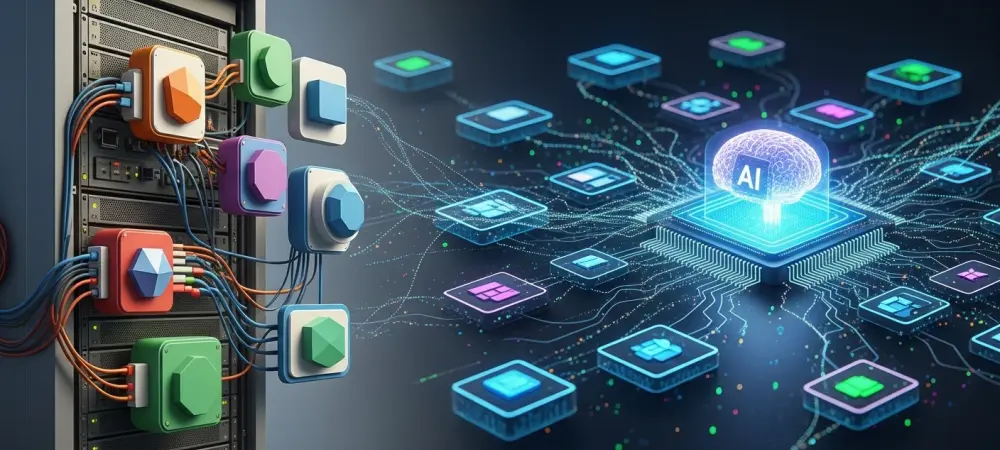
The traditional enterprise resource planning market has recently crossed a significant threshold where the superficial application of artificial intelligence no longer suffices for complex industrial operations. By 2026, a distinct divide has emerged between legacy platforms that merely retrofitted AI features onto old code and those built from the ground up for the modern era. This evolution is changing how manufacturers and distributors view their digital tools, forcing a move away from flashy marketing toward a deeper look at technical foundations. While most vendors offer similar-looking tools like chatbots and predictive alerts, these features often hide a massive difference in how the software actually works. The real challenge for businesses is no longer finding a system with AI, but finding one where intelligence is deeply integrated into the data structure. Understanding this difference is essential for companies that want to use technology to solve complex problems rather than just automating basic tasks in isolation.
Distinguishing Between Surface Features and Core Design
The Limitations of Legacy Bolt-On Models
Most ERP systems currently on the market rely on a bolt-on model, which adds an AI layer on top of databases designed decades ago. These older systems are built on rigid tables that were never intended to handle the fluid reasoning required by machine learning. Consequently, while the AI can handle simple tasks like summarizing a single report, it often fails to connect the dots across different business departments, such as how a minor supply delay might eventually affect a specific customer’s delivery date.
This structural limitation means that the artificial intelligence is essentially working in a vacuum, separated from the core transactional data by multiple layers of middleware. Because the data is not natively formatted for neural processing, the system must constantly export and transform information before it can generate an insight. This latency prevents real-time responsiveness and often leads to decision-making based on stale information, which is a significant disadvantage in an increasingly volatile global marketplace.
The Competitive Advantage of Native Architecture
In contrast, AI-native architecture treats business entities like shipments, equipment, and customer records as interconnected objects within a flexible data model. This allows the system to analyze relationships across the entire company automatically, providing insights that would normally require a human analyst to uncover. By building AI into the very foundation of the data, these platforms can identify risks and opportunities in real-time across the whole supply chain, ensuring that every department stays aligned.
This level of integration enables a concept known as active intelligence, where the software proactively suggests optimizations based on live data streams. For instance, if a machine on the shop floor begins to show signs of wear, the system can automatically adjust production schedules and notify procurement to order replacement parts. This seamless flow of information eliminates the traditional silos that once hindered organizational agility, allowing for a more cohesive approach to enterprise management.
Navigating the Procurement and Implementation Phase
Moving Beyond the Software Demonstration
One of the biggest hurdles for companies is the demo gap, where different systems look almost identical during a short sales pitch. Both old and new architectures can display a functional chatbot, but the difference in power only shows up during high-pressure, real-world operations. For mid-sized firms that lack their own data science departments, having a system that can provide cross-functional answers out of the box is a vital competitive advantage that cannot be overlooked during the selection process.
During these demonstrations, sales teams often use perfectly cleaned data that does not reflect the messy reality of daily business. When a bolt-on system is faced with incomplete records or conflicting timestamps, it often produces errors or fails to provide a logical path forward. An AI-native system, however, is designed to handle the ambiguity of real-world information, using probabilistic modeling to fill in gaps and offer the best possible recommendations despite the inherent noise of industrial data.
Prioritizing Structural Integrity Over Features
Despite these high stakes, many procurement teams still use outdated checklists that focus on specific features rather than the underlying technology. This focus on checking a box for AI capabilities often leads companies to buy software that looks modern on the surface but lacks the deep reasoning power needed for future growth. To stay ahead, business leaders must shift their focus to architectural transparency, ensuring their next ERP investment is built on a data model that can truly handle the volatility.
True architectural transparency requires vendors to explain how their models are trained and how they interact with the core database. Organizations must move beyond the surface-level user interface and ask technical questions about data persistence, model latency, and the frequency of autonomous updates. By prioritizing these foundational elements, a company can ensure that its digital core remains resilient and adaptable as new technological breakthroughs occur, preventing the need for a costly full-system replacement.
Strategic Integration for Operational Resilience
The successful transition to a modern enterprise framework necessitated a fundamental shift in how leadership viewed the relationship between data and decision-making. Decision-makers who moved beyond the initial hype cycle focused on building a single source of truth that was natively accessible by intelligent agents. They prioritized the cleanup of legacy data and the standardization of inputs across various global locations, which ensured that the AI had a reliable foundation for its predictive models. These steps were crucial for transforming the ERP from a ledger into a proactive advisor. Moving forward, the primary objective for industrial firms involved the continuous upskilling of the workforce to collaborate with these autonomous systems. Employees were trained to interpret AI-generated recommendations and provide the human context that models might still lack, creating a hybrid intelligence model. This approach allowed businesses to respond to unforeseen economic shifts with unprecedented speed and precision. By investing in native intelligence, organizations secured a technological foundation that remained relevant and powerful throughout the late 2020s.