

In the world of B2B commerce, the promise of a quick-to-launch website often hides a world of long-term operational pain. Many businesses are discovering that their “bolted-on” eCommerce platforms, initially seen as agile, have become fragile and costly as they scale. We’re joined by Dominic Jainy, an expert in integrated B2B eCommerce for Microsoft Dynamics 365 Business Central, to discuss a more resilient approach. Today, we’ll explore the hidden operational taxes of disconnected systems, the critical need for a single source of truth, and how an ERP-governed architecture not only solves today’s challenges but also provides a stable foundation for future growth, especially in complex B2B environments.
Many businesses adopt “bolted-on” eCommerce for speed, but this can create fragility as they scale. What specific operational pains, like manual order correction or sync issues, signal that a disconnected system is failing? Can you share an example of this “operational tax”?
It almost always starts small. A business launches a separate eCommerce site, and at first, the manual work feels manageable. But as order volume grows, the cracks become chasms. You start to see teams spending their days not on growth activities, but on damage control. It’s the constant cycle of troubleshooting sync issues, manually correcting orders where the pricing or inventory was wrong, and reconciling discrepancies between the web platform and Business Central. This is what we call the “operational tax.” It’s a hidden cost that never appears on an invoice but drains resources every single day. What begins as “just a few exceptions” soon becomes a permanent, frustrating part of everyone’s job, from customer service to the warehouse floor.
When an ERP and a separate eCommerce platform both manage data like pricing and inventory, conflicts often arise. How does this “dual ownership” create confusion for teams, and what are the long-term consequences for a business that lacks a single source of truth?
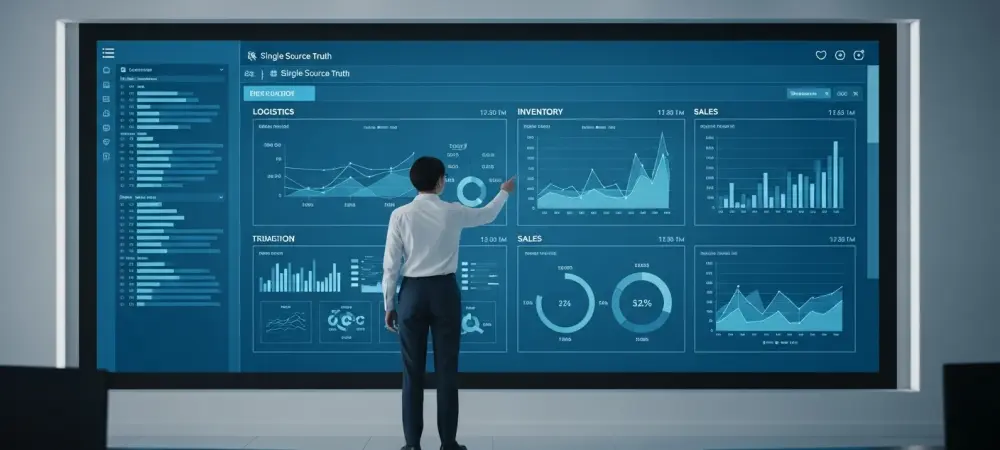
This issue of “dual ownership” is one of the most insidious problems of a bolted-on architecture. It creates a constant state of confusion. Imagine your sales team asking, “Who owns the customer’s pricing? Is it the rule we set in the eCommerce platform for a promotion, or is it the contract pricing hard-coded into the ERP?” When the answer is “both,” it really means neither system is truly in control. This leads to immediate errors, like a key account getting the wrong discount, but the long-term consequences are far worse. Trust in the data erodes across the entire organization. Finance can’t rely on the revenue numbers, operations can’t trust the inventory levels, and leadership is making decisions based on fragmented information. Over time, this lack of a single source of truth doesn’t just cause errors; it hobbles the company’s ability to grow efficiently.
Some organizations delay essential ERP upgrades because they fear breaking their connected eCommerce stack. What are the primary risks they are trying to avoid, and how does an ERP-governed architecture change the dynamic of planning and executing these necessary system updates?
It’s a classic case of the tail wagging the dog. Organizations know they need to upgrade their ERP for security, new features, and performance, but they’re paralyzed by fear. The primary risk they’re trying to avoid is a catastrophic failure of their eCommerce integration. These connections are often brittle, custom-coded things that can easily break when the underlying ERP changes. The nightmare scenario is that an ERP upgrade takes their entire online sales channel offline for days, or even weeks. This fear forces them to accumulate massive technical debt by running on outdated systems. An ERP-governed architecture completely flips this dynamic. Because the eCommerce solution lives inside Business Central, they share one unified upgrade path. The upgrade is a single, cohesive project, not a high-wire act hoping two separate systems will still talk to each other afterward. It transforms a high-risk event into a predictable, manageable process.
B2B commerce often involves complex rules like contract pricing and customer-specific catalogs. How do bolted-on platforms typically handle these needs, and what specific advantages does an ERP-governed system offer in delivering these features without extensive custom code or manual workarounds?
This is where bolted-on platforms really struggle. B2B isn’t like B2C; it’s built on relationships and complex agreements. You have customer-specific catalogs, unique contract pricing, role-based approvals, and intricate fulfillment logic. A generic, bolted-on platform wasn’t designed for this. To make it work, businesses are forced into two bad options: commissioning expensive, hard-to-maintain custom code or creating manual workarounds where staff have to babysit every complex order. The advantage of an ERP-governed system is profound because all of that business logic already exists inside Business Central. The system doesn’t need to replicate it; it simply reuses it. The contract pricing, the customer permissions, the approval workflows—they are all natively available to the eCommerce front-end. What would be a massive re-engineering project for a bolted-on platform becomes an inherent capability, available right out of the box.
AI’s value in eCommerce depends heavily on context. Could you contrast how an external AI tool might make a product recommendation versus an AI embedded within the ERP? Please walk me through how ERP-governed AI respects business logic and inventory realities.
The difference is context, and in business, context is everything. An external AI tool, operating outside the ERP, might look at browsing history and recommend a product that looks great on the surface. But it has no operational clarity. It might suggest an item that is out of stock, has a long lead time, or is not available to that specific customer due to a contractual agreement. It’s a recommendation made in a vacuum. In contrast, an AI embedded within Business Central operates with the full picture. It uses the authoritative ERP data, so when it suggests an upsell, it knows the real-time inventory, it respects the customer’s specific pricing rules, and it can even analyze their order history to make an intelligent suggestion. It’s the difference between a flashy novelty and a truly practical tool that drives efficient, profitable sales because it is grounded in the operational reality of the business.
The text suggests that ERP-governed platforms are designed for longevity, helping businesses avoid expensive rebuild cycles every few years. How does this architectural approach provide more predictable investment and reduce long-term technical debt for leadership teams? Please provide some metrics or a scenario.
This is a strategic conversation I have with leadership all the time. The endless cycle of re-platforming every three to five years is incredibly expensive and disruptive. Businesses don’t change that drastically, but their bolted-on architectures fail to age well. An ERP-governed platform is designed for longevity because it evolves in lockstep with the core ERP. As Microsoft updates Business Central, a native solution like Nav-to-Net™ evolves with it. Imagine a company that spends a quarter-million dollars on a custom-integrated site. In four years, it’s brittle, the connectors are outdated, and they have to do it all over again. With an ERP-governed model, that initial investment is in a platform that will last as long as their ERP. For leadership, this means predictable investment and a much lower total cost of ownership. They are no longer budgeting for massive, recurring rebuilds, and their technical debt is dramatically reduced because the system stays current. It’s an investment in a foundation, not a disposable storefront.
What is your forecast for ERP-governed eCommerce?
My forecast is that ERP-governed eCommerce will shift from being an architectural preference to a strategic requirement, especially for any business running on a powerful system like Business Central. The initial rush to get online with any tool available is over. Now, businesses are feeling the deep operational pain of disconnected systems and realizing that efficiency, accuracy, and scalability aren’t just IT goals—they are competitive advantages. As complexity in B2B and hybrid sales models continues to grow, the idea of managing a separate, replicated system for commerce will seem completely untenable. Companies will demand a single source of truth not as a feature, but as the fundamental principle of their digital operations. The future isn’t about integrating commerce with the ERP; it’s about running commerce from within the ERP.