

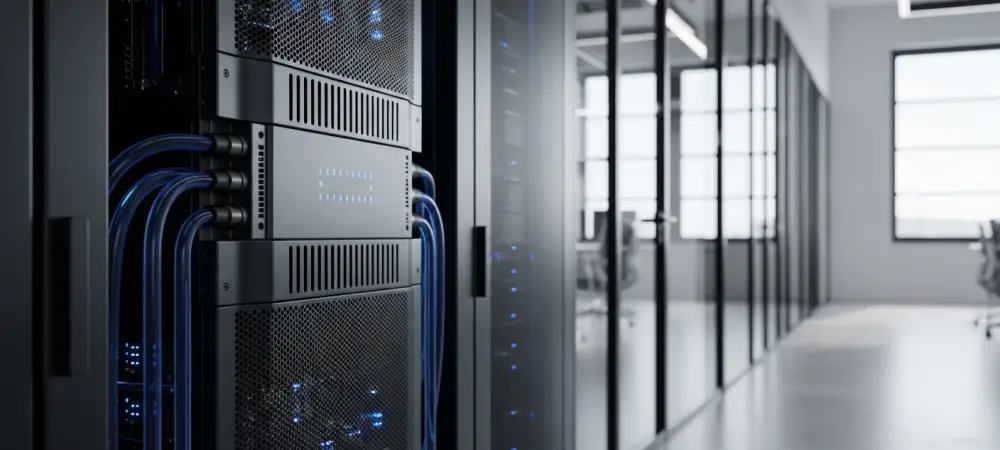
The sudden shift from experimental cloud-based large language models to permanent, on-premises corporate infrastructure marks a defining moment in the history of industrial computing. This transition represents a significant advancement in the information technology and high-performance computing sectors, moving beyond the novelty of chat interfaces toward the integration of generative intelligence into core business workflows. This review explores the evolution of this technology, its multi-tiered hardware architecture, and the performance metrics that distinguish sovereign systems from generic cloud services. The purpose is to provide a thorough understanding of current capabilities while evaluating how these systems address the physical and security limitations of modern corporate environments.
The Paradigm Shift Toward Sovereign On-Premises AI
The initial phase of the AI boom relied heavily on public APIs, yet enterprises soon discovered that sending proprietary data to external servers created unacceptable risks. This realization birthed the concept of “Sovereign AI,” a framework where data ownership and model training remain entirely within a company’s physical control. By bringing compute power in-house, organizations can customize models to their specific niche without the threat of data leakage or the volatility of fluctuating cloud subscription costs.
Moreover, this shift addresses the “data gravity” problem, where the sheer volume of corporate information makes it inefficient to move datasets back and forth between local storage and remote data centers. Establishing an on-premises ecosystem allows for tighter integration with existing legacy systems and ensures that low-latency requirements are met for real-time applications. This localized control represents a move toward digital self-sufficiency, allowing firms to treat AI as a permanent asset rather than a rented service.
Architectural Components of the Multi-Tiered AI Ecosystem
Modern AI infrastructure is no longer a monolithic server room but a diverse landscape of hardware designed for specific organizational layers. Each tier serves a unique purpose, ranging from the individual developer’s desk to the massive global clusters required for training foundational models. This stratified approach ensures that compute resources are allocated efficiently, preventing expensive data center racks from being bogged down by simple pre-processing tasks.
Localized Edge Nodes for Professional Pre-Processing
Individual researchers and engineers require immediate access to high-performance workstations like the FusionXtation X3 8000 Gen2 to handle the heavy lifting of initial model refinement. These nodes are designed to process models ranging from 70 billion to 200 billion parameters, providing the raw power needed for high-intensity 8K rendering and complex architectural simulations. By integrating professional-grade GPUs with high-capacity DDR5 RAM, these workstations eliminate the “queuing” delay often found in shared cloud environments. The unique value of this tier lies in its ability to facilitate “pre-processing,” where large datasets are cleaned and formatted locally before being sent to larger clusters. This decentralized power speeds up the development cycle by allowing for rapid iteration and testing without consuming centralized server bandwidth. It ensures that the creative and technical staff have the tools to push the limits of localized AI without hitting the performance ceiling of standard office hardware.
Secure Sandbox Appliances for Workgroup Compliance
In regulated sectors such as finance and healthcare, the FusionXpark provides an essential layer of security through isolated workgroup appliances. These “sandbox” environments allow teams to develop custom software and fine-tune models while remaining completely compliant with strict data protection laws. Because these units are compatible with industry-standard toolchains like NVIDIA DGX OS and CUDA, developers can transition their workflows seamlessly from local development to wider deployment without rewriting code.
This tier acts as a critical bridge, offering a secure environment that remains disconnected from external vulnerabilities. It allows for the processing of sensitive datasets—such as patient records or proprietary financial algorithms—within a protected perimeter. By clustering these units, workgroups can achieve the performance needed for 405-billion parameter models, ensuring that even the most complex internal projects stay within the bounds of corporate governance.
Centralized Utility Servers for Enterprise-Wide Inference
The TokenBox represents the evolution of AI into a standard corporate utility, functioning much like a private cloud for an entire organization. These servers are engineered to run massive 1.6-trillion parameter models, providing inference capabilities to hundreds of employees simultaneously. Unlike traditional servers that require specialized cooling, these units utilize integrated liquid cooling technology, allowing them to operate at a whisper-quiet 35 decibels in a standard office setting.
This hardware innovation is significant because it removes the requirement for expensive data center construction or facility upgrades. A corporation can simply “plug and play” high-density compute power into an existing office floor, treating AI tokens as a predictable resource. This shift from unpredictable per-token cloud pricing to a fixed hardware investment allows for more accurate budgeting and long-term scaling of AI-driven operations.
High-Density Data Center Engines and Storage Fabrics
At the apex of the infrastructure hierarchy are high-density engines like the FusionServer G6550 V8 and the FusionPoD, designed for global-scale operations. These systems push the limits of physics, managing thermal loads of up to 240 kilowatts per cabinet through the use of graphene pads and diamond cold plates. Such materials provide extreme thermal conductivity, which is necessary to prevent hardware throttling during the intense heat generated by continuous GPU-heavy training cycles.
To complement this massive compute power, high-bandwidth storage solutions like the FusionOne DFS are employed to prevent “data starvation.” With sequential read bandwidth reaching 200 GB/s, these storage fabrics ensure that GPU clusters are never left idle while waiting for data to be retrieved. This tier is built for the era of exabyte-scale information, providing the backbone for the most ambitious AI initiatives in the modern corporate landscape.
Emerging Trends in Vertical AI Integration
The current landscape is witnessing a definitive move toward “Vertical AI Integration,” where hardware and software are tightly coupled to optimize performance for specific industry needs. This trend is characterized by a departure from general-purpose cloud computing in favor of owned infrastructure that can be precisely tuned for unique workloads. By controlling the entire stack, enterprises can achieve a higher degree of efficiency and reliability than is possible through third-party providers.
Moreover, the rise of hybrid workflows allows companies to prioritize local security while maintaining the ability to burst into the cloud for overflow capacity. This “local-first” approach ensures that the most sensitive tasks never leave the building, while still providing the flexibility to handle sudden spikes in demand. Innovations in “silent” liquid cooling and compact form factors are further accelerating this trend by allowing massive compute power to reside in executive suites and boardroom environments.
Real-World Applications and Deployment Scenarios
The deployment of tiered AI hardware is already transforming specialized fields such as medical imaging, where data sovereignty is a legal and ethical requirement. In these environments, localized clusters allow for the rapid analysis of high-resolution scans without the risk of exposing patient data to public networks. Similarly, architectural firms are utilizing edge nodes to perform real-time 3D rendering, drastically reducing the time required to visualize complex structural designs.
In the financial sector, isolated sandboxes are being used to run complex risk simulations and market models that would be too sensitive for cloud environments. These real-world applications demonstrate that the choice of hardware must be tailored to the organizational maturity and specific risk profile of the business. By matching the hardware tier to the task, companies are finding that they can achieve specialized performance metrics that generic cloud services simply cannot replicate.
Technical Obstacles and Market Limitations
Despite the rapid advancements, the infrastructure faces significant hurdles, primarily regarding power density and thermal management. As cabinets reach 240 kilowatts of power consumption, traditional facility power grids are often pushed to their breaking point, requiring substantial upgrades to electrical infrastructure. Additionally, maintaining a low Power Usage Effectiveness (PUE) remains a challenge, as cooling systems must work harder to dissipate the heat generated by increasingly dense GPU clusters.
Furthermore, the high initial capital expenditure (CAPEX) of on-premises hardware represents a barrier for smaller organizations compared to the pay-as-you-go cloud model. Organizations must also manage the massive sequential read bandwidth required for exabyte-scale storage, which can create bottlenecks if the network fabric is not properly optimized. Navigating these trade-offs requires a strategic approach to procurement, balancing the desire for raw power with the physical realities of the corporate environment.
The Future Roadmap of AI Computation
The trajectory of AI computation points toward a future defined by even more localized, high-parameter processing and advanced material science. Graphene-based thermal conductivity is expected to become the standard for heat dissipation, allowing for even greater transistor density without catastrophic thermal failure. As hardware becomes more efficient and “invisible,” we can expect the total integration of high-density AI compute into every aspect of the modern office. Long-term, the landscape will likely decentralize further, with every major corporation operating its own private, high-density AI cluster as a standard part of its IT stack. This evolution will turn AI from a specialized tool into a background utility that powers every facet of corporate life, from automated logistics to real-time strategic modeling. The development of even more efficient, “silent” compute units will ensure that this power remains accessible outside of traditional data center environments.
Conclusion and Strategic Assessment
The transition of artificial intelligence from a cloud-based experiment to a core production asset signaled a major strategic pivot for global enterprises. The multi-tiered hardware approach provided a scalable roadmap that allowed organizations to balance computational requirements with the strict realities of data security and thermal management. Organizations that successfully adopted these localized clusters found that they could mitigate the risks of public APIs while achieving predictable, high-performance results.
Looking ahead, the success of any AI strategy depended on an organization’s ability to audit its physical infrastructure and power density capabilities before committing to high-density racks. The integration of advanced materials like graphene and the adoption of liquid-cooled systems proved essential for maintaining operational efficiency in non-traditional server environments. Ultimately, the move toward sovereign AI infrastructure was not just a technical upgrade but a fundamental shift in how corporate intelligence was stored, processed, and protected.