

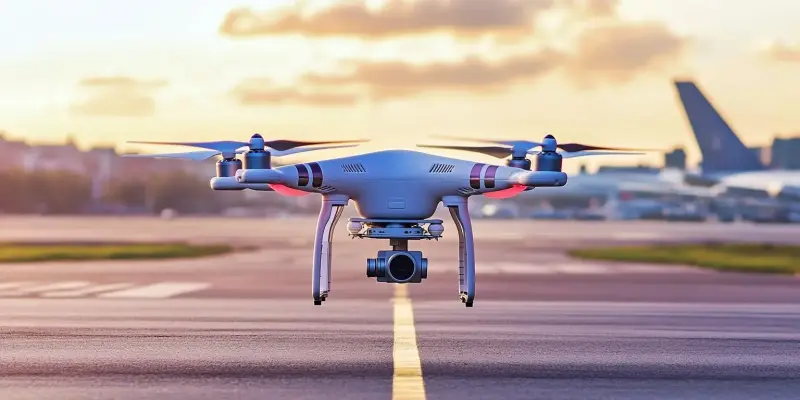
Recent drone activities near major airports and military bases in the Northeastern U.S., particularly around Boston’s Logan International Airport, have led to significant concerns and actions by authorities. Over the past weekend, two men, identified as 42-year-old Robert Duffy and 32-year-old Jeremy Folcik, were arrested for operating a drone dangerously close to Logan International Airport. Their arrest was facilitated through advanced drone monitoring technology, showcasing the effectiveness of real-time crime surveillance in tracking and locating unmanned aircraft systems (UAS). These individuals have been charged with trespassing, but a third suspect remains at large, adding to the ongoing investigation and public anxiety.
The recent drone-related activities have not been confined to Logan International Airport alone but have spread to other sensitive locations. For instance, the weekend saw heightened drone-related anxiety, initiating a four-hour shutdown at Wright Patterson Air Force Base in Ohio. This incident, coupled with similar drone sightings across New Jersey and other surrounding states, drove home the urgent need for more stringent security measures. Notably, the Wright Patterson closure is significant as it marks the second airspace closure within a matter of weeks, exacerbating concerns about these unknown aerial phenomena (UAPs). The increasing frequency of such occurrences has consequently elevated national attention towards understanding and managing this modern threat.
Rising Concerns and Legislative Actions
Despite the arrests at Logan International Airport, authorities still face numerous unanswered questions about the surge of UAPs over Northeastern U.S. skies. These incidents have stirred a hornet’s nest of speculation and concerns from various quarters – from general public bafflement to legislative calls for action and inquiry. For example, New Jersey and its surrounding regions have reported drones with wingspans of about six feet, much larger than the smaller drones involved in the Boston incident. This anomaly has led to a spectrum of theories ranging from advanced surveillance technology being tested to more unconventional explanations. Among the more intriguing claims is New Jersey Congressman Jeff Van Drew’s assertion that Iran could be launching drones from a mothership stationed in the Atlantic.
In response to the increasing frequency of unexplained drone sightings, New Jersey authorities have been notably proactive. Governor Phil Murphy spearheaded an initiative, meeting with New Jersey State Police and radar technicians to investigate and address these phenomena. Furthermore, Murphy has demanded clear answers from the federal government, underscoring the urgency felt at the state level. Despite these efforts, the sightings have not been isolated incidents, extending their reach into Connecticut and Pennsylvania. This expansion hints at a broader, regional issue that necessitates multi-state coordination and coherent responses. The wider implication is a pressing need to examine the intentions and origins behind these sophisticated drone activities more thoroughly.
New York’s Response and Technological Advancements
New York has not remained isolated from these occurrences either, as evidenced by a recent incident at Stewart International Airport north of New York City that led to a shutdown of the runways for about an hour. The potential risks posed by such unauthorized drones prompted New York Governor Kathy Hochul to seek federal assistance. Consequently, this has led to the deployment of a state-of-the-art drone detection system, enhancing New York’s ability to monitor and manage UAS activities effectively. Senator Chuck Schumer has lent his support to these measures, highlighting the advanced nature of the new “Robin Radar Systems.” These systems offer comprehensive 360-degree coverage, vastly surpassing the capabilities of existing technology.
Despite local authorities now having access to some advanced tools, Schumer emphasized that the lack of a robust drone registration system still impedes law enforcement’s ability to track and manage these drones efficiently. His call for federal legislative measures to grant more power to local authorities reflects a broader trend towards addressing this contemporary challenge more decisively. The bottleneck in legislation and registration mechanisms suggests an urgent need for clear policies to better regulate drone activities and augment security protocols. Effective management of this advanced technology at both local and national levels is imperative to countering the associated risks.
Public Speculation and the Need for Clear Information
The recent spate of drone activities has not only incited legislative action but has also fueled public speculation, making it viral on social media platforms. Conspiracies and theories have thrived in the public realm, propelled by viral videos and eager online discussions. This environment has complicated the authorities’ task of providing clear and factual information to the public, as the absence of consistent explanations or a strong governance framework only fuels further confusion and anxiety. The surge in drone-related incidents underscores the need for accurate information dissemination from credible sources to prevent misinformation from dominating public discourse.
While recent developments underscore significant advances in drone detection and surveillance technology, they also illuminate the gaps that plague current frameworks. The confusion and uncoordinated responses exemplified by varying state-level actions underline the pressing need for integrated systems and consistent rules and regulations governing drone activities. These gaps reveal a fragmented approach that fails to fully address the complexities and dangers posed by unauthorized drone operations, exacerbating public unrest and diminishing confidence in current security measures. Clear, coordinated, and comprehensive strategies will be crucial in restoring public trust and ensuring effective counter-drone measures.
The Path Forward: Coordinated Efforts and Federal Support
Recent drone activities near major airports and military bases in the Northeastern U.S., especially around Logan International Airport in Boston, have sparked significant concerns and actions by authorities. Over the past weekend, two men, 42-year-old Robert Duffy and 32-year-old Jeremy Folcik, were arrested for flying a drone dangerously close to the airport. Their capture was made possible through advanced drone monitoring technology, highlighting the effectiveness of real-time surveillance in tracking and locating unmanned aircraft systems (UAS). They have been charged with trespassing, but a third suspect remains at large, adding to public anxiety and ongoing investigation.
These drone-related activities are not limited to Logan International Airport. Over the same weekend, increased drone anxiety led to a four-hour shutdown at Wright Patterson Air Force Base in Ohio. Similar drone sightings across New Jersey and other states underline the need for stricter security measures. The recent Wright Patterson closure, the second airspace closure in weeks, has heightened concerns about unidentified aerial phenomena (UAPs). The rising frequency of such events has drawn national attention to the urgency of understanding and controlling this modern threat.