

The landscape of high-performance computing in 2026 has witnessed a dramatic shift as enthusiasts increasingly reject overpriced aesthetic frills in favor of raw, uncompromised functional power. This evolution in consumer demand has created a unique opportunity for manufacturers to strip away the “gaming tax” and focus on the core engineering that actually drives system performance and longevity. The ASRock X870E Challenger WiFi enters this competitive arena not as a flashy showpiece, but as a calculated, high-utility tool designed to maximize the potential of the AM5 platform. By integrating the top-tier X870E chipset into the traditionally budget-friendly Challenger lineup, ASRock is effectively democratizing access to professional-grade features such as USB4 and PCIe Gen5 storage. This approach addresses a significant pain point for modern builders who require cutting-edge connectivity for high-speed data transfers and future-proof graphics support without spending a fortune on unnecessary RGB lighting and OLED screens.
Market Positioning and Aesthetic Design
Visual Identity: The Shift to Stealth Aesthetics
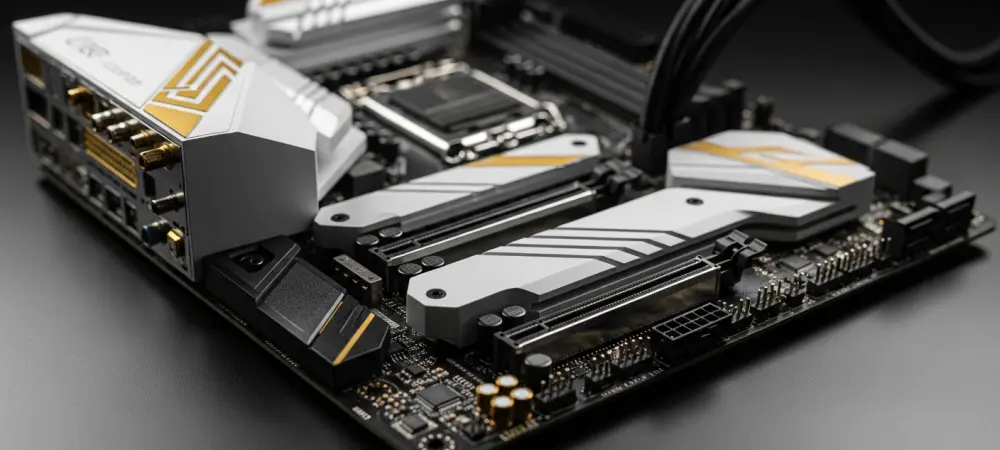
This motherboard serves as a definitive entry point for the X870E lineup, specifically targeting a demographic that values hardware stability and high-speed connectivity over the saturated market of flashing lights. It features an understated, “stealth” design with an all-black printed circuit board accented by minimalist white and gold lettering, which makes it an ideal fit for professional workstations or clean, dark-themed gaming builds. The aesthetic choice here is deliberate; by removing the integrated RGB lighting elements, the manufacturer can reallocate the production budget toward higher-quality internal components and better power stages. This professional appearance reflects its underlying purpose: providing a reliable, high-performance foundation for those who do not require their internal components to glow or change colors. For many users, this return to a more sober and industrial look is a welcome departure from the overly aggressive marketing seen in previous hardware cycles.
Furthermore, the absence of pre-installed lighting strips simplifies the building process and reduces the number of cables and software controllers required to manage the system environment. This lean approach appeals to minimalist builders who prefer to use their own custom lighting solutions or who want a completely dark machine that does not distract during nighttime work or gaming sessions. The gold and white accents provide just enough visual interest to prevent the board from looking generic, yet they remain subtle enough to blend into almost any chassis environment. By focusing on this specific visual identity, the board successfully carves out a niche for itself as a serious piece of hardware rather than a toy. The target audience of software developers, video editors, and high-end gamers often prefers this no-nonsense approach, as it emphasizes the functional aspects of the motherboard over the superficial trends that often inflate the prices of flagship electronics.
Structural Quality: Engineering for Heavy Components
The construction of the motherboard is rooted in an 8-layer server-grade PCB that incorporates significant amounts of extra copper to ensure superior signal integrity and heat management. This sophisticated layer stack is essential for maintaining the high-speed communication required by modern components, as it minimizes electrical noise and provides a stable path for power delivery. The physical rigidity of the board is particularly impressive, as it helps prevent the PCB from flexing or bending when installing heavy components like large dual-tower air coolers or massive modern graphics cards. This structural integrity is a critical factor for long-term reliability, as repeated stress on a motherboard can lead to micro-fractures in the traces or solder joints over several years of use. By prioritizing the quality of the substrate, the design ensures that the board remains a stable platform for even the most demanding hardware configurations in 2026.
While the board omits some of the convenience-focused luxury features found on its more expensive siblings, such as a remote-release button for the primary PCIe slot, the overall build quality remains high. Builders might find themselves reaching for a screwdriver or using a more traditional method to release the graphics card latch, but this is a minor trade-off for the structural robustness provided elsewhere. The heatsinks for the VRM and chipset are physically substantial and securely mounted, providing excellent thermal mass for heat dissipation without relying on fragile or loud active cooling fans. This focus on durability over “quality-of-life” gimmicks suggests a design philosophy that favors the longevity and physical safety of the internal components. For builders who assemble their systems once and expect them to run without intervention for several years, this focus on mechanical stability and high-grade materials provides significant peace of mind.
Power Delivery and Core Specifications
Power Management: Driving the Ryzen 9000 Series
To effectively manage the demanding power requirements of the flagship AMD Ryzen 9000 series processors, the Challenger is equipped with a powerful 20+2+1 power phase design. This configuration utilizes high-efficiency 110A Dr.MOS components, which are designed to provide exceptionally stable voltage even during periods of heavy overclocking or sustained professional rendering workloads. The inclusion of such a high-amperage power delivery system ensures that the CPU always has access to clean, reliable power, reducing the risk of system instability or crashes during peak utilization. This level of power engineering was once reserved for the most expensive enthusiast boards, but its inclusion here signifies a commitment to supporting the full potential of the AM5 platform. Whether running a stock configuration or pushing the silicon to its limits, the motherboard provides a solid foundation that can handle the electrical demands of any compatible processor. Thermal management of these power components is handled by substantial, heavy-duty heatsinks that cover the voltage regulator modules entirely. These cooling elements are designed to dissipate heat efficiently through passive convection, ensuring that the power stages remain within their optimal operating temperature range without the need for complex heat pipes or small, failure-prone fans. The thermal pads used between the components and the heatsinks are of high quality, facilitating rapid heat transfer even during extended periods of high power draw. This robust thermal design is a key reason why the board can maintain its performance standards under load, as it prevents thermal throttling of the power delivery system. By investing in these fundamental areas, the manufacturer has ensured that the motherboard can support the highest-end processors in the Ryzen lineup without compromising on stability or thermal safety, regardless of the intensity of the tasks.
Memory Optimization: Pushing DDR5 Frequency Limits
The motherboard provides full support for the entire range of AMD Socket AM5 processors, including the latest Ryzen 9000 series as well as the older 7000 and 8000 series chips. It features four DIMM slots that can accommodate up to 256GB of DDR5 memory, offering plenty of room for memory-intensive applications like virtual machine hosting or large-scale data processing. For those looking to maximize their system responsiveness, the board supports overclocked memory speeds of up to 8200MT/s through both AMD EXPO and Intel XMP profiles. This high memory bandwidth is crucial for modern computing, as it reduces latency and improves the overall throughput of the system in both gaming and creative professional workloads. The 8-layer PCB design mentioned earlier plays a vital role here, as it provides the necessary signal shielding to maintain stable memory performance at these extremely high frequencies without errors or data corruption.
Beyond just supporting high speeds, the motherboard ensures compatibility with a wide variety of memory modules from various manufacturers, making the building process smoother for the end user. The BIOS includes extensive tuning options for memory timings and voltages, allowing enthusiasts to fine-tune their RAM for the best possible balance of speed and stability. Having the ability to run 256GB of memory at such high speeds makes this board a viable option for entry-level workstations that require significant amounts of fast RAM for complex simulations or professional video editing. This broad compatibility and high memory bandwidth ensure that the system remains relevant as software demands continue to increase through 2026 and into the future. By providing a stable environment for high-frequency DDR5, the motherboard allows users to extract every bit of performance from their memory kits, ensuring that the system never becomes a bottleneck for the processor.
Storage and Advanced Connectivity
High-Performance Storage: Navigating NVMe Expansion
Storage capabilities are a major highlight for this motherboard, which features four M.2 slots designed to handle high-speed NVMe drives for a variety of use cases. The primary slot is fully compatible with the latest PCIe Gen5 x4 standards, offering blistering read and write speeds that are essential for modern gaming and large file transfers. To keep these high-performance drives cool, ASRock has included a tool-less heatsink that is easy to remove and install, ensuring that the drive can maintain its peak performance without thermal throttling. This focus on easy installation is a welcome feature for builders who want to get their systems up and running quickly. The inclusion of Gen5 support on the primary slot future-proofs the system against upcoming storage advancements, allowing users to upgrade to even faster drives as they become more common and affordable in the general marketplace.
However, users should be aware of the physical layout of the secondary storage slots, as some are positioned behind the primary graphics card area. This design choice means that accessing these drives for maintenance or upgrades may require the temporary removal of the GPU, which can be a minor inconvenience during the assembly process. Additionally, because these slots are located near the heat-generating graphics card, careful consideration of the case’s airflow is necessary to ensure that secondary NVMe drives remain properly cooled during intensive tasks. Despite these layout considerations, having four dedicated M.2 slots on a board at this price point is a significant advantage for users who need a large amount of fast local storage. By providing a mix of Gen5 and Gen4 slots, the motherboard offers a versatile platform that can accommodate a wide range of storage configurations, from a single high-speed boot drive to a massive array of secondary storage.
User Diagnostics and Future Outlook
To assist builders during the setup and troubleshooting process, the motherboard includes a convenient four-LED diagnostic panel that provides instant visual feedback on the status of core components. These LEDs light up in sequence to indicate the progress of the CPU, memory, and graphics card during the boot sequence, allowing users to quickly identify and rectify any hardware issues. This functional tool is far more practical for most builders than expensive and complex OLED screens, as it provides all the necessary information to get a system running without the added cost. Additionally, the board is equipped with seven fan headers for complete control over system cooling, along with multiple ARGB headers for those who wish to add their own custom lighting. By focusing on these functional tools rather than built-in decoration, the motherboard provides a high-end experience that prioritizes the needs of the builder and the long-term performance of the hardware. Builders who adopted the X870E Challenger WiFi successfully maximized their hardware budgets by reallocating savings into faster NVMe storage or higher-tier graphics cards. The transition toward functional, stealth-focused designs provided a clear blueprint for the industry to follow in subsequent hardware cycles. It became evident that professional users preferred robust power delivery and high-speed networking over the flickering distractions of integrated lighting. Moving forward, potential buyers should evaluate their need for secondary conveniences versus core architectural stability before committing to more expensive flagship alternatives. This motherboard proved that the high-end chipset market could be accessible without sacrificing the technical standards required for modern workloads. Industry analysts noted that this shift toward value-oriented flagships forced competitors to rethink their pricing strategies for the upcoming hardware generations. Strategically investing in 5GbE and USB4 standards ensured that these systems remained relevant throughout 2026 and beyond.