

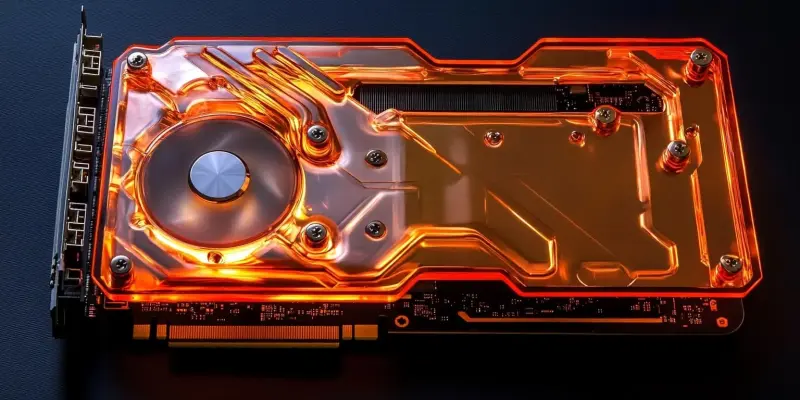
The quest for higher GPU performance often pushes enthusiasts and professionals alike to pursue innovative cooling solutions to extract the maximum potential out of their hardware. Renowned overclocker Der8auer has taken this pursuit to new heights with his custom-built copper water block designed for Nvidia’s RTX 5090 GPU, the fastest consumer GPU available on the market. Demonstrating the ingenuity and technical acumen required for this endeavor, Der8auer’s initiative has showcased a significant drop in the GPU’s operating temperatures, proving the feasibility and necessity of such advanced cooling methods.
Impressive Temperature Reduction
Der8auer’s primary goal with the custom copper water block was to address and significantly lower the operational temperature of the RTX 5090, which is crucial for unlocking the GPU’s overclocking potential. The stock cooling solution of the Founders Edition card posed a considerable challenge, operating at an average temperature of approximately 73.8° Celsius under load. Through meticulous engineering and precise modifications, including matching the water block’s dimensions to the original heatsink and ensuring compatibility with the short display cable, Der8auer managed to bring the temperature down by an astounding 30° Celsius, resulting in a stable 43.8° Celsius. This marked improvement was not an easy feat and required detailed planning to disassemble the original cooling solution, which was tightly integrated with the card’s overall design.
Overcoming Technical Hurdles
The process of developing and implementing the custom copper water block was fraught with complexities, beginning with the challenge of disassembling the RTX 5090 Founders Edition. The card’s compact design, combined with its short display cable, necessitated a water block that precisely matched the dimensions of the original heatsink to ensure proper fitment. This precision was crucial for maintaining the card’s structural integrity and performance. Der8auer had to meticulously design and fabricate the copper block, carefully considering factors such as thermal conductivity, coolant flow, and structural support. Beyond the mechanical challenges, the endeavor also involved extensive testing and iterations to achieve the desired thermal performance, all while maintaining the overall stability and reliability of the GPU.
Implications for Overclocking Enthusiasts
The pursuit of higher GPU performance is a driving force for both enthusiasts and professionals, leading them to seek out innovative cooling solutions that can maximize their hardware’s potential. Renowned overclocker Der8auer has significantly advanced this effort with his custom-designed copper water block specifically for Nvidia’s RTX 5090 GPU, which holds the title as the fastest consumer GPU on the market. His work exemplifies the ingenuity and technical expertise required to achieve noteworthy results. By incorporating this custom cooling system, Der8auer has managed to notably decrease the operating temperatures of the GPU. This demonstration of advanced cooling methods underscores their feasibility and necessity for those looking to push their technology to the limits. Der8auer’s endeavor not only highlights the importance of effective thermal management but also sets a new benchmark in GPU performance enhancement, reaffirming that with the right approach, the capabilities of high-end hardware can be further unlocked.