

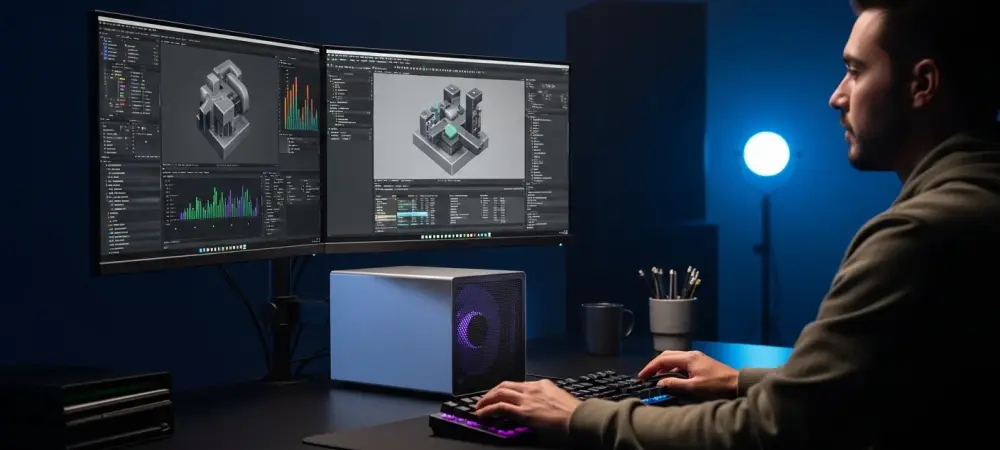
The professional workstation industry is currently navigating a fundamental transformation as compact, small-form-factor units finally match the raw power of enterprise towers. For years, Apple’s Mac Studio has held a near-monopoly on high-performance creative hardware, but the landscape is shifting with the arrival of the Dell XPS RTX Spark. Driven by a strategic alliance between Nvidia and Microsoft, the industry is moving toward a reinvented personal computer architecture that prizes efficiency and power.
This segment now prioritizes localized AI development and high-fidelity creative production, with major players like Dell and Asus challenging the silicon-based dominance of the Mac ecosystem. Through modularity and extreme memory configurations, these new entrants offer a level of flexibility that Apple has traditionally restricted. The shift suggests that the era of closed, non-upgradeable professional systems may be facing its most significant challenge yet as Windows-based hardware regains its footing in the high-end creative market.
The High-Performance Mini PC Renaissance and the Battle for Desktop Dominance
The emergence of the Dell XPS RTX Spark marks a pivotal moment where compact design no longer necessitates a sacrifice in thermal headroom or processing speed. This renaissance is fueled by professional users who demand the footprint of a mini PC but the performance of a full-sized rack. By integrating the N1X RTX Spark processor, Dell has managed to bridge a gap that previously forced creators to choose between aesthetic minimalism and raw computational throughput.
Moreover, the competition between Dell and Apple is driving a rapid acceleration in hardware capabilities across the board. While the Mac Studio relied on its unified memory architecture to maintain an edge, the new wave of RTX-powered desktops uses dedicated high-speed pathways to handle complex rendering and simulation. This rivalry is beneficial for the end-user, as it forces innovation in cooling technology and power delivery systems that were previously thought impossible for such small chassis.
Market Dynamics and the Shift Toward Localized AI Workstations
Emerging Trends in Localized Machine Learning and Creative Production
The primary driver in the current hardware market is the overwhelming demand for localized AI development. While cloud computing remains a staple for massive deployments, professionals increasingly seek hardware capable of handling generative AI models locally to ensure lower latency and higher data security. The Dell XPS RTX Spark addresses this specific need by offering up to 128GB of RAM, effectively targeting memory-intensive workloads that have outpaced the current 96GB ceiling found on top-tier Mac Studio models.
Furthermore, the trend toward high-connectivity designs is forcing manufacturers to pack enterprise-grade ports into increasingly smaller footprints. Creative professionals are no longer willing to rely on external dongles for basic functionality. The inclusion of dual HDMI ports and multi-port USB-C arrays in the latest XPS models reflects a broader industry move toward creating a true hub for professional peripherals without requiring additional desktop clutter.
Performance Indicators and the Competitive Global Landscape
Market data indicates a growing appetite for ultra-premium workstations despite their high entry costs, which often sit between $4,000 and $5,000. The industry is seeing a clear bifurcation between general consumer hardware and these professional-grade tools. Competitors like Asus are already responding with low-power-draw alternatives such as the ProArt Mini PC, creating a highly saturated environment by the late-year launch window. This saturation suggests that performance is becoming the primary metric for market share. Growth projections suggest that the professional mini PC segment will see sustained investment as long as manufacturers can deliver the memory overhead required for next-generation AI software. The ability to run large language models locally is becoming a non-negotiable feature for enterprise buyers. Consequently, the global landscape is shifting away from general-purpose machines and toward highly specialized units that can double as data science workstations.
Navigating the Global RAM Crisis and Supply Chain Volatility
The most significant obstacle facing Dell and its competitors is the ongoing RAM crisis, which has disrupted global stock levels and threatened launch timelines. While Dell aims for a September release, the volatility of the hardware supply chain remains a constant threat to actual availability. This challenge is magnified by Apple’s current struggle with four-month lead times for its high-end configurations, highlighting a systemic vulnerability in high-end electronics manufacturing that affects the entire sector.
To succeed in this climate, Dell must implement aggressive inventory management strategies to avoid the same pitfalls that have hampered its rivals. Securing long-term contracts for high-density memory modules is now as important as the engineering of the computer itself. Manufacturers that can actually put products on shelves during this period of high demand will likely capture a significant portion of the professional market, regardless of brand loyalty.
Compliance and the Collaborative Evolution of Hardware Standards
As hardware becomes more specialized for AI, the regulatory landscape is shifting to focus on data security and energy efficiency standards. The collaboration between Nvidia and Microsoft to develop the N1X RTX Spark platform represents a move toward standardized, AI-ready architectures within the Windows ecosystem. This partnership ensures that new hardware meets rigorous compliance benchmarks for both performance and security, providing a reliable alternative to closed-system architectures for government and corporate clients.
Furthermore, as power-hungry workstations become the norm, industry players are facing stricter regulations regarding thermal management and energy consumption. This has forced a shift toward more efficient designs like those recently showcased at the Computex exhibition. Engineers are now balancing the need for 140W+ power delivery with the necessity of meeting global green-energy certifications, leading to a new generation of smart power management systems.
The Future of Compact Computing and Market Disruptions
Looking ahead, the industry is poised for further disruption as the line between traditional desktops and mobile workstations continues to blur. The move toward 128GB and higher RAM capacities in mini PCs suggests that the next frontier will involve modular internal components. Such innovation would allow professionals to upgrade their hardware without replacing the entire unit, directly challenging the planned obsolescence often associated with high-end consumer electronics.
Innovation in cooling technologies, such as advanced vapor chambers and liquid metal interfaces, will likely enable even smaller devices to handle extreme workloads. As economic conditions stabilize, consumer preference will shift toward devices that offer the greatest flexibility for remote, AI-driven work. This evolution could potentially erode the market share of established players if they fail to adapt to the demand for modularity and localized processing power.
Balancing Innovation with Availability in the Professional Market
The Dell XPS RTX Spark represented a significant milestone in the effort to decentralize high-performance computing from massive towers to the desktop. Analysis of the recent market cycle showed that the shift toward 128GB of RAM set a new baseline for professional expectations in the Windows ecosystem. It was discovered that the N1X architecture successfully proved that modularity could exist in small-form-factor devices without sacrificing the thermal integrity required for intense AI training.
The industry trajectory was ultimately determined by how effectively companies mitigated the global RAM crisis through diversified sourcing. For organizations that transitioned to these compact workstations, the move provided an actionable path toward maintaining high security without the latency of cloud-based AI tools. This era of competition confirmed that the future of the professional market depended on the delicate balance between extreme performance specifications and the practical ability to manufacture them at scale.