

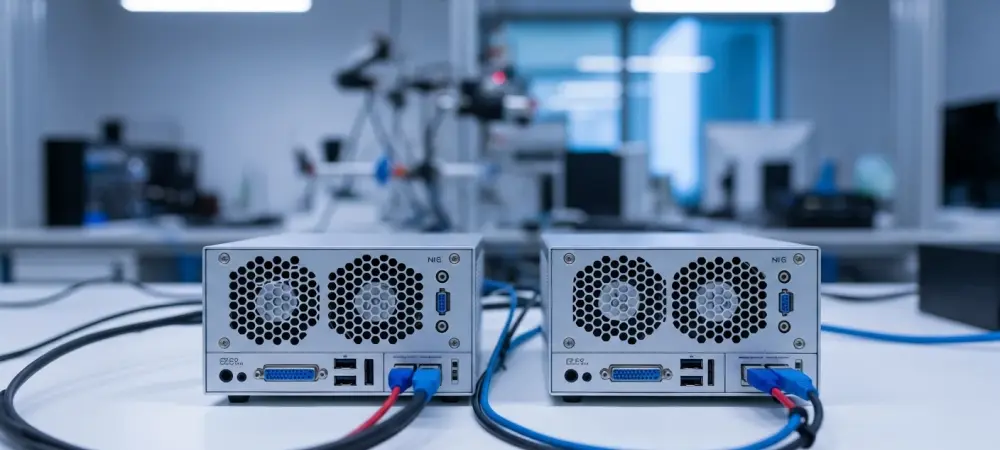
The rapid decentralization of artificial intelligence marks a significant turning point for enterprises that have spent years tethered to expensive and often restrictive cloud-based infrastructure. The emergence of the Dell Pro Max with GB10 serves as a primary catalyst for this shift, effectively shrinking the immense power of an industrial-grade AI server into a compact form factor that fits comfortably on a standard office desk. By leveraging Nvidia’s DGX Spark reference architecture, this workstation offers a sophisticated alternative for organizations seeking to maintain local control over their computational pipelines. It functions as a mini supercomputer, providing the necessary high-performance resources for data-heavy tasks that once necessitated massive, room-filling server racks. This transition toward localized compute represents more than just a reduction in hardware footprint; it signals a new era of privacy and operational independence for developers and researchers who require immediate access to massive processing power without the latency or security risks associated with external data centers.
Strategic Positioning: Specialized Workflows and Local Security
Specialized Workflows for Data Science
This powerful workstation is strategically positioned to serve an elite cadre of power users, ranging from seasoned data scientists to academic researchers pushing the boundaries of machine learning. The primary appeal lies in the ability to run and refine incredibly complex AI models within a strictly local environment, which fundamentally changes how sensitive data is managed. By moving high-level AI development away from a total reliance on the cloud, professional practitioners can enjoy a more private and efficient workflow that minimizes the risk of proprietary intellectual property leaks. This localized approach allows for rapid iteration cycles, as researchers no longer need to wait for data to upload or for remote server availability during peak demand times. Furthermore, the shift to on-device setup helps organizations circumvent the unpredictable and often escalating costs associated with enterprise-scale cloud computing subscriptions, providing a predictable expenditure model for long-term research initiatives.
Privacy and Security: Maintaining Localized Control
Beyond mere convenience, the move toward specialized local hardware addresses the critical bottleneck of latency that often plagues remote cloud communications. In an industry where seconds can dictate the success of a real-time training session, the near-instantaneous response of the Dell Pro Max ensures that performance remains consistent regardless of internet connectivity or bandwidth constraints. This stability is particularly vital for enterprise AI practitioners who are tasked with developing mission-critical applications that require constant uptime and reliable throughput. By maintaining complete control over the entire hardware and software stack, organizations can tailor their security protocols to meet stringent regulatory requirements without compromising on speed. The machine effectively bridges the gap between traditional professional workstations and full-scale data centers, offering a scalable solution that can be deployed across various departments without the logistical hurdles of installing large-scale cooling and electrical infrastructure.
Technical Specifications: The Blackwell Architecture
High-Intensity Performance: The Power of the Superchip CPU
The architectural foundation of this workstation is the Nvidia GB10 Superchip, a technological marvel that features a sophisticated 20-core Arm-based processor designed specifically for high-intensity workloads. This particular architecture utilizes a hybrid processing approach, which intelligently combines ten high-intensity performance cores with ten efficiency cores dedicated to managing lighter background processes. Such a configuration ensures that the system remains exceptionally responsive and stable, even when the processor is subjected to the heavy, sustained loads typical of deep learning training or complex simulation tasks. By delegating less demanding threads to the efficiency cores, the performance cores are left entirely free to handle the core computational logic of AI models, preventing bottlenecks that often occur in traditional multi-core designs. This balanced engineering not only maximizes raw speed but also optimizes power consumption, allowing the system to operate efficiently during long-duration research projects.
Graphical Prowess: Real-Time Inference Performance
Computational and graphical processing prowess is further amplified by the integrated Blackwell GB20B GPU, which is manufactured using a cutting-edge 5nm process to ensure maximum density and performance. This component delivers an astonishing 1,000 teraFLOPS of performance when utilizing 4-bit precision, a metric that makes it an unrivaled engine for rapid AI inference and real-time data processing. Even when moving to more standard industry benchmarks, the system maintains a robust output of 170 teraFLOPS at 16-bit precision, ensuring that it can handle a diverse array of professional computational tasks without slowing down. The Blackwell architecture represents a significant step forward in GPU design, prioritizing throughput and memory bandwidth to accommodate the massive data sets required for modern generative AI. This level of power allows researchers to execute tasks that would typically require a cluster of older graphics cards, all within a single unit that fits into a professional office environment.
Memory Capacity: Supporting Substantial Language Models
Massive Parameter Support: 128GB of Unified Memory
A defining technical characteristic of the Dell Pro Max is its inclusion of 128GB of unified memory, a specification that fundamentally alters the scope of local AI development. This massive memory capacity allows the machine to support and run incredibly large AI models with up to 200 billion parameters locally, effectively surpassing the requirements of many state-of-the-art large language models currently in use. Traditional workstations often struggle with memory bottlenecks when dealing with such high parameter counts, forcing developers to offload significant portions of their work to external data centers or to utilize slower storage-based swapping. With 128GB of high-speed unified RAM, the Dell Pro Max keeps all the necessary model weights and datasets within immediate reach of the processing cores, resulting in a dramatic reduction in training times and an increase in inference speed. This capability provides a level of freedom previously unavailable to individual researchers.
Enhancing Productivity: Workflow Preservation and Efficiency
This expansive memory pool does more than just host larger models; it enables a more holistic approach to data science by allowing multiple processes to coexist without competing for limited resources. Researchers can maintain multiple versions of a model in memory simultaneously, facilitating side-by-side comparisons and faster debugging cycles during the development process. By eliminating the need to constantly shuffle data between the system and a cloud-based server, the workstation preserves the integrity of the research workflow and reduces the cognitive load on the user. Furthermore, the high-speed unified architecture ensures that data movement between the CPU and GPU is virtually instantaneous, a critical factor when dealing with the high-bandwidth requirements of modern transformer-based architectures. This seamless integration of high-capacity RAM and high-speed processing makes the device a versatile tool for everything from genomic sequencing to advanced financial modeling.
Connectivity and Scalability: Modular Design Standards
Modular Expansion: Parallel Processing with SmartNIC Technology
Dell has clearly focused on the long-term scalability of the Pro Max by integrating specialized hardware links, most notably the Nvidia ConnectX-7 SmartNIC port. This high-performance networking interface allows users to connect two separate units in a parallel configuration, effectively doubling the available computational capacity and allowing for the local hosting of models with over 400 billion parameters. This modular approach is a key differentiator in the market, as it ensures that the workstation can grow in tandem with the evolving needs of a research project or an expanding enterprise AI team. Instead of requiring a complete hardware overhaul when model complexity increases, organizations can simply scale their infrastructure horizontally by adding more units as needed. This flexibility provides a clear and cost-effective path for expansion, making it a viable investment for teams that expect their computational requirements to scale significantly without needing massive upfront capital.
Physical Engineering: Thermal Design and Modern Interface
The physical construction of the device reflects a balance between professional aesthetics and functional engineering, featuring a compact chassis that incorporates a hexagonal honeycomb grill for superior thermal management. Given that the 240W Superchip generates significant heat during intensive operations, this design is crucial for maintaining peak performance without thermal throttling. Dell has also modernized the input/output selection, opting to omit legacy USB-A ports in favor of a comprehensive USB-C ecosystem that supports 20Gbps transfer speeds and DisplayPort 2.1 compatibility. The understated, industrial design is intentionally tailored for corporate or laboratory environments, where quiet operation and reliability are prioritized over flashy lighting or aggressive styling. By focusing on airflow and cooling efficiency, the workstation ensures that the internal components stay within optimal temperature ranges, which is essential for preserving the longevity of the hardware during the multi-day training runs.
Economic Value: Implementation and Strategic Outcomes
Performance Benchmarks: Reliability and Operational Efficiency
In rigorous benchmark testing, the Dell Pro Max consistently demonstrated impressive results, recording high scores in both single-core and multi-threaded computational tasks that rivaled much larger server configurations. Real-world usage scenarios confirmed that the machine remained exceptionally quiet and thermally efficient, maintaining surprisingly low internal temperatures even when it was tasked with processing the most demanding AI workloads for hours on end. While it was true that a single desktop unit could not fully replace the raw capacity of a massive data center, the performance-to-size ratio of this system made it an undisputed market leader for localized AI research. The combination of the Blackwell architecture and Dell’s engineering expertise created a stable platform that delivered predictable results, which was a critical requirement for professional environments. This reliability ensured that researchers focused on the results of their simulations rather than the hardware.
Strategic Integration: Long-Term Resource Management
Organizations that integrated this workstation into their infrastructure identified specific high-value projects where data privacy and low-latency processing offered the greatest return on investment. As AI models grew in complexity, the ability to expand capacity via parallel links became a standard requirement for future-proofing hardware purchases across the enterprise. Future considerations included the training of specialized staff on the DGX OS environment to ensure that the advanced features of the Nvidia Playbooks were fully utilized by the development teams. By establishing a robust internal pipeline that leveraged this mini supercomputer’s unique strengths, companies significantly reduced their long-term operational expenses while they maintained a competitive edge in the rapidly evolving landscape of machine learning. The shift toward localized, high-performance assets proved to be a decisive factor in accelerating the deployment of proprietary AI solutions within secure corporate networks.