

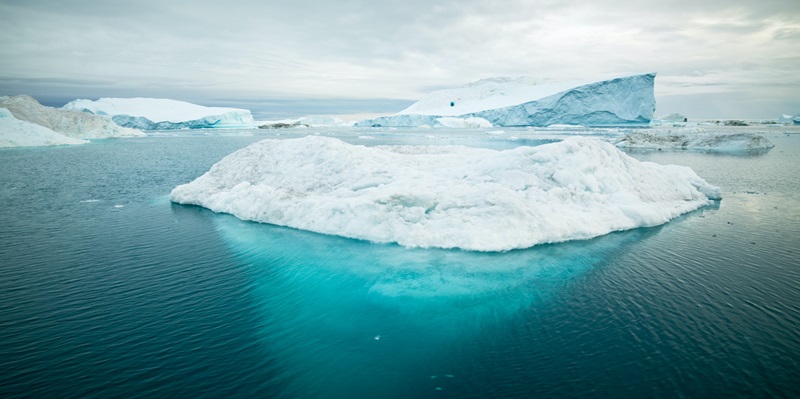
Icebergs, the majestic giants of the polar regions, have long captivated our imagination. However, their significance extends beyond their enchanting beauty. Icebergs play a crucial role in altering ecosystems and impacting global environmental patterns. Understanding their behavior and impact is vital for studying and addressing climate change. In an exciting development, a team of scientists funded by the Alan Turing Institute is utilizing Synthetic Aperture Radar (SAR) technology from ESA’s Sentinel-1 satellites to overcome the obstacles in studying icebergs and pave the way for groundbreaking research.
Utilizing Synthetic Aperture Radar (SAR) Technology
Funded by the prestigious Alan Turing Institute, the team of scientists has tapped into the potential of the ESA’s Sentinel-1 satellites and their SAR technology. SAR overcomes the limitations imposed by cloud cover, darkness, and thick sea ice, making it the perfect tool for studying icebergs. With the help of this advanced technology, the team aims to revolutionize iceberg research and monitoring.
Application of an Unsupervised AI Algorithm
To analyze the vast amount of SAR readings collected between October 2019 and September 2020, the team employed an unsupervised AI algorithm. With this cutting-edge approach, they successfully identified nearly 30,000 icebergs. The algorithm’s ability to autonomously analyze the SAR data not only saves time and resources but also enhances the accuracy and efficiency of iceberg detection.
Developing a Comprehensive Digital Model
By accurately detecting and tracking these icebergs, researchers aim to develop a comprehensive digital model of the Antarctic sea. This digital twin will provide valuable insights into the complex interactions between the ocean, ice, and atmosphere. It holds immense potential for enhancing our understanding of marine ecosystems, predicting climate patterns, and informing future conservation efforts.
Accuracy and Scalability of the Method
Remarkably, the method employed by the team proves to be as accurate as other alternative iceberg-detection methods and outperforms most without the need for human input. This breakthrough paves the way for easy scalability beyond the study area. Moreover, it enables near real-time monitoring, offering the potential for prompt response to iceberg-related events, such as hazardous drifting paths or iceberg impacts on shipping routes.
Advancing our Understanding of Icebergs
Through this innovative approach, scientists hope to deepen our understanding of the impact and behaviour of icebergs. By unravelling the mysteries of icebergs, their findings have the potential to revolutionize our ability to predict and mitigate the ecological and environmental consequences of climate change. The study expands the boundaries of polar studies, offering exciting new avenues for future research and exploration.
Implications for Further Research and Exploration
The findings of this study open new avenues for further research and exploration in the realm of polar studies. With the accurate and scalable approach established, scientists can delve deeper into the ecological, climatic, and oceanographic implications of icebergs. This breakthrough technology creates a ripple effect, fostering collaboration and sparking curiosity among researchers in various areas of study.
Icebergs, often seen as silent wanderers of the polar seas, have been unveiled from their shroud of mystery through the fusion of SAR technology and AI. This groundbreaking research has enhanced our understanding of icebergs and has far-reaching implications for comprehending the complex dynamics of our planet. By tracking and studying icebergs, scientists aim to gain a more comprehensive understanding of the ecological and environmental consequences, assisting in the development of more effective climate change strategies. The ongoing research in this field exemplifies the limitless potential of human ingenuity and technological advancements in unravelling the secrets of our universe. As we embark on this journey, we have only begun to scratch the surface of what lies ahead in the realm of polar studies.