

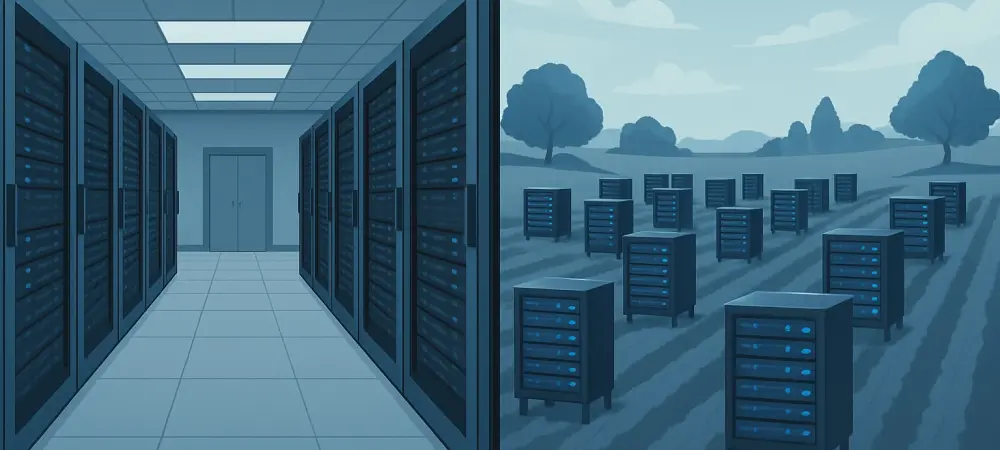
As businesses race toward digital transformation, data centers and server farms have become integral to IT strategies across various sectors. These two types of facilities, though seemingly similar, play distinct roles in the management and deployment of technological resources. Understanding these differences is crucial for professionals tasked with designing and maintaining robust IT infrastructures.
The Foundation of Digital Transformation
Data centers are constructed to house IT equipment and necessary support infrastructure—ranging from electrical systems to cooling mechanisms and network setups. Their holistic approach is fundamental in supporting large-scale IT operations, making them indispensable in an era where seamless digital services are paramount. These facilities are the backbone of modern computing, ensuring the smooth operation of massive amounts of data and applications.
On the other hand, server farms consist of many interconnected servers functioning together to achieve specific tasks. Contrary to the all-encompassing nature of data centers, server farms are characterized by their focused utility, often working like a well-oiled machine to host websites, manage databases, or process vast workloads. They symbolize efficiency and collaboration in digital processing tasks, performing discrete functions toward a unified goal.
Structure and Dynamics in IT Settings
Data Centers: Holistic Operational Excellence
Data centers encompass a variety of structural components. Space management is crucial due to the extensive hardware setups involved. Electrical systems are a linchpin in maintaining uninterrupted power, while cooling systems are vital in managing the heat generated by server operations. Networking services facilitate connectivity on a large scale, forming the essence of a data center. This intricate composition allows data centers to support businesses across all industries, from financial services to healthcare.
Server Farms: Collaborative Yet Targeted Operations
Server farms focus on the synergy of their components rather than their individual roles. The interconnected nature of servers in these facilities ensures that operations are streamlined and collaborative, with each server working in harmony toward a common goal. Where data centers provide a comprehensive infrastructure, server farms prioritize efficiency in deploying and managing specific workloads. Consequently, server farms excel in environments requiring rapid task execution and collaboration.
Innovations in the Digital Ecosystem
In recent times, advancements within data centers and server farms have taken center stage, driving the digital landscape unmistakably forward. Developments in energy efficiency and sustainability have changed how these facilities use power, significantly reducing their environmental footprints. Innovations in edge computing have pushed computing power closer to data sources, reducing latency and improving performance across distributed networks, highlighting the industry’s commitment to continuous evolution.
Industry Applications and Utility
Industries like finance and healthcare have long benefited from the robust infrastructure offered by data centers. These sectors require unparalleled data integrity and operational continuity—features naturally provided by data centers. Conversely, media companies often turn to server farms for efficient data processing and content management, highlighting their flexibility and directed functionality. Such targeted utilization showcases the profound adaptability each facility type offers.
Navigating Obstacles in Operation
Despite their advancements, data centers and server farms face significant operational challenges. Energy consumption remains a major concern, with rising costs and environmental impact posing ongoing barriers. Space requirements limit expansion capabilities, while technological changes threaten to render existing infrastructure obsolete. Efforts to counteract these challenges, including green technology initiatives and modular construction, signal the industry’s proactive stance on overcoming hurdles.
Looking Ahead in Technology
The future promises notable transformations for both data centers and server farms. Technological advancements are expected to streamline operations, with AI and machine learning improving efficiency and reducing operational costs. Market needs are likely to steer designs toward more flexible and adaptive models, while regulatory factors could impose new standards. The trajectory suggests a future where these facilities will continue to evolve, meeting the ever-expanding demands of the digital economy.
Final Thoughts
The review underscored the distinct roles data centers and server farms have played in shaping 21st-century IT infrastructure. While data centers provided a comprehensive backbone for enterprise-level operations through their extensive support systems, server farms enabled streamlined task execution through their collaborative functionality. The anticipation of consistent growth and the need for innovation meant that both would likely endure transformative changes, proving essential to driving technological evolution and supporting industry demands.