

Surging Demand Fuels a Competitive Landscape
In 2025, the global data center market finds itself at a critical juncture, with tech giants and infrastructure providers racing to secure vast parcels of land to support an unprecedented surge in digital demand. Picture this: a single hyperscale data center campus sprawling over 1,000 acres, consuming enough power to rival a small city, all to fuel the artificial intelligence (AI) and cloud computing workloads driving modern innovation. This land rush, while a testament to technological progress, poses significant environmental challenges and resource constraints that could reshape the industry’s trajectory. This market analysis examines the forces propelling data center expansion, dissects current trends and projections, and explores the sustainability hurdles that stakeholders must navigate. The purpose is to illuminate the balance between digital growth and planetary health, offering strategic insights for a sector poised for exponential growth.
Market Trends and In-Depth Analysis
Historical Growth and Current Scale
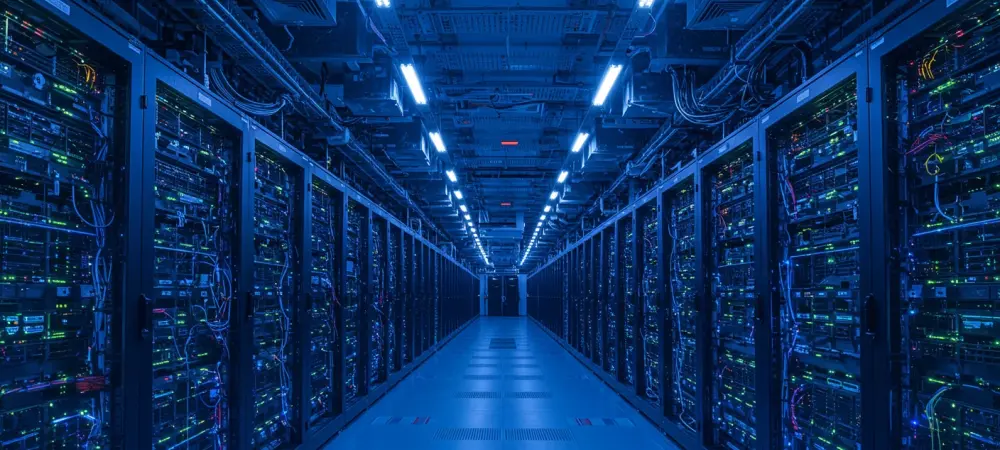
The data center industry has undergone a dramatic transformation over recent decades, evolving from modest facilities to sprawling complexes that underpin the digital economy. Initially, small-scale centers required just 1 to 2 megawatts (MW) of power and minimal land, often repurposed from existing structures. Today, hyperscale facilities demand between 40 MW and 200 MW, necessitating land parcels ranging from 10 acres to over 1,000 acres for future-ready campuses. As of this year, over 10,000 data centers operate globally, collectively occupying an estimated 400,000 acres, with recent land acquisitions averaging 224 acres per site—a sharp rise from previous years. This escalation reflects not only technological advancements but also a competitive market where securing strategic locations near power grids and urban hubs has become paramount.
Power Density and Land Scarcity Pressures
A defining trend in the market is the soaring power density per server rack, largely driven by AI applications. From 8 kilowatts (kW) per rack just a few years ago, the average has climbed to 17 kW in 2025, with projections reaching 30 kW by 2027. This intensifies the need for larger land areas and robust energy infrastructure, pushing global demand from 60 gigawatts currently to an anticipated 180 gigawatts by 2030. However, suitable land near critical infrastructure remains scarce, driving developers into rural or ecologically sensitive regions. Construction timelines, averaging 18 to 30 months under ideal conditions, face further delays due to supply chain disruptions and regulatory barriers, amplifying the challenge of meeting market needs without compromising environmental standards.
Environmental Footprint of Expansion
The environmental implications of this land grab are a growing concern within the market. Constructing data centers often means clearing forests, converting farmland, or altering wetlands, which disrupts biodiversity and diminishes essential ecosystem services like carbon sequestration. The carbon footprint of these facilities, both from construction and operation, contributes significantly to greenhouse gas emissions, aligning the sector with broader climate change challenges. Additionally, transforming natural landscapes leads to soil erosion and altered water flows, while the loss of agricultural land raises questions about food security in affected regions. These factors position environmental impact as a critical market risk that investors and operators must address.
Regional Disparities in Development Strategies
Market dynamics vary widely across regions, reflecting diverse challenges and approaches to data center expansion. In densely populated areas like Western Europe, land scarcity drives up costs and encourages vertical or urban-integrated designs to maximize space. Conversely, in North America, sprawling campuses in rural areas often encroach on agricultural zones, sparking local opposition and regulatory scrutiny. A misconception persists that renewable energy can fully offset these issues; for instance, powering a 100 MW data center with solar would require 1,446 acres of panels, far exceeding typical site footprints. Such regional nuances underscore the need for tailored strategies that account for local conditions and resource availability, shaping how the market evolves in different geographies.
Future Projections and Innovative Shifts
Looking toward the horizon, the data center market is poised for transformative changes as demand pressures mount. Projections suggest a tripling of capacity needs by 2030, compelling the industry to explore alternatives like vertical, underground, or underwater facilities to conserve land, despite higher costs and technical hurdles. Regulatory frameworks are tightening, with zoning laws increasingly protecting sensitive ecosystems near biodiversity hotspots or national parks. Economically, investments in on-site renewable energy and advanced cooling systems signal a pivot toward sustainability, while AI-driven optimization tools are expected to enhance space and energy efficiency. These innovations could redefine market standards, balancing growth with environmental responsibility in the coming years.
Reflecting on Market Implications and Strategic Pathways
Looking back, this analysis reveals that the data center market in 2025 stands as a battleground of innovation and constraint, with land demand skyrocketing due to AI and cloud computing, yet facing severe environmental and logistical hurdles. The historical shift from small-scale facilities to hyperscale campuses underscores a trajectory of intensified resource use, while regional disparities highlight the complexity of scaling globally. Environmental impacts, from habitat loss to carbon emissions, emerge as pivotal risks that shape stakeholder priorities. For future considerations, developers and policymakers should prioritize strategic site selection to avoid ecologically critical areas, fostering partnerships with local communities for balanced growth. Businesses are encouraged to invest in sustainable technologies, such as renewable integration and efficient infrastructure, to mitigate operational impacts. Additionally, exploring non-traditional construction models offers a pathway to conserve land, ensuring the digital economy can thrive without exhausting finite resources. These steps, grounded in the insights gained, point toward a future where technology and sustainability can coexist through deliberate action and innovation.