

Unveiling the Cyber Sabotage Campaign
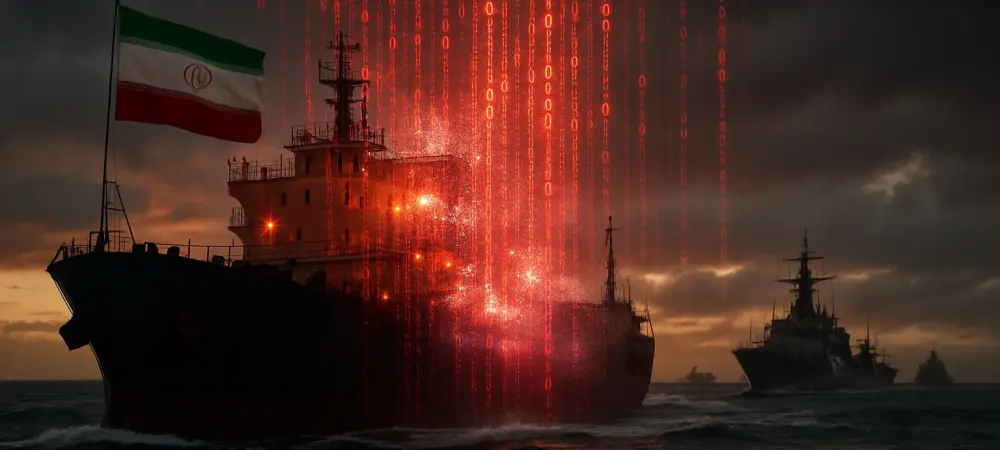
Imagine a fleet of tankers, vital to a nation’s economy, suddenly cut off from communication, drifting aimlessly in international waters with no access to weather updates or port coordination, a scenario that became reality in late August. A sophisticated cyberattack targeted Iran’s maritime communications infrastructure, disrupting satellite links and navigation aids for dozens of sanctioned vessels. Attributed to a group known as Lab-Dookhtegan, this operation struck at the heart of Iran’s covert oil trade, exposing glaring vulnerabilities in centralized networks.
The attack focused on disrupting the strategic operations of Iran’s tanker fleets, which play a critical role in evading international sanctions through hidden oil transfers, primarily to China. By targeting Fanava Group, the IT provider for the National Iranian Tanker Company (NITC) and Islamic Republic of Iran Shipping Lines (IRISL), the perpetrators achieved a sweeping blackout across multiple ships. This incident raises pressing questions about the security of critical maritime systems and the precision required to execute such a coordinated assault.
Beyond the immediate impact, the broader implications for maritime security are profound. How could a single breach cascade into such widespread chaos? What does this mean for other nations relying on similar infrastructure? This campaign serves as a stark reminder of the risks posed by digital warfare in an increasingly connected world, urging a closer examination of systemic weaknesses.
Background and Geopolitical Context
Iran’s maritime operations have long been a cornerstone of its strategy to circumvent international sanctions, with sanctioned tanker fleets facilitating covert oil trade to sustain economic stability. These vessels, often operating under deceptive practices, rely heavily on secure communication systems to coordinate transfers and avoid detection. The reliance on such fleets has made them a prime target for adversaries seeking to disrupt Iran’s economic lifelines.
At the center of this attack was Fanava Group, a key IT provider managing satellite communications for major Iranian shipping entities like NITC and IRISL. These organizations are pivotal to Iran’s ability to export oil despite restrictions, making Fanava a critical node in the network. The exploitation of its systems highlights how even ancillary service providers can become linchpins in national security when tied to vital industries.
Globally, this incident underscores a critical lesson in cybersecurity: legacy systems and inadequate security practices in critical infrastructure can yield devastating economic and strategic consequences. Many nations still operate on outdated technology, vulnerable to modern cyber threats. This attack on Iran’s maritime network serves as a warning to the international community about the urgent need to modernize and protect such systems against evolving digital dangers.
Attack Methodology, Findings, and Implications
Methodology
The cyberattack on Iran’s maritime infrastructure was a masterclass in technical exploitation, beginning with the targeting of outdated iDirect Falcon terminals at Fanava Group, which operated on an obsolete Linux kernel. These terminals, riddled with unpatched vulnerabilities, provided an entry point through exposed management consoles, granting attackers root access. This initial breach laid the groundwork for a meticulously planned operation.
From there, the attackers employed a multi-stage infection process, using SSH keys for lateral movement across the network and deploying destructive scripts such as “dd if=/dev/zero” to wipe data. Email logs reveal that persistent access was maintained for months, with evidence of activity dating back to May, including “Node Down” tests to refine their approach. This prolonged infiltration culminated in a final, devastating strike on August 18, showcasing the depth of their preparation.
The technical sophistication was further evident in the attackers’ ability to map the entire fleet network by accessing a MySQL database containing sensitive information like modem serial numbers and plain-text credentials. This data enabled a synchronized assault, demonstrating how a single point of failure in a centralized system can be weaponized to paralyze an entire operation.
Findings
The outcomes of this cyber sabotage were staggering, with disruptions synchronized across 64 vessels through the exploitation of detailed fleet data extracted via SQL queries. The attackers automated shutdowns using orchestration scripts and embedded malicious cron entries for timed execution, ensuring maximum impact. This level of control over the network underscores the depth of reconnaissance conducted prior to the attack.
On August 18, the campaign reached its destructive peak with a “scorched earth” tactic that overwrote storage partitions on satellite modems, rendering remote recovery impossible. The immediate aftermath saw severed email and SIM communications, halted weather updates, and disrupted coordination with ports. Such chaos left tankers vulnerable to drifting off-course or even seizure by international forces monitoring sanctioned activities.
The operational fallout was profound, as the attack not only crippled communication but also exposed the fragility of relying on outdated systems for critical functions. Tankers, isolated from essential updates, faced heightened risks in navigation and security. This incident paints a grim picture of how cyber warfare can translate into tangible, real-world disruptions for an entire industry.
Implications
The broader impact on Iran’s maritime operations cannot be overstated, as the attack amplified risks during a pivotal period of covert oil trade. With communications severed, the ability to coordinate discreet transfers was severely hampered, potentially leading to significant financial losses. This event laid bare the systemic vulnerabilities in satellite communication systems that underpin such operations.
Geopolitically, the incident demonstrates the potency of cyber warfare as a tool to inflict economically and strategically damaging blows on national interests. It serves as a case study in how digital attacks can achieve objectives that traditional military actions might not, shifting the battlefield to cyberspace. Nations worldwide must take note of this evolving threat landscape, where critical infrastructure is increasingly at risk. Urgent action is needed to bolster cybersecurity practices, such as isolating management interfaces from external access and enforcing rigorous patch management protocols. The global maritime sector, in particular, must prioritize the protection of communication networks to prevent similar disruptions. This attack is a call to action for enhanced defenses, as the cost of inaction could be catastrophic for international trade and security.
Reflection and Future Directions
Reflection
The Lab-Dookhtegan campaign stands out for its meticulous planning and execution, highlighting the immense challenge of securing legacy systems against advanced cyber threats. Every step, from initial breach to final destruction, was calculated to maximize damage, revealing how even minor oversights in security can be exploited with devastating effect. This operation exemplifies the sophistication of modern cyber adversaries.
However, limitations in current analysis persist, particularly regarding definitive attribution of the attackers’ identity. While insights from researcher Nariman Gharib provide clarity on methods and motives, the true origins of the group remain unclear, necessitating a focus on factual evidence over speculation. Such gaps underscore the complexity of tracing cyber operations in a landscape often shrouded in anonymity.
Further exploration could delve into the attackers’ reconnaissance phase, uncovering how they identified and mapped vulnerabilities over months. Additionally, examining the long-term recovery process for affected systems could offer valuable lessons in resilience. Expanding research in these areas would provide a more comprehensive understanding of both the attack and the path to mitigation.
Future Directions
Investigating the evolving tactics of state or state-sponsored actors in cyber warfare remains a critical area for future research, especially as these methods increasingly target global trade networks. Understanding how such groups adapt and innovate will be essential for anticipating and countering future threats. This incident with Iran’s maritime infrastructure is just one example of a growing trend that demands attention. Another promising direction lies in developing robust frameworks for securing satellite communications and modernizing legacy infrastructure within the maritime sector. Collaborative efforts between governments and industry stakeholders could drive the creation of standards that prioritize security without sacrificing operational efficiency. Such initiatives are vital to safeguarding critical industries from digital sabotage.
Unanswered questions also linger, such as how to strike a balance between operational needs and stringent security measures in high-stakes environments. Preventing similar attacks will require innovative solutions that address both technical and policy challenges. These gaps in knowledge present opportunities for researchers and policymakers to shape a more secure future for global maritime operations.
Conclusion: A New Era of Digital Threats
The cyber sabotage campaign orchestrated by Lab-Dookhtegan dealt a severe blow to Iran’s maritime infrastructure, exposing critical weaknesses through technical precision and devastating operational impact. The synchronized disruption of 64 vessels revealed how legacy systems and lax security practices became liabilities, turning a digital breach into a tangible crisis. This event marked a turning point in understanding the vulnerabilities inherent in centralized communication networks. Looking ahead, actionable steps must include the urgent modernization of outdated systems and the implementation of strict cybersecurity protocols across the maritime industry. International cooperation will be key to establishing shared standards and rapid response mechanisms for cyber incidents. Investing in research to predict and prevent such attacks should become a priority for governments and private entities alike.
Beyond immediate fixes, this incident opened a window into the future of digital warfare, where entire sectors could be paralyzed by unseen adversaries. Building resilience will require not just technological upgrades but also a cultural shift toward prioritizing security at every level. As cyber threats continue to evolve, proactive measures and global partnerships offer the best hope for safeguarding critical infrastructure against this new era of danger.