

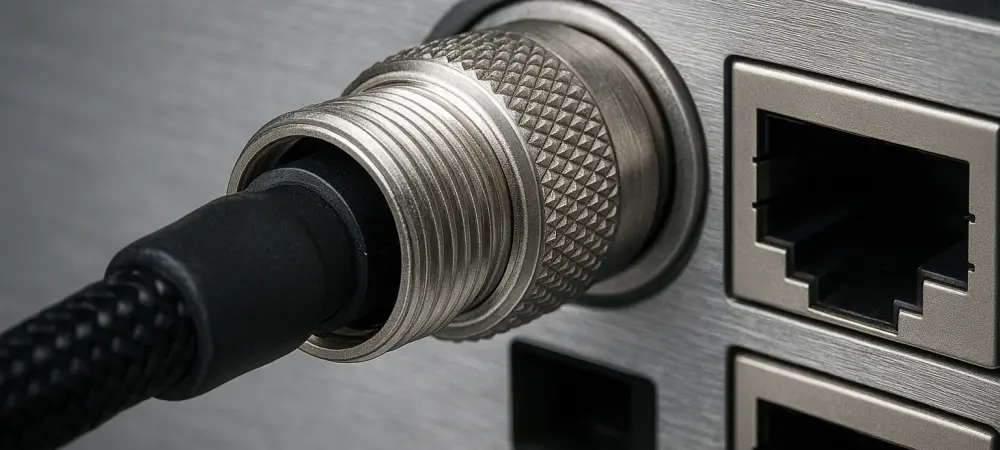
System integrators are increasingly turning to specialized M12 X-coded connectors to ensure stable data connections in high-vibration transit environments where traditional RJ45 jacks prove insufficient. This shift represents a broader realization that standard networking gear often crumbles under the physical and logistical demands of 2026’s hyper-connected landscape. As the Industrial Internet of Things (IIoT) expands into every corner of urban planning and automated manufacturing, the reliance on generic, mass-produced switches has become a significant bottleneck. Organizations now recognize that a network is only as strong as its weakest physical link, and in the case of modern infrastructure, that link is frequently a connector or a chassis designed for a clean, static office rather than a moving rail car or a chemical plant.
Consequently, the role of Original Equipment Manufacturing (OEM) has moved beyond simple white-labeling to become a sophisticated engineering partnership. These collaborations are essential for building the resilient backbones required for real-time telemetry and public safety systems that cannot afford a single millisecond of latency. By focusing on bespoke hardware that integrates seamlessly with specialized software protocols, enterprises are bypassing the limitations of “good enough” technology in favor of systems built specifically for their unique stressors. This evolution signals a departure from the one-size-fits-all model that dominated previous hardware cycles, ushering in an era where architectural flexibility and physical durability are prioritized as core performance metrics for global digital growth.
Overcoming the Limitations of Off-the-Shelf Hardware
Engineering for Harsh Operational Environments
Standard commercial switches are generally designed for climate-controlled indoor environments, making them ill-suited for the rigors of heavy industry where heat and dust are omnipresent. In 2026, the demand for networking hardware in non-traditional settings—ranging from the high-temperature enclosures of solar farms to the sub-zero conditions of arctic mining operations—has rendered traditional enterprise gear obsolete. Custom OEM providers address these shortcomings by designing ruggedized hardware capable of operating in severe conditions, such as extreme temperature fluctuations, high humidity, and heavy vibration. These specialized devices utilize industrial-grade components and thermal management systems that do not rely on moving parts, which are often the first point of failure in dusty or humid zones. By eliminating fans and using specialized heat sinks, manufacturers can create sealed units that prevent the ingress of corrosive particles. This engineering focus ensures consistent network uptime in locations where environmental stressors are a constant threat to electronic stability, providing a level of reliability that off-the-shelf products simply cannot match. The move toward these hardened solutions reflects a growing industry-wide mandate to place high-speed data processing as close to the source as possible, regardless of how hostile that environment might be to sensitive circuitry. This shift is particularly evident in the deployment of edge computing nodes, where the proximity to industrial processes necessitates hardware that can survive without the luxury of a dedicated server room or active cooling.
Physical Design: Tailoring Form Factors for Transit Systems
Beyond mere temperature resistance, the mechanical integrity of these custom solutions plays a pivotal role in maintaining long-term connectivity in mobile or seismically active environments. Traditional RJ45 ports, while ubiquitous in office buildings, often fail in transit applications due to the constant jolting and vibration that can cause electrical contact interruptions or physical fatigue in the plastic housing. To solve this, OEM partners integrate high-retention connectors and reinforced chassis designs that can withstand the perpetual motion of autonomous trucking fleets and high-speed rail networks. These designs often support wide-temperature operations, ranging from -40°C to +80°C, and offer flexible mounting options like DIN-rail or compact footprints to fit into overcrowded control cabinets.
By tailoring the physical enclosure and port density to specific spatial constraints, organizations can deploy high-performance networking in previously inaccessible locations. This level of physical customization ensures that the hardware remains operational through years of mechanical stress, significantly reducing the maintenance overhead associated with replacing failed commercial-grade components. The result is a network infrastructure that is not just high-performing on paper but physically capable of surviving the realities of 2026’s industrial landscape. Such durability is not just a luxury; it is a foundational requirement for the safety systems and automated controls that define modern transportation and heavy industry, where a simple loose connection could result in catastrophic operational failure.
Intelligent Management and Software Flexibility
Network Reliability: Enhancing Performance through Custom Firmware
Beyond physical durability, the internal intelligence of a switch—its firmware and software management layer—is a vital component of the OEM value proposition that dictates how effectively a network can respond to stress. Modern networks in 2026 demand specialized Layer 2 and Layer 3 management capabilities that align with specific operational workflows, rather than generic enterprise protocols that may not prioritize the right traffic. Custom software allows providers to integrate proprietary routing protocols and localized dashboards, ensuring the hardware fits seamlessly into a company’s existing technological ecosystem while maintaining a user-friendly interface. This means that a transit authority can have a firmware package specifically tuned to manage the rapid handovers required as trains move between wireless access points. Network reliability is further strengthened through advanced features like Ethernet Ring Protection Switching (ERPS), which allows for sub-50ms fault recovery to prevent downtime during link failures. While some commercial switches offer basic redundancy, custom OEM firmware can be optimized for complex ring or mesh topologies that are common in distributed IIoT networks. This rapid recovery is critical in environments like automated warehouses, where even a momentary loss of connectivity can cause a fleet of robotic pickers to stop, leading to costly logistical delays. Additionally, custom firmware enables the implementation of advanced security measures, such as port-level MAC authentication and deep packet inspection, which are essential for protecting critical infrastructure from cyberattacks. By controlling the entire software stack, OEM providers ensure that vulnerabilities are patched quickly and that the software remains lightweight.
Power Management: Achieving Granular Control and Energy Efficiency
Effective power management has become a cornerstone of modern networking, especially as the number of PoE-dependent devices like IP cameras, sensors, and wireless access points continues to surge. Custom power management for Power over Ethernet (PoE) devices enables automated port-level reboots and real-time power allocation monitoring, which are essential for maintaining uptime in remote or unmanned locations. For instance, if a high-definition surveillance camera hangs, a custom-programmed switch can detect the lack of data traffic and automatically cycle the power to that specific port, performing a hard reboot without human intervention. This capability is invaluable for managing remote surveillance grids and IoT sensors, where manual intervention is often difficult and costly for technicians. Furthermore, OEM solutions can be designed with high-output PoE++ capabilities, delivering up to 90W per port to support power-hungry devices like motorized PTZ cameras or outdoor lighting systems. This eliminates the need for separate power injectors, simplifying the installation and reducing the number of potential failure points in the system. Energy efficiency is another area where custom OEM solutions provide a significant advantage over generic hardware by allowing for precise control over power consumption. Switches can be programmed with sophisticated “green” modes that disable ports during scheduled downtimes or reduce power output based on the length of the connected cable. In 2026, the ability to monitor and report on the power usage of every connected device provides a valuable data stream for optimizing facility-wide energy consumption and meeting sustainability targets.
Strategic Business Advantages and Market Entry
Global Compliance: Streamlining Production and Time-to-Market
For many technology brands and systems integrators, the financial and temporal costs of developing a proprietary hardware platform from scratch are often prohibitive, especially given the rapid pace of innovation. OEM partnerships offer a streamlined path to market by allowing brands to leverage pre-validated hardware architectures that have already undergone extensive research and development. This collaborative approach significantly reduces “time-to-market,” allowing companies to respond quickly to emerging industry trends without the burden of massive capital expenditure. In 2026, the ability to pivot and launch a new product line in months rather than years is a decisive competitive advantage that separates industry leaders from those struggling to keep up. Quality and regulatory compliance are maintained through a rigorous commitment to international standards, including CE, FCC, and RoHS certifications, which are mandatory for global distribution. Leading OEM manufacturers utilize advanced surface-mount technology (SMT) and conduct intensive 72-hour “burn-in” testing to ensure every unit can handle full-load operations in real-world scenarios. By providing comprehensive qualification test reports, these manufacturers ensure that the products are not only market-ready but also meet the highest benchmarks for reliability and safety. This is particularly important for companies entering regulated sectors like healthcare or transportation, where equipment failure can have serious legal and safety implications. This commitment to quality ensures that when a company puts its label on an OEM-produced switch, it is backed by engineering excellence.
Lifecycle Optimization: Building Long-Term Industry Value
Custom OEM solutions resolve the common issue of “feature overhead,” where customers pay for unnecessary functions found in generic equipment that may never be utilized in their specific application. Through Bill-of-Materials (BOM) optimization, manufacturers can strip away superfluous components and focus exclusively on the required ports and power modules, thereby reducing the total unit cost. This targeted approach also ensures a longer product lifecycle, as dedicated OEM partners provide sustained component sourcing and firmware maintenance for a decade or more. In industries like rail transport or municipal infrastructure, where hardware is expected to last fifteen to twenty years, the rapid obsolescence cycles of consumer-grade electronics are a significant and expensive liability.
OEM partners mitigate this by selecting industrial-grade components with long availability windows and by offering long-term support contracts that guarantee the availability of replacement parts. This ensures that the network infrastructure remains stable and supportable throughout its intended service life, providing a much higher return on investment compared to off-the-shelf alternatives. These specialized networking solutions are now foundational across diverse sectors, including smart transportation and public safety surveillance grids. The strategic value of these partnerships lies in their ability to deliver a product that is perfectly specified for the task, avoiding the pitfalls of over-engineered enterprise solutions.
Strengthening Infrastructure Resilience for Success
The transition toward custom OEM networking solutions has fundamentally reshaped how modern infrastructure was planned and executed during 2026. It became clear that the most successful projects were those that moved away from generic hardware in favor of ruggedized, purpose-built systems that could withstand physical and digital stressors simultaneously. To replicate this success, organizations should have prioritized early collaboration with manufacturing partners to define the specific environmental and software requirements of their deployments. Moving forward, stakeholders ought to conduct a thorough audit of their existing network nodes to identify points of vulnerability, particularly in high-vibration or extreme-temperature zones where standard RJ45 connections or fan-cooled units were traditionally prone to failure.
Investing in hardware with a locked Bill-of-Materials and long-term firmware support was proven to be the most effective strategy for ensuring the longevity of critical systems. By adopting a “rugged-first” mentality and leveraging the flexibility of custom software, enterprises successfully built networks that were not only efficient but also remarkably resilient. The lessons learned from this era emphasized that the true cost of a network is not the initial purchase price of the hardware, but the total cost of ownership across its entire operational lifecycle, including maintenance, downtime, and replacement. Organizations that recognized these factors early on were able to secure their data backbones against the unpredictable challenges of a dense and demanding industrial landscape, setting a new standard for infrastructure excellence.