

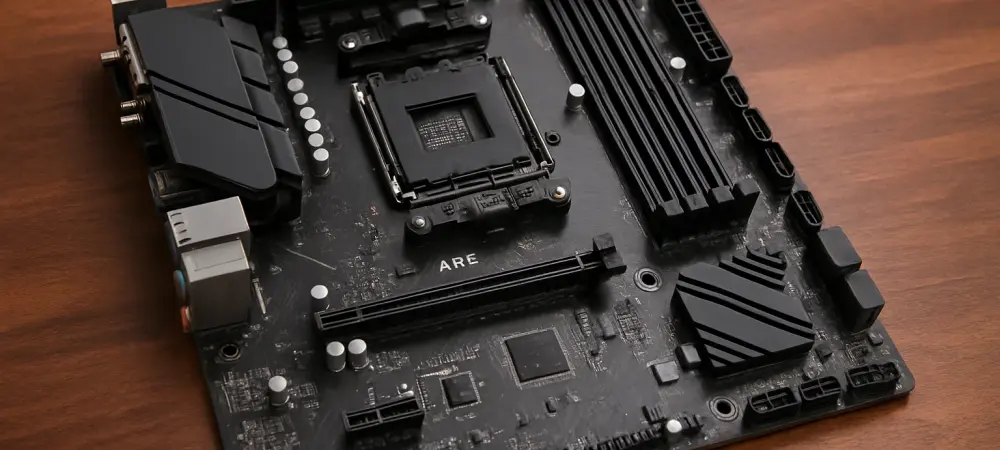
The transition to AMD’s latest AM5 platform has long been tempered by a significant financial barrier for many enthusiasts, as motherboard and DDR5 memory costs have kept the price of entry relatively high for budget-conscious system builders. However, a recent development from the Chinese market signals a potential seismic shift in platform accessibility. Manufacturer JGINYUE has introduced two new entry-level AM5 motherboards, the Aurora B850M Aurora-B and the B650EM Aurora, with an astonishingly low price point of under $70 US. This aggressive pricing strategy directly challenges the established market, where comparable motherboards in Western regions consistently command prices at or above the $100 mark. The arrival of such cost-effective options, even if currently localized, raises a critical question for the global DIY community: could this be the catalyst that finally democratizes the AM5 ecosystem, making next-generation performance attainable for a much broader audience? The implications are significant, potentially pressuring larger manufacturers to reconsider their pricing structures.
Unpacking the Impressive Feature Set
Despite their budget-friendly positioning, these mATX motherboards are far from barebones, boasting a feature set that defies their low cost and appears ready to handle a wide range of modern processors. Both the black B850M and white B650E models are constructed with a robust 8+2+1 phase DrMOS Voltage Regulator Module (VRM) design, a configuration more than capable of providing stable power to AMD’s Ryzen 7000 and 8000 series CPUs. Crucially, they also include support for the upcoming 9000 series processors, offering a degree of future-proofing that is rarely seen at this price tier. Perhaps the most surprising specification is the memory support. The two DDR5 DIMM slots are not only capable of housing up to 96 GB of total system memory but can also handle overclocked speeds reaching an impressive 8000 MT/s. This high-frequency memory capability is a premium feature, typically reserved for more expensive enthusiast-grade boards, and its inclusion here makes these JGINYUE offerings a remarkable value proposition for builders who want to extract maximum performance without a significant financial outlay.
Modern Connectivity and Market Implications
The forward-looking design of these motherboards extends beyond their processor and memory support, encompassing a full suite of modern connectivity and expansion options that ensure longevity and relevance. A key feature is the inclusion of a full-speed PCIe 5.0 x16 slot, providing maximum bandwidth for the latest and most powerful graphics cards on the market. Storage capabilities are equally impressive, with a total of three M.2 slots available for high-speed SSDs. One of these slots operates on the cutting-edge PCIe 5.0 x4 interface, enabling access to the fastest storage drives available. The boards also feature essential modern I/O, including a 2.5GbE LAN port for high-speed networking, a versatile USB Type-C connector, and support for Wi-Fi adapters. While their availability was initially limited to the Chinese domestic market, the existence of these boards sent a clear message to the industry. It demonstrated that the core technologies of the AM5 platform could be delivered at a fraction of the prevailing cost, establishing a new benchmark for value that had the potential to reshape consumer expectations and competitive dynamics on a global scale.