

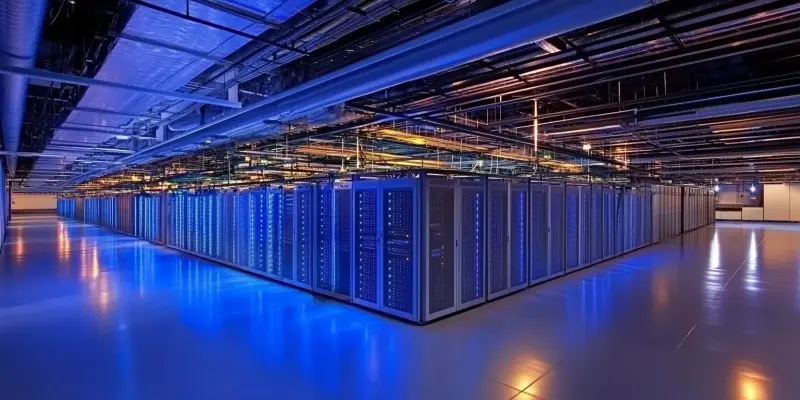
The anticipated rise in global copper demand is being driven primarily by the burgeoning need for data centers, which are critical to the advancement of artificial intelligence (AI) technologies. This article delves into the intricate relationship between the growth in AI tools and generative AI technology and the concomitant demand for copper, driven largely by the infrastructure requirements of data centers. Major players such as Microsoft, OpenAI, and Google, with tools like Copilot, ChatGPT, Gemini, and Dall-E, have revolutionized work, creativity, and interaction in modern society.
AI Tools and Data Centers
AI and generative AI tools are transforming various facets of work and lifestyle. The efficiency and innovation brought about by these tools require substantial computational power, primarily sourced from data centers. Data centers play a crucial role, providing the necessary infrastructure for rapid data processing, storage, and retrieval. This is essential for training and deploying sophisticated machine learning models and algorithms integral to AI functionalities.
The growth in AI tools has led to a marked increase in data center construction to support the soaring demand for AI and cloud computing capabilities. Over the past decade, this growth has burgeoned, with construction doubling in the United States in the last two years as major technology companies like Amazon, Alphabet, and Microsoft heavily invest in these infrastructures. Other regions, including China, Japan, and the European Union, are also seeing a significant upsurge. For instance, Microsoft announced an investment totaling $6.1 billion across Japan and the UK solely dedicated to enhancing data centers and cloud infrastructure.
This exponential growth in data centers is not just limited to tech giants building their proprietary infrastructures. The trend extends to colocation data centers, where multiple companies share the same data center facility to maximize efficiency and reduce costs. These centers are becoming an ideal solution for small and large enterprises to scale their AI capabilities without the massive capital expenditure needed to build their own cyber-infrastructure. Additionally, the proliferation of Internet of Things (IoT) devices is contributing to the data avalanche that these data centers manage, further straining the need for more robust and numerous data centers.
Copper’s Role in Data Centers
Copper is indispensable for data centers owing to its usage in power networks, circuit boards, and cooling systems. A study highlighted the enormity of copper use, with a single $500 million data center housing over 2,177 tonnes of copper. This underscores the substantial copper requirement, equating to approximately 27 tonnes per megawatt (MW) of applied power.
Data centers are immensely power-intensive, and their energy consumption necessitates significant copper usage for both the generation and delivery of electricity. Hyperscale data centers, which are becoming increasingly prevalent, demand 100 MW or more, aligning their annual electricity consumption with that of around 350,000 to 400,000 electric cars. This substantial energy requirement further emphasizes the critical role of copper in the operational needs of data centers.
The complexity and density of copper utilization in data centers are evident not only in their energy grids but also in their intricate cooling systems. Effective thermal management is crucial in these high-performance environments, where heat generated can disrupt functionalities and jeopardize hardware longevity. Copper’s superior thermal and electrical conductivity make it the ideal material for heat sinks, power lines, and circuitry within these colossal data behemoths. Moreover, as data centers strive to become more sustainable and energy-efficient, copper’s recyclability and durability add considerable value and alignment with green technology goals. These factors together reinforce copper’s pivotal role in both conventional and futuristic data center designs.
Digitalization Driving Copper Demand
The rising trend of digitalization, driven by the expansion of AI tools, directly influences the global copper market. The inherent correlation between data processing needs and copper usage forms an essential aspect of the digital era, as highlighted in BHP’s insights. The projection estimates a six-fold increase in copper usage in data centers by 2050, from approximately half a million tonnes annually to around 3 million tonnes. This massive escalation is analogous to the combined annual output of the world’s four largest copper mines today.
With the substantial energy consumption by data centers, there’s an expected rise in global electricity demand, increasing from 2% today to an estimated 9% by 2050. Some nations are already experiencing higher proportions; for instance, data centers account for a fifth of Ireland’s total electricity consumption. Despite this growth in energy consumption by data centers, the IEA emphasizes that other factors such as economic growth, electric vehicles, air conditioning, and electricity-intensive manufacturing remain significant drivers in the global electricity market.
The future forecast for copper demand also reflects political and economic dynamics, where national policies on digital infrastructure and renewable energy play critical roles. The European Union’s ambitious Green Deal and China’s Digital Silk Road initiative are examples where technological frameworks and environmental goals intersect, driving substantial copper requirements. As these global entities push for more energy-efficient, AI-enabled infrastructures, copper’s strategic importance only intensifies. Furthermore, emerging markets in Africa and Southeast Asia are poised to join this digital transformation wave, potentially adding millions of new data center capacities and thereby magnifying copper demand to unprecedented levels. This interconnectedness of technology drive and material supply highlights the multifaceted scope of copper in this digital age.
Advanced Technology and Copper Integration
The expected increase in global copper demand is largely fueled by the growing need for data centers, which are essential for advancing artificial intelligence (AI) technologies. This article explores the complex link between the rise of AI tools, including generative AI technology, and the resulting demand for copper, which is mainly driven by the infrastructure needs of data centers. Key industry players such as Microsoft, OpenAI, and Google have pioneered tools like Copilot, ChatGPT, Gemini, and Dall-E, transforming the way we work, create, and interact in our modern world. As AI continues to develop at a rapid pace, the demand for more robust and expansive data centers increases, thereby creating a higher requirement for copper. This is because copper is a vital component in the electrical wiring and cooling systems of these facilities, making it indispensable in the evolution of data technology. Thus, the simultaneous growth of AI and its supportive infrastructure is poised to significantly impact the copper market on a global scale.