

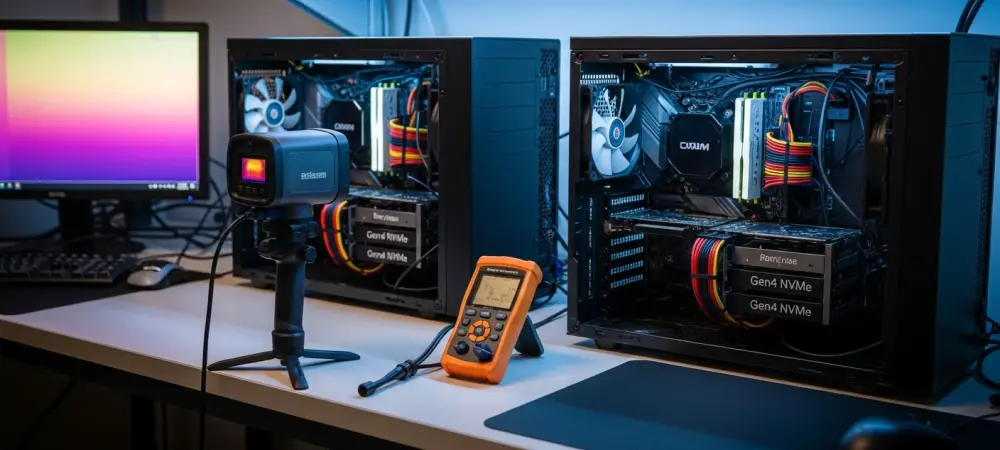
A New Kind of Small-Form Power
Small-form desktops long chased silence or speed but rarely both, until a quiet newcomer blurred that trade-off with a laptop-class 24-core CPU soldered onto a micro-ATX motherboard. The move shifted the center of gravity for compact workstations: fewer watts, more threads, and a simpler path to reliable cooling.
Colorful’s Battle-AX HM770M-K WiFi D5 V20 put Intel’s Core i9-13900HX—24 cores, 32 threads, up to 5.4 GHz, 36 MB L3—into a desktop shell rated at 55W, a fraction of typical tower draw. That foundation reframed what a modest case could accomplish without the fan roar or heat soak that often doomed dense SFF builds.
The Stakes for Builders and IT
Why it mattered came down to converging pressures: energy costs, desk space, and the need for sustained throughput in everyday rigs. Mobile-on-Desktop (MoDT) designs resurfaced as a pragmatic compromise—mobile efficiency joined to desktop expandability—just as DDR5 matured enough to supply bandwidth and capacity headroom.
For SFF enthusiasts and IT admins, the calculus changed. Compute density no longer demanded a loud, hot chassis. With two DDR5 DIMMs supporting up to 96 GB at up to 6400 MT/s, the platform enabled heavier project timelines—code compiles, media transcodes, light 3D, and lab virtualization—without resorting to full ATX.
Inside the Compact Workhorse
The board’s layout read like a purpose-tuned kit. One PCIe 4.0 x16 slot fit a serious GPU; a PCIe 3.0 x1 slot handled capture, networking, or control cards. Dual PCIe 4.0 M.2 NVMe drives split OS and scratch—or mirrored assets—while six SATA ports built cool, quiet storage pools for proxies and archives.
Connectivity took a utilitarian turn: WiFi 6, 1 GbE, four USB 3.2 Gen1, two USB 2.0, and three analog audio jacks, but no rear USB-C and no 2.5/10 GbE. The choice signaled a vendor strategy: prioritize CPU efficiency and memory speed, then skip premium I/O to keep thermals and cost in check until demand proved otherwise.
Signals From the Field
“Thermals, not cores, decide case size,” a small-form-factor designer said, summarizing years of constrained builds. The 55W HX profile shifted that equation; compared with 125W-class desktop parts of similar thread counts, cooling paths grew simpler, noise profiles dropped, and sustained clocks became easier to hold inside compact airflow.
What evaluators would watch remained consistent: VRM design and temperatures, all-core boost behavior under long renders, memory stability at 6400 MT/s with two DIMMs, and real throughput when both Gen4 NVMe slots ran hot. Early builder anecdotes pointed to quieter enclosures when PL limits were tuned a notch below peak for minimal performance loss.
The Path From Idea to Build
Next steps favored a quick-fit framework: match threads-per-watt to target workloads, plan GPU-first or CPU-centric thermals, and map storage with NVMe for scratch and SATA for bulk. Accepting the I/O trade-offs, many teams budgeted a PCIe x1 NIC or a front-panel USB-C adapter, and validated XMP with extended memory tests before rollout.
Procurement had hinged on unknowns—price and availability—so trial units and pilot deployments reduced risk while confirming acoustics and stability. With that groundwork, compact studios, edge nodes, and home labs moved ahead on a blueprint that kept noise down, heat controlled, and compute plentiful, turning a niche MoDT idea into a practical, daily driver.