

Introduction
The traditional barriers preventing widespread industrial adoption of private cellular networks are finally crumbling as specialized hardware becomes more modular and affordable for the average enterprise. For years, the promise of private 5G remained locked behind prohibitive costs and engineering complexities that only the largest global conglomerates could navigate. However, the telecommunications landscape is currently undergoing a radical transformation as the industry pivots from bespoke, high-cost installations toward standardized, repeatable solutions. This shift is essential for mid-sized organizations that require the reliability of cellular connectivity but lack the massive technical departments of Fortune 500 companies. The strategic collaboration between CloudRAN.AI and Firecell serves as a primary driver in this evolution, specifically targeting the democratization of private 5G across North America and Europe. By integrating advanced radio solutions into a cohesive ecosystem, these organizations aim to provide system integrators with a versatile hardware portfolio that functions as a single delivery model. This article explores the specific mechanisms through which this partnership simplifies access, the technical innovations designed for diverse environments, and the economic implications for the broader industrial market. Readers will gain an understanding of how modular design and streamlined logistics are reshaping the wireless utility landscape.
Key Questions Regarding the Partnership
Why Is This Strategic Shift Necessary for the Current Market?
Industrial environments have long relied on Wi-Fi for wireless connectivity, but the limitations of that technology become glaringly apparent in high-density or high-mobility scenarios. While Wi-Fi is inexpensive and easy to install, it often struggles with signal interference, limited range, and “handover” issues where moving devices lose connection between access points. Private 5G offers a robust alternative with superior security and predictable performance, yet the total cost of ownership has historically been too high for most regional factories or logistics hubs.
This partnership addresses those economic hurdles by focusing on hardware economics and deployment speed. By offering a standardized set of tools, the collaboration removes the need for system integrators to source disparate components from multiple vendors, which usually leads to increased engineering hours and troubleshooting. The goal is to transform private 5G from a niche luxury into a accessible utility that can be deployed with the same ease as legacy wireless systems. Moreover, the focus on repeatable designs allows integrators to scale their operations, moving from unique pilot projects to high-volume rollouts across various industrial sectors.
How Do All-in-One Radios Reduce the Complexity of Outdoor Networks?
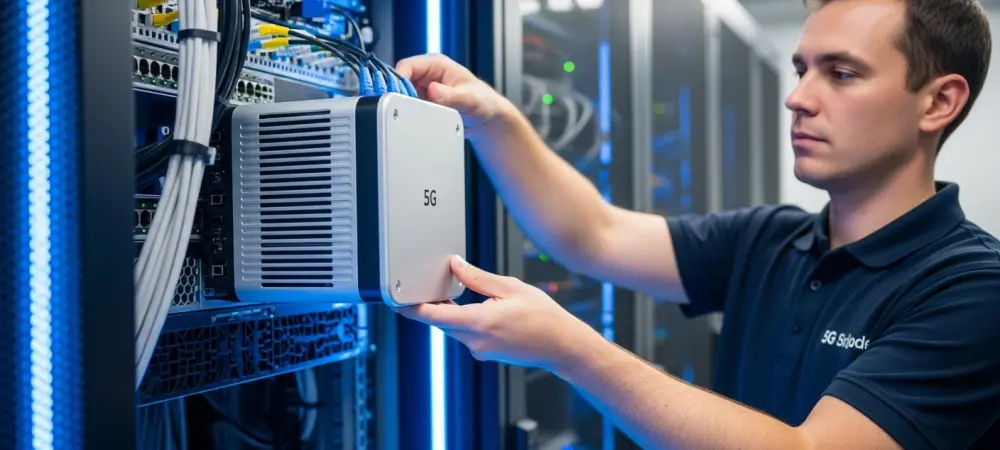
Deploying wireless coverage in expansive outdoor areas like loading docks, shipping yards, and industrial perimeters presents significant physical and logistical challenges. Conventional 5G architectures often require separate baseband units and radio units, necessitating extensive cabling, multiple power sources, and complex mounting configurations. This fragmentation increases the physical footprint of the installation and creates multiple points of potential failure that can be difficult to diagnose in harsh outdoor environments. The introduction of CloudRAN.AI’s 10W and 40W All-in-One (AiO) radios solves these issues by consolidating the baseband and radio unit into a single physical chassis. This streamlined architecture significantly cuts down the time required for on-site installation and reduces the amount of specialized hardware an integrator must manage. By simplifying the hardware stack, organizations can lower their upfront capital expenditure while ensuring a more reliable connection for outdoor operations. Furthermore, these high-power units provide the extended range necessary to cover large areas with fewer pieces of equipment, further driving down the overall infrastructure costs.
What Technical Innovations Support High-Mobility Robotics Indoors?
Modern warehouses and factories increasingly rely on Automated Guided Vehicles and autonomous robots that must remain connected while navigating through complex, partitioned spaces. Indoor environments are notoriously difficult for wireless signals because thick walls, metal shelving, and heavy machinery create reflections and “dead zones.” In a traditional setup, a robot moving between different radio coverage areas might experience a brief disconnection, known as a handover drop, which can trigger safety stops and lead to expensive operational downtime. To mitigate these risks, the partnership utilizes an Active Distributed Antenna System architecture paired with Pico Radio Units. This technical approach creates a unified coverage layer that allows devices to move seamlessly throughout a facility without the risk of signal interruption. Instead of treating each radio as a separate island, the system manages the network as a continuous fabric, ensuring that low-latency connectivity is maintained at all times. This level of reliability is a prerequisite for advanced automation, making it possible for mid-market players to adopt the same robotic efficiencies previously reserved for the most advanced smart factories.
Summary of Key Findings
The partnership between CloudRAN.AI and Firecell highlights a significant movement toward making private 5G a mainstream industrial tool. By providing a “single delivery model,” the collaboration assists system integrators in bypassing the traditional complexities of network design and hardware sourcing. The focus on All-in-One radios for outdoor use and Active DAS for indoor mobility ensures that specific industrial challenges are met with targeted technical solutions. Additionally, the standardization of hardware across different regulatory regions allows for global scalability, enabling companies to apply the same fundamental designs in both European and North American markets.
Conclusion and Forward-Looking Actions
The collaboration between these two entities successfully bridged the gap between complex carrier-grade technology and the practical needs of the enterprise sector. It was clear that the move toward hardware modularity provided a necessary blueprint for reducing the total cost of ownership in the private cellular space. This strategic alignment did more than just launch new products; it established a repeatable framework that allowed system integrators to deploy networks faster and with greater confidence. The industry observed a noticeable shift as private 5G moved away from experimental phases and became a standard component of industrial infrastructure.
For organizations looking to capitalize on these advancements, the next logical step involved evaluating existing wireless bottlenecks and identifying areas where high-mobility automation could improve efficiency. Decision-makers should prioritize solutions that offer a unified hardware stack to avoid the long-term maintenance burdens associated with fragmented systems. As the market continues to mature, staying informed about the intersection of spectrum availability and modular radio hardware will be crucial for maintaining a competitive edge. Embracing these simplified access models will likely be the deciding factor for enterprises aiming to fully integrate robotics and real-time data analytics into their daily operations.