

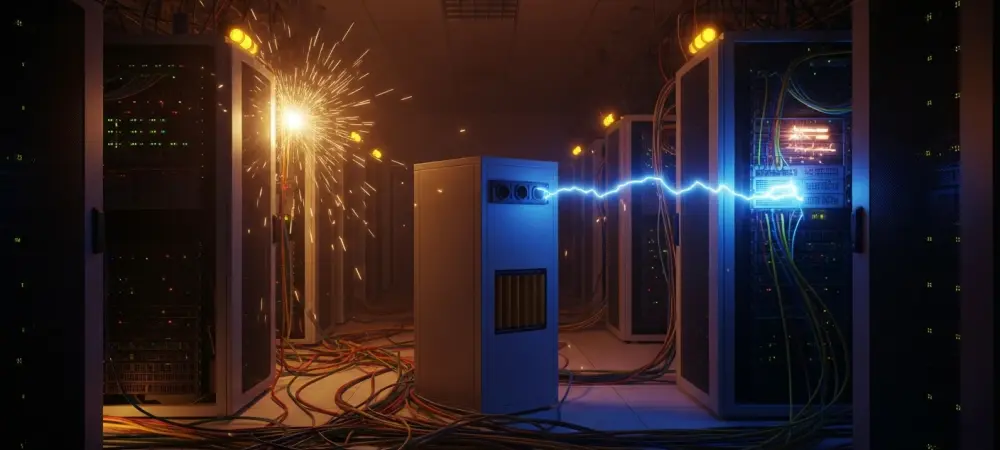
The intricate digital ecosystem that powers modern commerce and communication rests on a surprisingly fragile foundation, where a power disturbance lasting less time than a single heartbeat can trigger a cascade of systemic failures. While many organizations focus on preparing for prolonged blackouts, the more common and insidious threat is the momentary power “blip”—a flicker that is often just as catastrophic. These brief interruptions are long enough to cause server crashes, disrupt critical workloads, and initiate a lengthy and costly recovery process. Understanding this vulnerability is the first step toward building true resilience. This guide explores the critical concept of Voltage Ride-Through (VRT), addresses the inherent “switchover problem,” and outlines the essential technologies that ensure absolute operational continuity in the face of an unstable power grid.
The Hidden Threat: Why Milliseconds of Power Loss Matter
The sensitivity of modern IT hardware transforms minor grid fluctuations into major operational incidents. Servers and networking equipment operate on precise power specifications; a voltage sag or momentary interruption forces an immediate shutdown and reboot. Unlike a simple desktop computer, a data center server reboot is a complex, time-consuming process that can disrupt dependent applications and services across the entire network. This ripple effect means a single power blip can halt business operations, corrupt data in flight, and require hours of work from IT teams to restore services, far outweighing the duration of the initial event itself.
Consequently, building a power infrastructure capable of navigating these transient events is non-negotiable for any mission-critical facility. The core challenge lies in seamlessly transitioning from a failing grid to a backup power source without creating a power gap. This is where the principle of Voltage Ride-Through becomes paramount. A robust VRT strategy ensures that IT equipment never experiences an interruption, effectively making the data center immune to the grid’s volatility. The following sections detail the technologies and strategies that make this level of resilience not just possible, but a standard best practice.
The VRT Advantage: Ensuring Uptime and Protecting Assets
Connecting sensitive, high-value data center equipment directly to the primary electrical grid introduces an unacceptable level of operational risk. The grid is not a perfectly stable utility; it is a dynamic system prone to voltage sags, surges, brownouts, and frequency variations caused by everything from weather events to shifting industrial loads. For a data center, each of these fluctuations represents a direct threat to uptime and hardware integrity. A comprehensive VRT strategy mitigates this risk by decoupling the IT load from the raw, unfiltered power of the utility grid.
The foremost benefit of this approach is Operational Resilience. VRT technology is specifically designed to solve the “switchover problem”—the momentary power gap created when an automated transfer switch moves the load from a failing grid to a backup source. By providing an instantaneous, secondary power source, a VRT system bridges this gap, ensuring the servers never lose power. This prevents the costly reboots and system crashes that define downtime, allowing the data center to ride through the disturbance as if it never happened.
Moreover, a VRT strategy delivers crucial Equipment Protection and tangible Cost Savings. The same systems that provide ride-through capability also act as power conditioners, smoothing out voltage spikes and sags before they reach the servers. This buffering effect protects delicate circuitry from damage, extending the lifespan of expensive hardware. Ultimately, this proactive approach is far more cost-effective than a reactive one. The investment in VRT infrastructure pales in comparison to the immense costs associated with system recovery, data restoration, lost revenue, and damage to brand reputation that follow a preventable outage.
Building a Resilient Power Foundation: Key Strategies and Technologies
Achieving true power resilience requires a multi-layered defense, where each component serves a distinct but complementary purpose. This approach ensures that the data center is protected against everything from a millisecond-long voltage sag to a multi-day grid outage. Implementing a robust VRT capability is not about a single piece of equipment but about designing an integrated system that provides an instantaneous response for short-term events and sustained autonomy for long-term failures.
The First Line of Defense: Implementing an Uninterruptible Power Supply (UPS)
The Uninterruptible Power Supply (UPS) is the foundational technology for any VRT strategy. Its role is twofold and indispensable. First and foremost, it provides immediate, zero-transfer-time power from its internal batteries the instant an anomaly is detected on the utility line. This function is the very essence of VRT, creating the seamless bridge that prevents servers from ever experiencing a power loss during a short-term disturbance. Beyond its battery backup function, the UPS continuously conditions the power flowing to the IT load. It takes in the often “dirty” power from the grid, filters out noise and fluctuations, and delivers a clean, stable, and precise electrical waveform to the sensitive equipment. This dual functionality makes the UPS the primary guardian of both uptime and hardware health, serving as an essential buffer between the unpredictable grid and the critical data center environment.
Real-World Scenario: Averting a Server Crash During a Brownout
Consider a scenario where a nearby industrial accident causes a severe voltage drop, or brownout, across the regional power grid. In a facility without a proper VRT strategy, every server would instantly detect the under-voltage condition and crash, triggering a facility-wide outage. However, in a data center equipped with a UPS, the system’s internal logic would detect the voltage sag in milliseconds. It would immediately disconnect from the unstable grid input and switch to its batteries, continuing to supply perfect power to the IT load without interruption. The servers would remain completely unaware of the external power issue, and operations would continue seamlessly.
The Gold Standard: Integrating Backup Generators for Long-Term Autonomy
While a UPS provides the critical instantaneous response needed for VRT, its battery runtime is inherently limited, typically lasting only minutes. For protection against prolonged outages, a multi-layered strategy that pairs the UPS with on-site backup generators is the industry’s gold standard. This integrated system combines the immediate failover of the UPS with the long-term power generation of a generator, creating a comprehensive solution for complete power autonomy.
In this configuration, the two systems work in perfect concert. When a grid failure occurs, the UPS instantly takes over the full IT load, drawing from its battery reserves. This action provides the crucial ride-through window—the vital seconds or minutes needed for the automated transfer switch to signal the generators to start, stabilize, and prepare to accept the building’s load. Once the generator is online and producing stable power, the UPS seamlessly transitions from battery power to generator power, recharging its batteries while continuing to protect and condition the power for the IT equipment.
Real-World Scenario: Seamlessly Overcoming a Complete Grid Failure
Imagine a severe storm that downs power lines, causing a complete and extended grid failure. In a facility with an integrated UPS and generator system, the event would be almost anticlimactic. The moment utility power was lost, the UPS would instantly engage its batteries, keeping the entire data center fully operational. Within 30 to 60 seconds, the on-site generators would have automatically started and synchronized. The transfer switches would then shift the facility’s load from the UPS batteries to the generators. From that point on, the data center could operate independently for as long as its fuel supply lasted, whether for hours or days, with zero downtime or disruption to its critical workloads.
Final Verdict: Is Your Data Center Truly Prepared?
The analysis presented in this guide demonstrated that a data center’s vulnerability lies not only in long-term blackouts but, more critically, in the momentary power disturbances that plague modern electrical grids. It was established that true operational resilience is achieved not by simply having a backup plan but by ensuring a seamless, instantaneous transition between power sources. A multi-layered VRT strategy, anchored by a UPS and supported by backup generators, was identified as the essential framework for guaranteeing this continuity.
For data center operators, IT managers, and business leaders, the conclusion was clear: any organization where uptime is non-negotiable must move beyond rudimentary backup plans and invest in a robust VRT solution. Before implementation, careful consideration was advised for calculating total load requirements, determining necessary battery runtime to bridge the generator startup gap, and planning for ongoing system maintenance. This strategic investment was positioned not as a cost but as a fundamental pillar of modern business continuity, protecting critical assets and ensuring the data center can survive any power event, no matter how brief.