

Dominic Jainy brings a wealth of knowledge from the high-stakes world of machine learning and blockchain to the consumer tech arena. His unique perspective allows us to look beyond the sleek aluminum frames and see the complex integration of hardware and software. Today, we are diving deep into the Honor Watch 6, a device that appears to rewrite the rules of wearable endurance and ergonomics. We will discuss the remarkable leap in energy density that allows for a month of battery life, the high-brightness display designed for the elements, and how specialized AI-driven sports tracking is changing the game for casual and professional athletes alike.
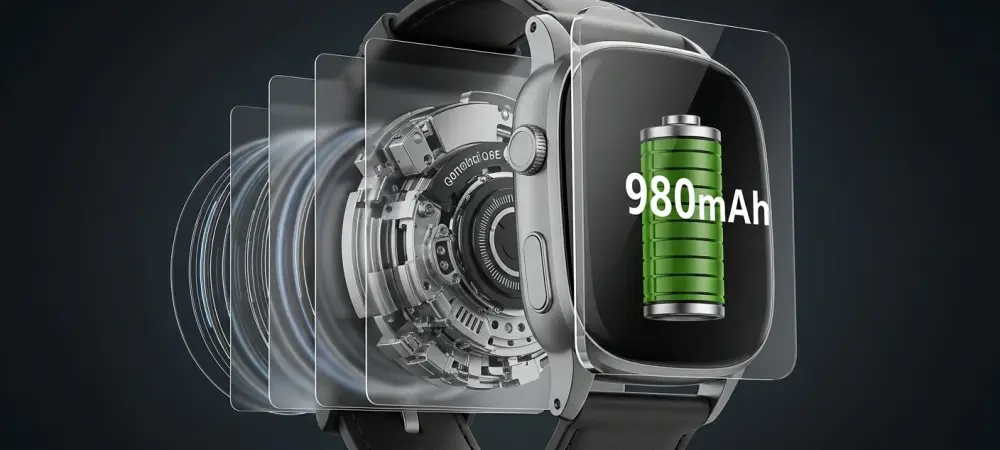
The most striking feature of the Honor Watch 6 is the massive 980mAh battery packed into a frame that is just 10.8mm thick. From an engineering standpoint, how significant is this achievement when compared to previous generations or current competitors?
It is genuinely staggering because typical 46mm watches usually plateau at around 500mAh, yet Honor has nearly doubled that capacity in a slimmer frame. To put it into perspective, the previous Honor Watch 5 Ultra was actually thicker at 11.4mm and heavier at 52g, but it only carried a 480mAh cell. Even the Xiaomi Watch 5, which is a bulky 12.3mm thick and 56g, still falls short of this mark with its 930mAh battery. By utilizing a recycled aluminum alloy and 316L stainless steel body, they managed to keep the weight down to just 41g while providing enough juice for 35 days of typical usage. This balance of a slender 10.8mm chassis and massive energy density represents a major shift in how we think about internal hardware stacking in wearables.
The display technology seems to be a major focus here, particularly with the 3,000 nits peak brightness and the “Racing Dashboard Design.” What does this mean for users who are often frustrated by screen visibility in harsh conditions?
A 3,000-nit peak brightness is essentially professional-grade, ensuring that the 1.46-inch round display remains perfectly legible even under the blinding midday sun. The “Racing Dashboard Design” adds a sense of precision with its beveled edges, but the real innovation is in the touchscreen functionality that works flawlessly even with wet fingers. This is a game-changer for someone running through a rainstorm or sweating during a heavy workout, as you won’t have to struggle with an unresponsive glass surface. Furthermore, the inclusion of wrist-twist gestures means you can silence alarms or manage calls without even touching the screen, which feels incredibly intuitive when your hands are full or dirty.
With over 120 sports modes and a dual-band “six-star” GPS system, the watch seems geared toward serious outdoor enthusiasts. How do the specialized tracking features, like the AI coach for trail running or football heat maps, enhance the training experience?
The integration of a “six-star” GPS is vital because it pulls data from multiple constellations like Galileo and BeiDou, providing rock-solid positioning even in dense forests. For those into specific sports, the data isn’t just surface-level; the football mode generates trajectory maps, while badminton players get specific smash speed reports to analyze their power. The AI coach in Trail Running mode is particularly impressive, as it breaks down distance and climbing metrics in real-time to help you pace yourself during a steep ascent. Having 4GB of onboard storage for maps further ensures that you can navigate safely on the trail without needing to constantly check a tethered smartphone.
Honor is touting its IntelliSense technology and the Quick Health Scan as superior alternatives to standard sensors. What makes this approach to health monitoring different from what we see in the wider market?
The IntelliSense system is designed to offer a much richer and more uniform signal than the typical PPG sensors found in most mid-range wearables. This leads to more accurate heart rate and blood-oxygen readings, which are then compiled into a comprehensive daily health report you can review as soon as you wake up. The Quick Health Scan provides an on-demand analysis that feels much more like a cohesive snapshot of your well-being rather than just a collection of random, disconnected data points. While it runs the proprietary MagicOS instead of Wear OS, the compatibility with Android 9.0 and iOS 15.1 ensures that these advanced health features are accessible to almost any smartphone user regardless of their ecosystem.
Considering the launch price starts as low as €170 during the first month, how do you see this device impacting the competitive landscape for high-end smartwatches?
At that €170 or £150 promotional price point, the value proposition is almost unbeatable, especially when you consider the massive €80 discount off the regular €250 price. You aren’t just getting a watch; the bundle includes a pair of Honor Choice Earbuds Clip worth £60, which sweetens the deal significantly for those who subscribe early. Even at the standard retail price for the Twilight Brown leather version at €270, the 35-day battery life alone puts it in a different league than most competitors that require daily charging. It forces other manufacturers to reconsider their pricing strategies, especially when Honor is offering premium materials like 316L stainless steel and recycled aluminum at these aggressive price points.
What is your forecast for the evolution of battery life in wearables over the next few years?
I believe we are entering an era where the “weekly charge” will become a thing of the past, replaced by the expectation of monthly endurance like we see with this 980mAh unit. As we see more efficient proprietary operating systems like MagicOS competing with power-hungry platforms, manufacturers will likely prioritize extreme energy density to keep devices under that 11mm thickness mark. We will probably see a push toward even more specialized AI sensors that consume less power while providing more granular biometric data. Ultimately, the goal is a device that stays on your wrist and out of the charger, making the technology truly integrated into our daily lives without the anxiety of a dying battery.