

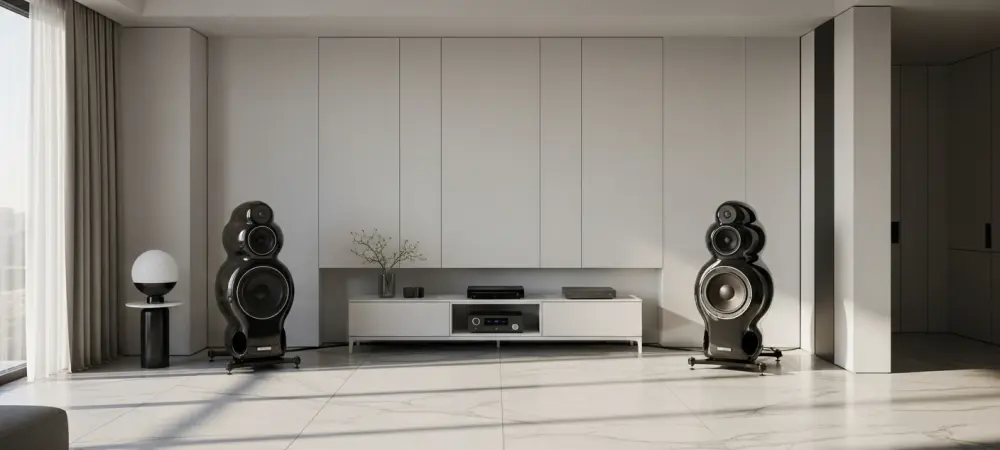
The pursuit of acoustic perfection often feels like chasing a ghost, yet the sudden silence in a crowded exhibition hall usually signals that something monumental has finally arrived. The introduction of a flagship loudspeaker is never merely a product launch; it is an argument for how music should be experienced in its purest and most unfiltered form. As technology evolves, the distance between a live performance and a recording continues to shrink, driven by the relentless innovation of engineers who refuse to accept the current limitations of hardware.
This evolution has reached a new crescendo with the latest offering from a brand that has long served as the gold standard for high-fidelity sound. The 801 D5 represents more than a simple technical update; it is a statement of intent for the next decade of audio reproduction. By addressing the subtle interference that often plagues high-output systems, this model seeks to provide a level of clarity that transforms a standard listening room into a hallowed space of sonic discovery.
A Sixty-Year Milestone: Debuting at High End Vienna 2026
The High End Vienna trade show served as a high-stakes arena for the global debut of the Bowers & Wilkins 801 D5. Instead of relying solely on its formidable reputation, the manufacturer utilized its 60th anniversary to showcase a design that pushes the boundaries of cabinet stability and driver integration. This flagship model serves as the vanguard for the D5 series, a collection of speakers designed to provide the same level of precision found in elite recording studios while maintaining an accessible elegance for the home.
The atmosphere at the Vienna event reflected the gravity of this release, as industry professionals and enthusiasts gathered to witness the culmination of six decades of research. The 801 D5 was positioned not just as a successor to previous models but as a radical reimagining of what a reference-grade loudspeaker can achieve. With its official release slated for September 9, the expectation surrounding this model remains immense, as it carries the burden of proving that physical engineering still holds the key to superior sound.
The Enduring Prestige of the Diamond Series Legacy
Understanding the significance of the 801 D5 requires an appreciation for the Diamond Series heritage, a lineage that has become synonymous with transparency and high-frequency extension. For many years, the presence of these speakers in a studio was a guarantee of a neutral, uncolored soundstage. The D5 series continues this tradition by refining the use of industrial diamonds in its tweeters, ensuring that even the most delicate high-frequency details are rendered without distortion or unwanted harshness.
In a market where boutique manufacturers often prioritize eccentric aesthetics over acoustic science, the 801 D5 remains a bridge between professional necessity and luxury lifestyle. It addresses the modern listener’s demand for equipment that can handle the massive dynamic shifts of high-resolution digital files while also serving as a visual centerpiece. The legacy of the Diamond Series provides a foundation of trust, allowing the brand to experiment with bold new materials and structural configurations without losing its core identity.
Mechanical Mastery: Bracing, Damping, and Internal Refinements
The transition from the previous generation to the D5 series is characterized by a relentless focus on eliminating parasitic noise and internal resonance. A major breakthrough in this model is the implementation of Space Frame Bracing, a structural system that provides an incredibly stable internal environment for the drivers to operate. This rigidity ensures that energy is directed solely toward sound production rather than being absorbed and re-emitted by the cabinet walls, which often leads to muddied audio and lost detail.
Furthermore, the 801 D5 incorporates new Tuned Mass Dampers designed to neutralize unwanted vibrations at specific frequencies before they can impact the listening experience. Internal refinements extend to the electrical components as well, with completely overhauled crossovers and wiring harnesses that minimize signal loss across the spectrum. These upgrades ensure that the iconic Diamond Dome Tweeter receives an immaculate signal, allowing it to provide the effortless high-end sparkle that has long been the hallmark of the brand’s engineering philosophy.
Audio Fidelity in Action: Analyzing Texture, Resolution, and Scale
During initial demonstrations in Vienna, the 801 D5 proved it could handle both the delicacy of acoustic instruments and the raw power of modern electronic music. In a performance of Odetta’s “Hit or Miss,” the speakers rendered the texture of the acoustic guitar with a lifelike percussive quality, demonstrating a warm and disciplined tonality. The ability to distinguish between the subtle nuances of string vibration and the resonance of the guitar body highlighted a level of resolution that is exceptionally rare in even the most expensive high-end systems.
The stereo imaging was equally impressive during playback of Eric Clapton’s “After Midnight,” where the vocals remained direct and grounded in a precise phantom center. However, it was the presentation of Thom Yorke’s “Black Swan” that truly showcased the effectiveness of the new bracing system. The seismic low-frequency notes were delivered with a rhythmic agility that prevented the bass from pooling in the corners of the room, maintaining a clear and expansive soundstage even during the most complex and demanding rhythmic sequences.
Strategic Implementation: Matching Components for the Ultimate Listening Experience
To achieve the full potential of a speaker with this level of resolution, the surrounding audio ecosystem must be curated with extreme care. The demonstrations in Vienna utilized Mark Levinson amplification and Innuos streaming hardware, highlighting that the 801 D5 requires a clean, high-current power source to maintain its grip on the lower frequencies. For the enthusiast, this necessitates a holistic approach to the signal chain, where every component from the digital-to-analog converter to the speaker cables is chosen for its transparency and speed.
Room acoustics also played a vital role in realizing the “soul-shaking” bass and precise imaging that these speakers were capable of delivering. As the September 9 release approached, the industry recognized that the 801 D5 was not merely a speaker but a precision instrument that thrived best in a controlled environment. The technical success of this model was solidified through its ability to render complex textures with lifelike accuracy, proving that the D5 series effectively bridged the gap between scientific measurement and emotional resonance. This milestone suggested that the future of audio rested on a foundation of mechanical stability, as the emphasis on damping and structural integrity pointed toward a new era of absolute clarity.