

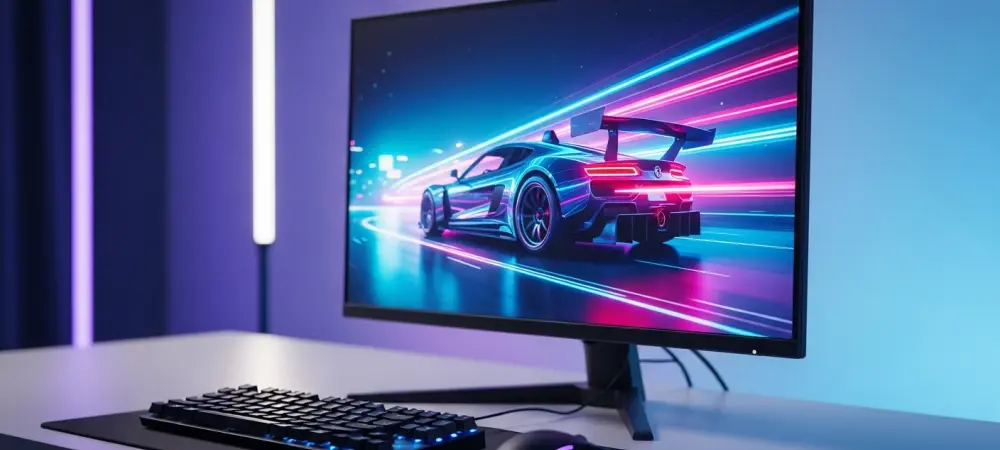
Breaking the Speed Barrier in Modern Display Technology
The pursuit of instantaneous visual feedback has led TCL CSOT to engineer a display that effectively erases the boundary between digital rendering and human perception. For years, professional gamers faced a binary choice: the immersive density of 4K resolution or the fluid responsiveness of ultra-high refresh rates. TCL’s latest project aims to eliminate this compromise by introducing a “dual-mode” monitor capable of an unprecedented 640 Hz refresh rate. This article explores the engineering behind this 4X switching capability and evaluates whether such extreme speeds can truly transform the professional gaming landscape or if we are reaching a point of diminishing returns.
The Evolution of Motion Clarity and Resolution
To understand the significance of a 640 Hz panel, one must look at the trajectory of the monitor industry over the current decade. Historically, the jump from 60 Hz to 144 Hz was a revelation, providing the smoothness necessary for the rise of modern e-sports. As hardware became more powerful, 360 Hz became the benchmark for elite play. However, as resolutions climbed toward 4K, maintaining these high speeds became a bottleneck. The industry shifted toward “dual-mode” displays—panels that allow users to toggle between high-fidelity visuals for cinematic games and high-velocity performance for shooters. TCL’s entry represents a massive leap forward, moving beyond standard doubling to a quadruple-speed configuration.
Analyzing the Impact of 4X Refresh Rate Switching
The Engineering Marvel of Dual-Mode Functionality
At the heart of TCL’s innovation is the 4X switching capability. While most dual-mode monitors on the market currently only double their refresh rate when dropping resolution—such as moving from 160 Hz at 4K to 320 Hz at 1080p— TCL is aiming for a 640 Hz output at 1080p. This leap is technically demanding, requiring advanced controller boards and panel synchronization to ensure every frame is delivered with surgical precision. By allowing users to switch from a 4K creative workstation to a 640 Hz gaming rig at the press of a button, TCL positions this monitor as a “do-it-all” solution for enthusiasts who refuse to compromise on any front.
Navigating a Highly Competitive Hardware Market
TCL is not developing this technology in a vacuum; they are entering a fierce refresh rate arms race. Other manufacturers are already pushing boundaries, with HKC recently teasing an 800 Hz FHD monitor and ASUS introducing 3X switching in its premium lineups. This competition suggests a consensus among tech leaders: consumers now prioritize hardware flexibility. The challenge for TCL will be differentiating its 640 Hz offering from these competitors. Success will likely depend on more than just the raw number on the spec sheet; factors like input lag, motion blur reduction, and the seamlessness of the transition between modes will determine which brand wins the favor of professional players.
Addressing Technical Hurdles and Panel Speculation
Despite the excitement, several technical questions remain unanswered, most notably regarding the panel type. While TCL CSOT is a leader in OLED production—leading many to hope for an OLED panel with near-instant response times—competitors have often relied on IPS technology to reach these extreme frequencies. Furthermore, achieving 640 Hz requires a high-end PC capable of pushing 640 frames per second, a feat currently reserved for a handful of titles like Counter-Strike or Valorant. There is also the matter of color accuracy; often, when panels are pushed to their speed limits, visual fidelity can suffer. How TCL balances these trade-offs will be critical for adoption.
How Extreme Refresh Rates Shape the Future of E-sports
The push toward 640 Hz signals a future where display technology may finally outpace the human eye’s ability to perceive incremental changes. While the difference between 60 Hz and 144 Hz is obvious, the gap between 360 Hz and 640 Hz is much subtler. However, for professional athletes where milliseconds determine victory, the reduction in “sample-and-hold” blur and the decrease in system latency are invaluable. We are likely to see a trend where “universal” monitors—those capable of both ultra-high resolution and ultra-high speed—become the standard for both home setups and tournament stages, eventually making single-purpose monitors obsolete.
Choosing the Right Display for High-Performance Environments
For professionals looking to stay ahead of the curve, the arrival of 640 Hz technology requires a strategic approach to hardware. It is essential to ensure that the rest of the system, particularly the GPU and CPU, can actually sustain the frame rates these monitors provide. Buyers should also look for monitors that offer robust “black frame insertion” or similar motion-blur reduction techniques, as these often have a more significant impact on perceived clarity than the refresh rate alone. Ultimately, if the primary focus is competitive play, prioritizing a monitor with low input lag and a high-speed mode, like the TCL 640 Hz, served as a sound long-term investment strategy.
Final Thoughts on TCL’s Disruptive Potential
The development of a 4X switching 640 Hz monitor was a testament to how far display engineering progressed by the mid-decade. By bridging the gap between 4K cinematic clarity and the extreme responsiveness required for professional e-sports, TCL set a new standard for hardware versatility. Stakeholders moved toward a market where the boundary between professional-grade equipment and consumer electronics continued to blur. As the industry advanced, the 640 Hz milestone served as the catalyst for a shift toward “all-in-one” gaming solutions that prioritized adaptive performance over static specifications.