

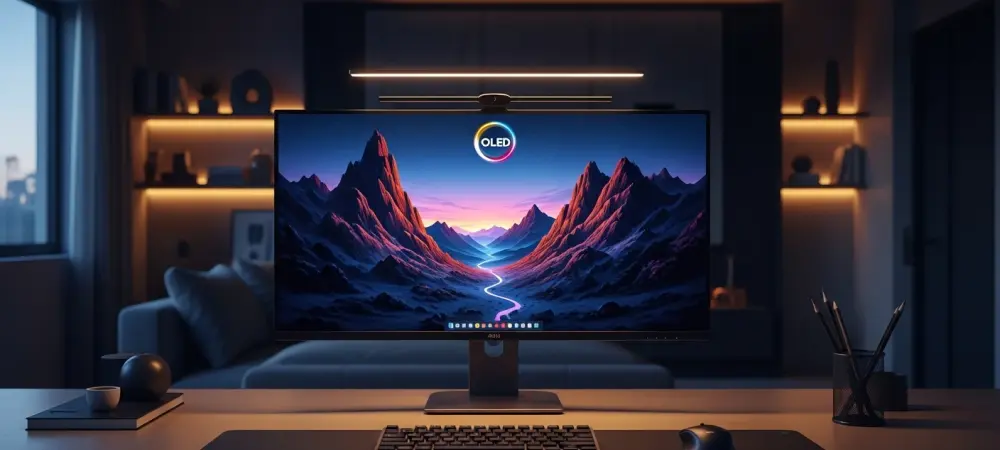
The persistence of a digital divide between ultra-high resolution and competitive speed has finally met its match in Samsung’s latest quantum dot organic light-emitting diode technology. For a long time, enthusiasts were forced to choose between the cinematic clarity of 4K and the blistering response times required for professional gaming. This technological stagnation ended when Samsung Display unveiled its 31.5-inch QD-OLED panel, which merges 3840×2160 resolution with a native 360Hz refresh rate. By integrating these two traditionally separate performance pillars, the manufacturer has effectively eliminated the compromise that has plagued the monitor market for years. This release signifies a massive shift in how display manufacturers approach high-end panels, suggesting that the era of choosing speed over beauty is rapidly closing. As this technology becomes standard, the expectations for high-end gaming and professional monitors will shift permanently toward this unified standard of excellence. This integration ensures that no detail is lost to motion blur while maintaining crisp resolution throughout.
Engineering Innovation and Performance Mastery
Technical Breakthroughs: Overcoming Data Processing and Circuitry Constraints
Achieving 4K resolution at 360Hz required Samsung to overcome significant technical barriers related to massive data throughput. Because a 4K screen contains roughly 8.3 million pixels, updating that image 360 times every second puts immense stress on the internal driving circuitry. Samsung’s engineers optimized these internal systems to ensure pixels charge and update fast enough to maintain a stable image, pushing past the previous 240Hz industry limit for 4K OLED displays. To handle this bandwidth, the implementation of advanced semiconductor materials was necessary to minimize signal interference and heat generation within the panel’s narrow chassis. This engineering feat involved redesigning the pixel layout to allow for faster electron movement, which effectively reduced the response time to a near-instantaneous 0.03ms. Such precision ensures that the high refresh rate does not lead to ghosting or artifacts that typically haunt high-frequency liquid crystal displays during intense motion sequences.
Performance Flexibility: Maximizing Fluidity with Dual-Mode Technology
To provide even more versatility for competitive gaming, the panel features a function that allows users to prioritize speed over resolution depending on the specific application. While it operates natively at 4K and 360Hz, the display can be switched to a Full HD mode to unlock a staggering 680Hz refresh rate for professional-grade eSports competitions. This flexibility addresses the unique needs of competitive players who often prefer lower resolutions to maximize their frame rates and minimize input latency during high-stakes tournaments. The transition between these modes is handled through intelligent scaling algorithms that preserve the integrity of the image without adding perceptible lag. Furthermore, this dual-mode capability ensures that the hardware remains relevant as graphics processing units continue to evolve, providing a buffer for future hardware generations. By offering both extreme resolution and extreme speed in a single unit, the design eliminates the need for separate monitors for work and play.
Strategic Market Evolution and Display Standards
Professional Integration: Expanding the Potential of Modern Workstations
Beyond the realm of gaming, the introduction of high-refresh QD-OLED panels has profound implications for creative professionals who require both color accuracy and motion clarity. Traditionally, video editors and digital artists had to sacrifice refresh rates to obtain the superior color reproduction of OLED panels, making it difficult to judge motion-heavy content accurately. With the advent of this 360Hz 4K technology, editors can now scrub through high-resolution timelines with a fluidity that was previously impossible, reducing eye strain and improving workflow efficiency. The quantum dot layer enhances the brightness and color volume of the display, ensuring that HDR content is represented with deep blacks and vibrant highlights that remain consistent even at high speeds. This combination makes the technology an ideal solution for studios that handle diverse tasks, from color grading to high-frame-rate visual effects production. Consequently, the industry is witnessing a shift where a single display can meet the rigorous demands of various high-end disciplines.
Industry Progress: Establishing New Benchmarks for Visual Excellence
The arrival of these high-performance panels fundamentally altered the trajectory of the display market by proving that speed and resolution were not mutually exclusive. Manufacturers moved toward a more integrated design philosophy, ensuring that the consumer no longer had to navigate a landscape of specialized hardware for specific tasks. This development encouraged software developers to optimize their engines for higher frame rates at 4K, leading to a broader adoption of these standards across the entertainment industry. For users looking to upgrade their current setups, the focus shifted toward adopting displays that offer this multifaceted performance to future-proof their investments. Looking forward, the emphasis on reducing power consumption while maintaining these high specifications became the next logical step for research and development teams. As these units became more accessible, the standard for a premium visual experience was redefined, setting a new expectation for what professional and consumer hardware could achieve in tandem.