

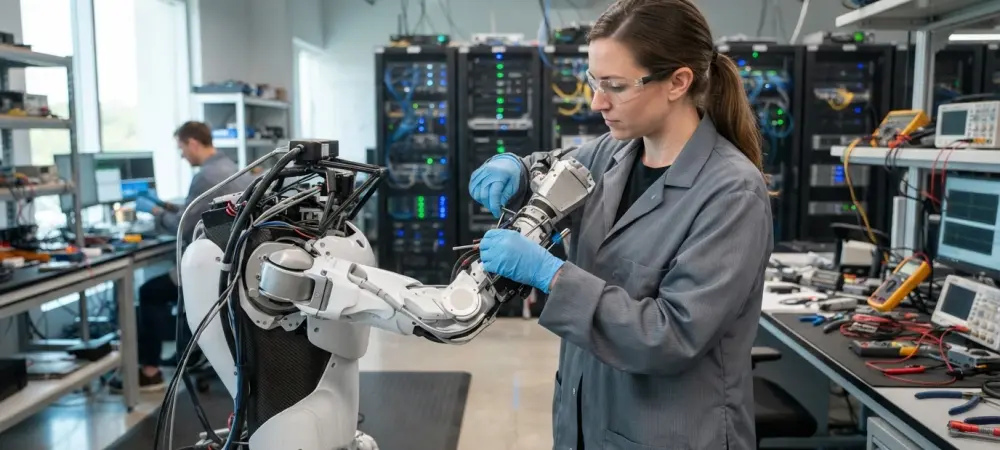
High-fidelity data captured from fleets of Gene.01 robots will be used to train specialized world action models capable of performing complex real-world industrial tasks. This initiative marks a definitive shift for Generative Bionics, an Italian robotics firm born from the Istituto Italiano di Tecnologia, as it begins constructing a 5,000-square-meter facility in Liguria. This site represents a pioneering integration of an AI data center with a dedicated humanoid robotics manufacturing hub. By localizing both the hardware production and the intelligence training within a single ecosystem, the company seeks to move humanoid machines out of laboratory environments and into the grit of large-scale industrial deployment. The facility is designed to serve as the nerve center for refining how robots interact with physical objects, ensuring that every movement is backed by massive datasets and high-speed processing capabilities.
Sovereignty: Local Growth
Strategy: Securing IP
The push for what leadership describes as European humanoid sovereignty is a direct response to the global race for dominance in artificial intelligence and mechanical engineering. By establishing a localized base for development, data collection, and model training, Generative Bionics aims to ensure that the intellectual property and critical infrastructure behind industrial robotics remain firmly on the continent. This strategy addresses mounting concerns regarding technological independence and the security of high-fidelity physical data used to train next-generation AI models. In an era where data is the most valuable resource, maintaining control over the information gathered from industrial floors is paramount for national and regional security. This approach prevents the leakage of sensitive manufacturing processes to external competitors while fostering a self-sustaining ecosystem of innovation that benefits European labor markets and technological standards in coming years.
Assets: Physical AI
Moving beyond the capabilities of traditional automation, the Gene.01 model is engineered to operate within the realm of Physical AI, where machines possess the nuanced intelligence required to navigate and manipulate complex industrial landscapes. Unlike stationary robotic arms that follow pre-programmed paths, these humanoid units are being trained to handle unpredictable variables and diverse material changes. The Liguria facility serves as the primary testing ground for these capabilities, allowing engineers to observe how the robots adapt to real-world friction, gravity, and spatial constraints. This evolution signifies a departure from rigid manufacturing protocols toward a more fluid and adaptive workforce. By prioritizing the development of robots that can see, reason, and act with human-like precision, the project sets the stage for a world where robotic labor is no longer confined to cages but is integrated into the heart of every modern factory floor in industry.
Innovation: Computing
Systems: AMD Helios
The operational success of this venture relies heavily on a sophisticated feedback loop between physical and digital environments, powered by a strategic partnership with AMD. The data factory utilizes the AMD Helios infrastructure, which is a high-performance, rack-scale system specifically optimized for intensive AI workloads. This hardware provides the necessary computational power to process both physical and synthetic data, facilitating complex simulations through digital twins. These virtual replicas of physical environments allow the team to run thousands of simulations simultaneously, testing diverse variables and potential failure modes that would be cost-prohibitive or dangerous to replicate in a physical setting. This rigorous validation process ensures that perception, control, and safety protocols are perfected before any unit is shipped to a customer. The integration of high-performance computing with physical robotics creates a seamless path to global deployment.
Future: Global Scale
With 70 million euros in funding already secured, the timeline for the Liguria site points toward partial operational status by the fourth quarter of 2027. This facility was intended to be the first in a global network, with subsequent plans including a second factory in Europe and a third located outside the continent to serve international markets. The project represented a significant pivot in the robotics industry, transitioning away from simple repetitive tasks toward a model where intelligent machines possessed sophisticated action intelligence. By grounding the development of humanoid robots in localized data centers, the initiative provided a blueprint for how regions could maintain technological leadership in a competitive global market. Ultimately, the integration of manufacturing and data processing under one roof established a new paradigm for industrial efficiency, ensuring that the next generation of humanoid workers was both capable and secure in every application.