

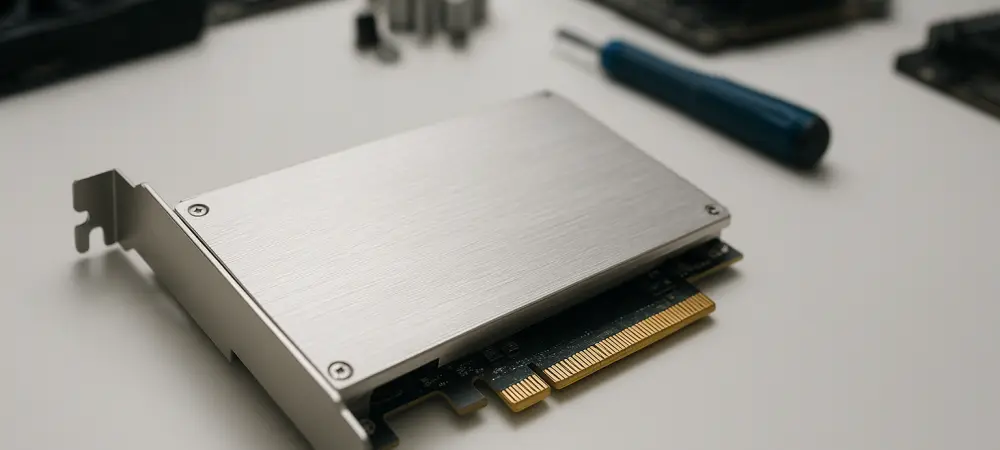
Intel is positioning its 1.3 petaflops FP8 compute card as a practical solution for businesses that need to run large-scale AI reasoning without overhauling their existing power grids. As the demand for generative AI shifts from the resource-intensive training of foundation models to the practical deployment of local inference, the hardware landscape is undergoing a radical transformation. This new GPU D-series, codenamed Crescent Island, represents a significant departure from traditional high-performance computing designs by prioritizing massive memory overhead above all else. By integrating 480GB of LPDDR5X memory, Intel has effectively shattered previous industry records, providing a unique alternative to the high-bandwidth memory architectures favored by competitors. This move suggests that the future of enterprise AI may not depend on the fastest possible compute cycles, but rather on the ability to fit massive datasets directly onto a single board. The strategic focus on capacity over raw speed reflects a deepening understanding of how large language models actually function in a production environment.
Strategic Pivot: Prioritizing Capacity Over Raw Bandwidth
The Memory Advantage: Breaking Records With LPDDR5X
The most striking feature of the Crescent Island architecture is its reliance on LPDDR5X memory, a technology more commonly associated with high-end laptops than massive data center accelerators. This choice allows Intel to pack an unprecedented 480GB of capacity into a single unit, vastly exceeding the 288GB found in the Nvidia Blackwell Ultra B300. While high-bandwidth memory like HBM3e offers faster data transfer rates, it comes with significant physical constraints and higher manufacturing costs. By opting for a high-density, power-efficient alternative, Intel ensures that organizations can store more parameters locally on the GPU. This strategy effectively reduces the need for frequent data swaps between the system RAM and the accelerator, which often creates a performance bottleneck in real-world inference tasks. This focus on capacity serves the growing need for specialized applications where memory size is the primary constraint for model output. Intel’s design indicates that for many enterprise users, having more room is more valuable than having a faster lane.
Scaling Enterprise AI: Trillion-Parameter Model Support
Utilizing 480GB of memory per card opens the door for a single GPU to host a large language model with up to 300 billion parameters. In a standard eight-GPU cluster configuration, this architecture can comfortably support models exceeding one trillion parameters, reaching a scale that was previously reserved for the world’s most expensive supercomputers. This breakthrough is particularly relevant for the inference-first phase of the AI lifecycle, where the goal is to serve responses to millions of users simultaneously. By providing 1.5TB/s of memory bandwidth, Intel strikes a calculated balance that provides enough speed for responsive interactions while maximizing the volume of data that can be processed at once. This approach challenges the notion that every enterprise needs the absolute peak bandwidth of liquid-cooled hardware, suggesting instead that a massive memory reservoir is often a more effective tool for the logistical realities of enterprise AI. It allows businesses to scale their operations without the constant threat of memory overflow during peak usage.
Operational Efficiency: Integration Within the Modern Data Center
Standardized Hardware: Air Cooling and PCIe Compatibility
Beyond the raw memory statistics, the D-series is designed to solve the physical challenges associated with modern AI hardware. Most top-tier accelerators require complex liquid-cooling systems and specialized racks that can handle extreme power draws, often exceeding 700 watts per card. Intel has engineered Crescent Island to operate within a much more manageable 350W power envelope, utilizing a standard PCIe form factor that relies on traditional air cooling. This design choice ensures that the hardware can be installed into existing server chassis without requiring a complete overhaul of the data center’s infrastructure. By fitting into the thermal and electrical profiles of standard enterprise environments, Intel provides a path for companies to scale their AI capabilities incrementally. This compatibility is crucial for mid-sized enterprises that lack the capital for exotic cooling solutions but still require high-capacity hardware to run advanced robotic or complex tasks. It makes high-end AI deployment a matter of modular upgrades.
Economic Feasibility: Reducing Barriers to Entry
The adoption of the D-series provided a clear blueprint for scaling AI reasoning without the logistical nightmares associated with more power-hungry alternatives. Organizations found success by focusing on model optimization and local hosting, which allowed them to maintain data privacy while reducing reliance on expensive cloud-based inference APIs. Moving forward, the industry learned that memory capacity is the true bottleneck for enterprise-grade intelligence, and solutions that addressed this directly proved to be the most resilient. Stakeholders were encouraged to audit their existing thermal and power budgets before committing to new hardware, ensuring that any expansion remained within sustainable limits. By embracing high-density memory architectures, businesses established a foundation for sovereign AI that balanced computational power with the practical constraints of utility grids. This strategy ensured that high-capacity AI was no longer a luxury for tech giants, but a viable tool for businesses scaling through 2026 and beyond. Leaders prioritized long-term versatility over short-term performance peaks.