

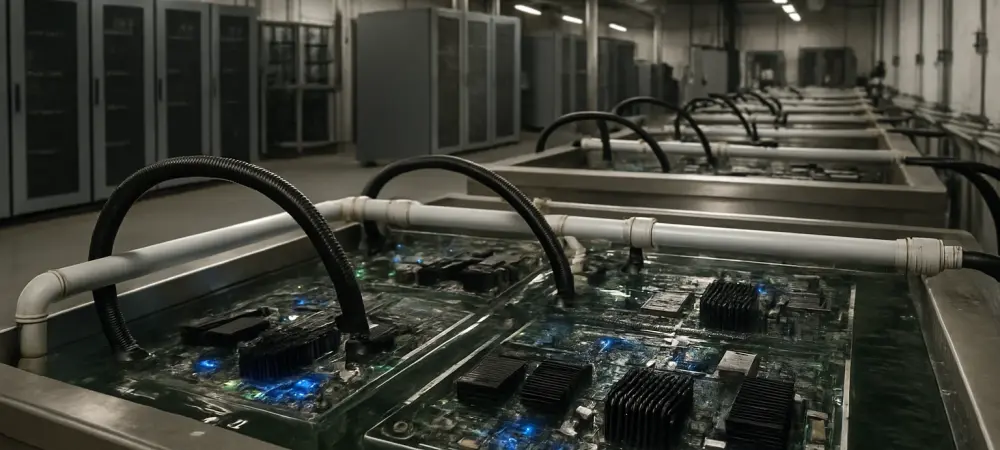
Did you know that data centers worldwide consume nearly 1% of global electricity, with cooling systems alone accounting for up to 40% of that energy demand? This staggering statistic underscores a critical challenge in the tech-driven erbalancing the exponential growth of computational needs with environmental sustainability. As climate concerns intensify alongside rising energy costs, the urgency for innovative solutions has never been greater. Immersion cooling, a cutting-edge technology that submerges IT hardware in thermally conductive liquids to dissipate heat, emerges as a transformative trend in this landscape. This analysis delves into the growing adoption of immersion cooling, showcases real-world applications, gathers expert insights, and explores its potential to redefine sustainable computing.
The Rise of Immersion Cooling in Computing
Growth and Adoption Trends
Immersion cooling has rapidly gained traction as a viable alternative to traditional air-cooling methods in data centers. Industry reports indicate that the global immersion cooling market is projected to grow at a compound annual growth rate of over 20% from the current year to 2030, driven by the increasing demand for energy-efficient solutions. This surge reflects a broader shift toward sustainability in high-performance computing environments, where energy consumption and carbon emissions are under intense scrutiny.
The technology’s appeal lies in its ability to significantly reduce energy usage. Studies suggest that immersion cooling can cut cooling-related energy costs by up to 50% compared to conventional systems, while also minimizing the environmental footprint of data centers. With major tech companies and academic institutions adopting this approach, the trend points to a future where sustainable practices are integral to IT infrastructure design.
This momentum is further fueled by regulatory pressures and corporate commitments to net-zero goals. As governments worldwide impose stricter energy efficiency standards, immersion cooling stands out as a practical solution that aligns with both economic and ecological priorities, setting a new benchmark for data center operations.
Real-World Implementation: Durham University Case Study
A pioneering example of immersion cooling in action can be seen at Durham University in the UK through its Immersion Cooling and Heat Storage (ICHS) Living Lab initiative. This project features a 50U XCI immersion cooling pod provided by Midas Immersion Cooling, with support from Vesper Technologies. The setup is designed to explore how this technology can integrate with seasonal heat storage to optimize computational efficiency while addressing environmental challenges.
The pod supports graduate students at Durham by handling some of the university’s most intensive computational workloads. Equipped with servers from Gigabyte and cooling fluids from Valvoline Global, the system demonstrates the practical benefits of immersion cooling in an academic setting. This initiative not only enhances research capabilities but also serves as a testing ground for sustainable IT practices.
Beyond this project, Durham University is advancing its computational infrastructure on a larger scale. The institution recently introduced the COSMA 8 supercomputer, boasting 67,584 processors and half a petabyte of memory, and is planning a new data center at Aykley Heads in County Durham to accommodate future supercomputing needs. These efforts highlight how immersion cooling fits into a broader vision of technological and environmental progress.
Expert Perspectives on Immersion Cooling’s Impact
Insights from industry leaders underscore the transformative potential of immersion cooling in sustainable computing. Scott Constable, Alliance Director at Vespertec, emphasizes that this technology addresses critical computational challenges while drastically cutting CO2 emissions. He views such deployments as a blueprint for data centers aiming to innovate responsibly in an era of escalating energy demands.
Similarly, Scott Sickmiller, CEO of Midas Immersion Cooling, highlights the importance of projects like Durham’s for expanding sustainable IT operations. He notes that this initiative marks a significant milestone in promoting high-performance research in the UK, showcasing how immersion cooling can support cutting-edge academic work without compromising environmental goals. His perspective reinforces the technology’s dual value in performance and sustainability.
A shared vision emerges among stakeholders, including Durham University, Vespertec, and Midas Immersion Cooling, focusing on harmonizing technological advancement with ecological stewardship. This consensus suggests that immersion cooling is not merely a trend but a foundational shift toward greener data center practices, with implications for both academia and industry.
The Future of Immersion Cooling and Sustainable Computing
Looking ahead, immersion cooling holds promise for further advancements that could amplify its impact on sustainability. One key area of development is heat recapture, as planned in the next phase of Durham University’s project. By reusing the heat generated from immersed hardware, data centers can enhance energy efficiency, potentially powering nearby facilities or heating systems, thus closing the loop on energy waste.
The broader implications for high-performance computing are significant. Widespread adoption of immersion cooling could slash carbon footprints across the sector, aligning data center operations with global climate objectives. This shift is particularly critical as digital transformation accelerates, increasing the demand for computing power while necessitating responsible energy use.
However, challenges such as high initial costs and scalability concerns remain. Despite these hurdles, the trajectory of adoption in academic and industrial settings suggests a positive outlook. If sustainability is not prioritized, the risk of escalating energy consumption could undermine technological progress, making innovations like immersion cooling essential for a balanced future in computing.
Conclusion: Paving the Way for Greener Computing
Reflecting on the journey of immersion cooling, its rise as a trend is evident through growing market adoption, impactful projects like Durham University’s ICHS Living Lab, and strong endorsements from experts who champion its dual focus on performance and sustainability. The exploration of future possibilities, such as heat recapture, further cements its role in shaping energy-efficient data centers. As a next step, institutions and industries are encouraged to invest in pilot programs and partnerships that test and refine immersion cooling solutions. By prioritizing scalable implementations and addressing cost barriers through innovation, the tech sector can take significant strides toward reducing its environmental impact. This collective effort lays the groundwork for a future where computing power and ecological responsibility go hand in hand, offering a model for sustainable progress.