

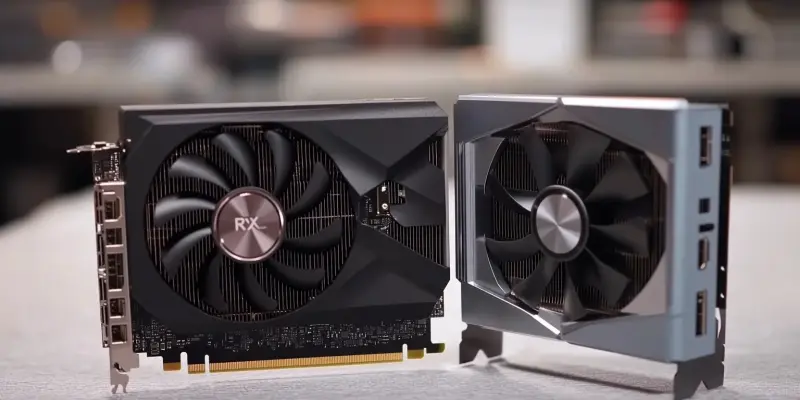
Considering the rapid advancements in AI and graphics technology, the potential for Nvidia’s RTX 3000 series GPUs to receive the Frame Generation feature could mark a significant shift in gaming performance. While currently exclusive to the RTX 4000 series, Frame Generation uses AI to enhance frame rates in games by creating additional frames. This potential expansion of capability was hinted at during a recent interview between Digital Foundry and Nvidia’s Applied Deep Learning Research VP, Bryan Catanzaro, emphasizing Nvidia’s commitment to maximizing the performance of older GPUs.
Technological Evolution of Frame Generation
Nvidia’s Optical Flow Hardware Accelerator
One primary technological element relevant to this possibility is Nvidia’s Optical Flow hardware accelerator, initially integral to the RTX 4000 series. This accelerator enhances Frame Generation capability by processing image data to estimate motion, thus enabling the creation of additional frames for smoother performance. However, the upcoming iteration of Frame Generation set to accompany the RTX 5000 series will pivot toward an AI-based solution, moving away from the Optical Flow accelerator altogether.
This evolution signifies a noteworthy transition, as the new Frame Generation model promises increased AI performance by leveraging Tensor Cores. Given that even the RTX 3000 series GPUs possess these Tensor Cores, albeit less advanced than their successors, it opens up the possibility for these older units to support the updated Frame Generation model. The new model’s design includes reduced VRAM usage and eliminates the need for the Optical Flow accelerator, further making it plausible for integration into the RTX 3000 series GPUs.
Tensor Cores and AI Performance
The ability to pivot from reliance on the Optical Flow accelerator to a purely AI-driven model that leverages Tensor Cores is a pivotal development. Tensor Cores, present in both the RTX 3000 and RTX 4000 series, although more advanced in the latter, handle computations required for AI-related tasks such as Frame Generation. This shift could neutralize the previous performance bottleneck posed by less advanced Tensor Cores in the RTX 3000 series.
Significant as it may be, the challenge lies in the relative weakness of Tensor Cores in the RTX 3000 GPUs. However, just the specter of this discussion indicates Nvidia’s genuine interest in extending this feature beyond its latest models. If successful, this pivot to AI-based Frame Generation could bolster the RTX 3000 series’ longevity, providing an enhanced gaming experience through improved frame rates and smoother gameplay, even without the hardware superiority of newer GPUs.
Implications for DLSS and Gaming Experience
Anticipated Improvements to DLSS 4
The advent of DLSS 4, expected to launch alongside the RTX 5080 and 5090, is set to offer further performance enhancements while focusing on reducing VRAM usage. DLSS technology, which incorporates deep learning to upscale lower-resolution images, already provides elements such as super-resolution, DLAA, and ray reconstruction to users of RTX 2000 and 3000 series GPUs. Integrating Frame Generation into this suite of features would mark a significant upgrade, as it would enhance the frame rates and visual performance dramatically.
For users of older GPUs who have already experienced benefits from DLSS 3, the potential inclusion of Frame Generation would mean a substantial gaming upgrade. This development would also indicate a trend where Nvidia continues to find ways to deliver advanced features to older hardware, ensuring longer product life cycles and broader accessibility to cutting-edge gaming technologies. It essentially opens the door for gamers to continue utilizing their current hardware while still enjoying almost the same performance enhancements as those with the latest GPUs.
Broader Implications for Gamers
Given the rapid advancements in AI and graphics technology, the potential for Nvidia’s RTX 3000 series GPUs to gain the Frame Generation feature could significantly impact gaming performance. Currently unique to the RTX 4000 series, Frame Generation utilizes AI to boost frame rates in games by creating additional frames, thus enhancing the gaming experience. This possible expansion of capabilities was hinted at during a recent interview between Digital Foundry and Nvidia’s VP of Applied Deep Learning Research, Bryan Catanzaro. Catanzaro highlighted Nvidia’s dedication to optimizing the performance of older GPUs, suggesting that the company is considering bringing this advanced feature to the RTX 3000 series. If implemented, this would allow a broader range of gamers to experience improved performance without needing to upgrade to the newest hardware. Such a move could democratize high-performance gaming, making advanced graphical enhancements more accessible and further solidifying Nvidia’s reputation as a leader in gaming technology.