

Security teams are staring at a blunt equation: whoever points capable AI at real context first writes the narrative of risk, and the loser merely reacts while dwell time compounds across code and cloud. The choice no longer sits between innovation and safety; it sits between acting now with owned knowledge or letting an adversary be first to discover the same cracks.
The Stakes: Who Moves First?
In Las Vegas, the question landed with the weight of a wager: will attackers or defenders seize AI’s edge first? This is not a theoretical arms race; it is a timing problem. If defenders use AI to probe their own systems before anyone else, discovery—and therefore tempo—belongs to them. If they wait, the same models will map the same weak joints, only from the outside in.
Yinon Costica, the co-founder of Wiz, pushed the line in plain terms: “Hack yourselves with AI.” It was less bravado than a playbook. The point was to compress the span from finding issues to fixing them, not by moonshot, but by turning the familiar motions of security work into machine-paced loops anchored in proprietary context.
The Nut Graph: Why This Moment Matters
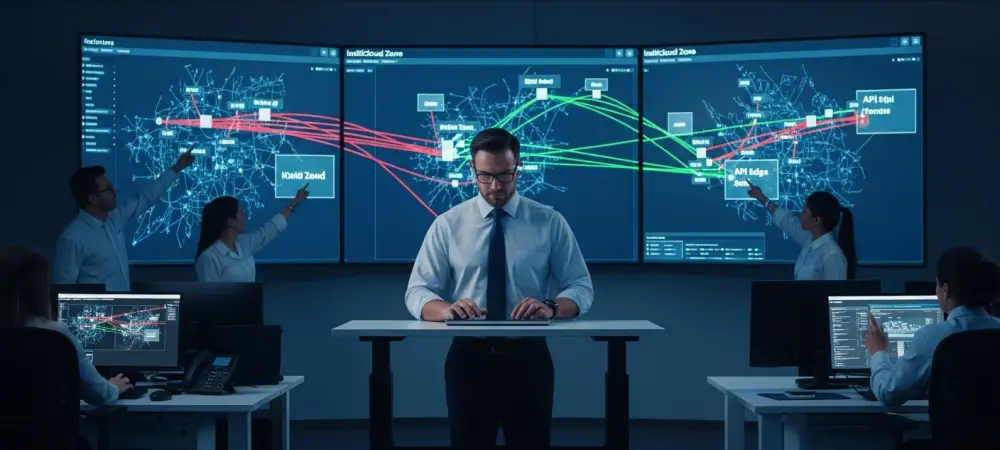
Context flips the script. Defenders hold architecture diagrams, repo histories, ownership maps, configuration baselines, data-flow charts—signals attackers rarely see. Feeding that into AI does more than accelerate scanning; it sharpens precision, ranking exposures by exploitability and business impact rather than theoretical severity. Speed has become the new control plane. Continuous, AI-directed probes beat quarterly assessments because risk drifts hourly across multicloud estates and API edges. Automation that routes, validates, and patches without long human queues is not a luxury; it is how control is asserted when workloads move faster than meetings.
Inside The Bet: Hack Yourself With AI
The wager gained heft with Google’s $32 billion acquisition of Wiz, the largest in Google’s history, and an early signal that consolidation can serve speed. The goal was not to rebadge tools, but to unify telemetry, analytics, and response while keeping multicloud reach intact. Costica’s message fit that frame: offense becomes defense when models see what owners see.
Practically, this meant turning AI loose where it has home-field advantage: exposed APIs, end-of-life edge gear, forgotten OT assets, sprawling IAM policies, and “vibe coded” services stitched together with AI help. By testing within guardrails, defenders could surface exploitable paths ahead of adversaries, then push fixes through pipelines already wired for change.
Agents In The ArenRed, Green, Blue
Wiz introduced three autonomous agents that mirror established functions. The red agent emulates real adversaries inside owned scope, running targeted penetration tests against high-risk surfaces and tagging each finding with exploitability and accountable owners. That focus narrows noise and creates urgency where it counts. The green agent handles the grind that stalls programs: triage. It de-duplicates, validates, and prioritizes findings against business impact, then routes with playbooked fix paths and SLAs. By collapsing the gap between detection and decision, it trims dwell time that historically let minor issues ferment into incidents.
The blue agent investigates at scale, building timelines, mapping blast radii, and correlating cloud, app-edge, and API signals. Containment steps are verified before hand-off to remediation, avoiding the ping-pong that costs hours when incidents spike. Together, the agents aim to automate end-to-end flow without uprooting existing workflows.
Consolidation With Choice: Google, Wiz, and the Ecosystem
Integration breadth underpinned the pitch. Google Security Operations and Mandiant Threat Defense formed the core connective tissue, while outer layers tied to Apigee, Cloudflare AI Security for Apps, and Vercel extended reach to API gateways and edge frameworks. The design signaled that visibility must follow traffic, not the other way around.
Crucially, Wiz kept a multicloud stance—AWS, Azure, Oracle, and Databricks—reflecting market resistance to lock-in. Portability across “agent studios” like AWS Agentcore, Azure Copilot Studio, Salesforce Agentforce, and Google’s Gemini Enterprise Agent Platform framed agents as guests in many houses, not tenants of one.
Governing Speed: AI-Native Software Lifecycle Security
As AI changes how software is made, guardrails have to ride alongside. Scanning AI-generated code pre-merge with suggested fixes meets developers where they work, catching injection points, insecure defaults, and permission missteps before they harden in production. “Vibe coded” services receive the same scrutiny, converting creative velocity into governed change. An AI bill of materials—AI-BOM—adds much-needed inventory: models, prompts, datasets, and generated artifacts. It surfaces shadow AI, blocks unknown components, and ties usage to policy. Agent-led remediation then orchestrates changes across repos, pipelines, and environments, shrinking manual handoffs that slow the clean-up loop.
How To Make It Real Now
Operationalizing the idea starts with a context backbone: map owners, dependencies, and data flows; centralize identity, asset, and config inventories; and define exploitability in business terms. With that in place, schedule bounded red-agent probes, let the green agent auto-triage and route, and ask the blue agent to confirm root cause and validate fixes in staging before release. Autonomy needs safety rails. Scope controls, rate limits, and change windows keep tests from tipping production. High-risk actions trigger human checkpoints, and every agent decision writes to an audit trail. Measured well—time to detect, to triage, to verify fixes; percent of issues closed without handoffs; noise reduction—progress becomes visible and defensible.
The Finish: What Security Leaders Should Do Next
The path forward favored action over aspiration. Leaders prioritized building a clean context backbone, stood up a red–green–blue loop with clear guardrails, and set metrics that rewarded compression from find to fix. They treated AI-BOM and shadow AI controls as table stakes for software supply chains.
Most of all, they moved first. By pointing AI at owned context, they shifted discovery to the inside, turned consolidation into speed without surrendering choice, and recast defense as a continuous, automated practice. The wager in Las Vegas had become an operating model, and the advantage belonged to whoever acted earliest and kept accelerating.