

The Urgent Intersection of Artificial Intelligence and Thermal Management
The invisible ceiling of silicon performance is no longer determined by the speed of light or the size of transistors, but by the relentless and suffocating accumulation of heat within the world’s server racks. The rapid evolution of Artificial Intelligence is fundamentally altering the physical and operational landscape of global data centers. As AI workloads become more complex and GPU-intensive, the industry is reaching a critical inflection point where traditional infrastructure can no longer sustain the heat generated by modern compute clusters. This transition is forcing a massive shift from air-based cooling to liquid-based innovation, creating a set of operational hurdles that will define the next decade of digital growth. By examining the current thermal crisis, it becomes clear that the physical limits of hardware are mandating a total redesign of the facilities that power the modern digital world.
From Cold Aisles to Thermal Crisis: The Legacy of Cooling
For decades, data center architecture relied on a predictable and relatively low-stress model of power consumption and heat dissipation. Standard racks were typically designed to handle workloads ranging from 5kW to 15kW, which were easily managed by circulating chilled air throughout the server room using raised floors and containment systems. This historical era of air-cooling dominance allowed for steady, incremental growth without requiring radical changes to building design or utility management. Infrastructure providers focused on optimizing airflow patterns and increasing fan speeds, techniques that proved sufficient for the general-purpose cloud computing and storage demands of the previous decade.
However, these past developments have reached their physical ceiling as the energy density of modern hardware exceeds the heat-carrying capacity of air. The rise of AI has triggered a massive density shift that traditional systems simply cannot accommodate. Current AI clusters, powered by high-performance GPUs and specialized accelerators, are generating between 50kW and 100kW per rack. Understanding this background is vital because it explains why the industry is currently in a state of high-stakes disruption; the transition is not merely a preference for new technology, but a mandatory response to the laws of thermodynamics. As heat production outpaces the thermal transfer capacity of air, the foundational concepts of data center design must be rewritten to prevent catastrophic hardware degradation and operational failure.
Engineering the Liquid Revolution
The Rise of Direct-to-Chip Liquid Cooling
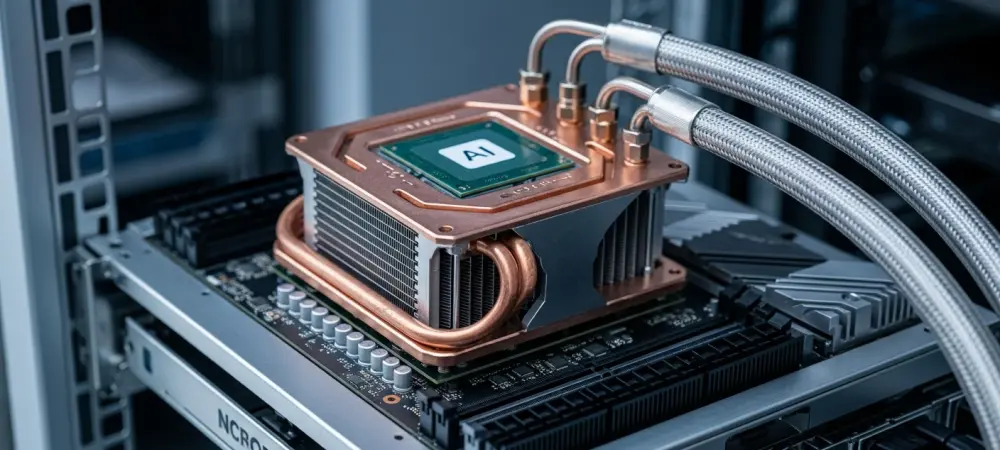
To address the shortcomings of traditional room-based cooling, the industry is moving toward component-level cooling solutions. While rack-level cooling provided a temporary bridge for some legacy systems, the consensus among infrastructure architects is that liquid cooling—specifically direct-to-chip technology—is the only reliable path forward for high-density AI environments. This method functions by circulating liquid through specialized cold plates attached directly to the processors, capturing heat before it can escape into the ambient air of the server room. By targeting heat at its source, operators can leverage the superior thermal conductivity of liquids to transport energy away from hardware far more efficiently than any air-based system could dream of achieving. This transition allows for extreme density, enabling facilities to pack more compute power into a smaller physical footprint while significantly improving Power Usage Effectiveness (PUE) scores that are increasingly scrutinized by investors and regulators.
Navigating Retrofitting and Operational Risks
Expanding on this technical shift requires addressing the immense engineering and financial challenges of implementation. Moving to liquid cooling is not a simple upgrade; it requires a comprehensive redesign of the internal architecture of a facility. Most existing data centers were not built with the heavy-duty plumbing or specialized flooring required to support liquid-to-chip systems, necessitating expensive and invasive retrofitting of piping, coolant distribution units, and heat exchangers. Furthermore, introducing liquid into environments filled with high-voltage electronics creates new safety concerns that did not exist in the era of fans and filters. This shift demands sophisticated leak-detection systems and a new breed of technician skilled in fluid dynamics and hydraulic maintenance. The transition highlights a significant talent gap in the current workforce, as traditional IT maintenance roles are being replaced by jobs that require a background in mechanical engineering and industrial plumbing.
The Impact of Geography and Resource Constraints
Beyond the mechanical room, regional differences and resource availability add further complexity to the thermal management equation. AI-dense workloads require locations with massive power availability and the capacity for large-scale heat rejection. This necessity limits the geographic viability of new projects to regions that can support intensive utilities and provide stable energy grids. Additionally, the water-energy nexus presents a looming regulatory challenge for the industry. While liquid cooling saves electricity by reducing fan usage, some systems require significant water volumes for heat rejection via evaporative cooling towers. In drought-prone areas or regions with strict environmental protections, like those governed by the EU Energy Efficiency Directive, operators must balance technical efficiency with local conservation mandates to avoid public and regulatory backlash.
Anticipating the Next Wave of Thermal Innovation
Identifying emerging trends suggests that the industry is moving toward a liquid-first philosophy in all new construction projects. Future innovations may include immersion cooling—where entire server blades are submerged in non-conductive dielectric fluid—and the integration of AI-driven software to predict and manage thermal hotspots in real-time. We can also expect a shift in regulatory landscapes, where data centers may be required to repurpose waste heat for local district heating systems, turning a byproduct into a community asset. These technological and economic changes will likely favor large-scale providers who have the capital to invest in these advanced systems, potentially consolidating the market around facilities that can prove their thermal and environmental sustainability. The move toward modular, pre-fabricated liquid-cooled pods is also gaining momentum, allowing for faster deployment in regions where traditional construction is too slow to meet the explosive demand for AI compute capacity.
Strategic Recommendations for an AI-Driven Future
The major takeaway from this market analysis is that cooling is no longer a backend utility concern; it is a primary driver of business success and operational uptime. To thrive in this environment, organizations should integrate cooling decisions into every phase of the data center lifecycle, from initial site selection to long-term hardware scaling. Best practices include auditing existing facilities for liquid-cooling readiness and prioritizing regions with stable power and water resources that are less likely to face future environmental restrictions. For professionals in the space, investing in training for fluid management and hydraulic systems is essential for career longevity. By treating thermal management as a strategic pillar rather than a mechanical afterthought, businesses can ensure their infrastructure remains resilient against the increasing heat of modern AI workloads, ultimately turning thermal efficiency into a competitive advantage in a crowded market.
Conclusion: Adapting to the New Thermal Reality
The evolution of digital infrastructure was defined not only by the speed of processors but by the ingenuity of the systems that kept them from melting. AI workloads effectively broke the traditional air-cooled model, which forced a necessary and rapid transition toward innovative liquid-based solutions. While the hurdles—ranging from high retrofitting costs to complex water-usage regulations—were significant, they represented the only viable path for sustainable growth in the age of high-density compute. This shift necessitated a fundamental reimagining of what a data center looked like and how it functioned within a local ecosystem. Ultimately, the facilities that successfully transformed from simple storage hubs into sophisticated, thermally optimized environments secured their place in the future. The industry proved that its ability to adapt to physical constraints was just as important as its ability to develop new software. This journey into liquid cooling established a new baseline for global technology, ensuring that the next decade of progress was built on a foundation of thermal resilience and environmental awareness.