

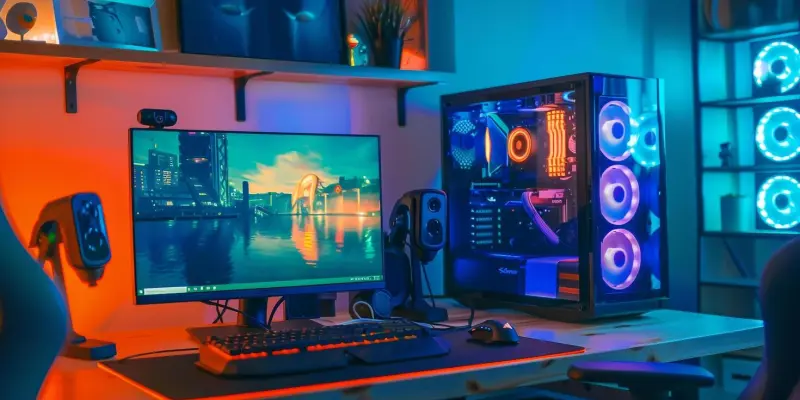
The world of desktop gaming has traditionally been dominated by bulky towers boasting complex cooling systems. However, sleek and compact designs are increasingly paving the way for modern gaming rigs, challenging the notion that bigger is better. The Asus TUF Gaming T500 stands at the forefront of this trend, utilizing mobile CPUs to overcome thermal challenges typically associated with smaller units. Central to its design is the Intel Core i7-13620H processor, which features a 6+4 core configuration, enabling 16 threads to operate at boost speeds of up to 4.9GHz. This innovative setup attains impressive gaming and multitasking capabilities while ensuring superior thermal performance compared to conventional desktop counterparts. The key lies in its desktop tower design, which integrates advanced airflow and cooling mechanisms, including a custom solution equipped with a 90mm fan, heatsink, and heat pipes for efficient heat dissipation.
Enhancing Graphics and Memory Capabilities
The T500 pushes boundaries with a robust graphics setup, offering the Nvidia GeForce RTX 5060 Ti as an option. This graphics card features 16GB of VRAM based on Nvidia’s Blackwell architecture, providing high frame rates at 1440p resolution and delivering competent 4K gameplay when paired with DLSS technology. For gamers seeking variety, alternatives like the RTX 5060 8GB, RTX 4060 8GB, and RTX 3050 6GB are also available. Complementing this graphics prowess is the option to upgrade up to 64GB DDR5 RAM coupled with 2TB PCIe 4.0 SSD storage capacity, catering to power users with demanding requirements. Such specifications ensure the T500 effortlessly handles resource-intensive games and multitasking scenarios, though noteworthy is its restrained power consumption, particularly appealing for setups with limited space or energy considerations.
Blending Aesthetics with Durability
The Asus TUF Gaming T500 goes beyond pure performance to offer a compelling design that attracts both gamers and enthusiasts, thanks to its inspiration from mecha anime. Users can choose between tempered glass or metal side panels, and its exterior is enhanced with customizable RGB lighting to let owners set the tone according to personal preference. This careful design is complemented by excellent connectivity, including ports like USB-C, USB-A, and USB 2.0, alongside strong wireless options like Wi-Fi 6 and Bluetooth 5.4. Crafted for durability, it adheres to MIL-STD-810H standards, ensuring resilience in challenging environments, appealing to those who value robust gaming desktops. The T500 embodies a shift toward a sophisticated blend of style and functionality in the gaming industry. Although pricing remains undisclosed, estimates near $1,299 hint at Asus’s tactic to position the T500 favorably in the compact gaming market, appealing to those who appreciate both aesthetics and power without compromising one for the other.