

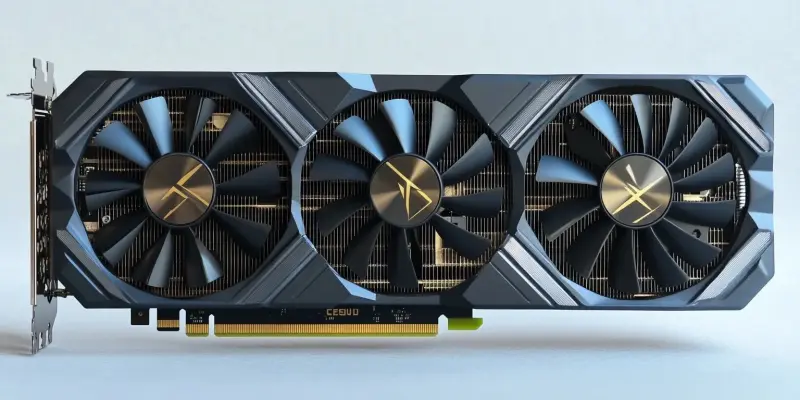
The realm of graphics processing units (GPUs) has been largely dominated by industry giants like Nvidia over the years. However, a Silicon Valley startup named Bolt Graphics is planning to disrupt this dominance with its innovative Zeus graphics card. Bold claims surround this upcoming product, with the company stating that the Zeus card is ten times faster than Nvidia’s current flagship in specific workloads. This daring assertion has captured the attention of both industry experts and consumers alike, sparking debates about the potential impact on the highly competitive GPU market.
Innovative Technology and Features
Bolt Graphics’ Zeus graphics card is built using a cutting-edge 4nm process chip, marking a significant leap in semiconductor manufacturing technology. This ultra-small and highly efficient chip not only enhances performance but also reduces power consumption. Among the myriad of advanced features, the Zeus card includes crucial ports such as HDMI 2.1b, DisplayPort 2.1b, an RJ45 port for high-speed Ethernet connectivity, and a 400 Gbe optical port for superior networking capabilities. These features hint at the card’s versatility, making it suitable for a wide range of applications beyond gaming, including professional and industrial uses.
Further distinguishing the Zeus graphics card are its on-board LPDDR5X memory and an additional PCIe Gen 5 x16 slot, offering substantial potential for expansions in high-performance computing tasks. Unique to this card is its capability to support additional DDR5 RAM. This allows users to push performance limits further, catering to the increasingly demanding needs of modern software and applications. The implementation of these advanced technologies positions the Zeus card as a formidable challenger to existing market leaders, promising superior speed, flexibility, and efficiency.
Market Implications and Competition
The ambitious specs of Bolt Graphics’ Zeus graphics card point towards a broader strategy aimed at capturing a significant share of both the gaming and professional markets. Traditionally, Nvidia has been the go-to brand for gamers due to its high-performance GPUs and dedicated support for gaming technologies. However, Bolt Graphics intends to attract this key demographic by ensuring the Zeus card delivers unmatched performance in gaming scenarios as well. This dual-market approach indicates Bolt Graphics’ plans to establish a strong presence across various sectors.
However, the journey to dethroning Nvidia will not be straightforward. Nvidia’s entrenched market position, backed by years of customer loyalty and continuous technological advancements, presents a formidable barrier for any newcomer. Despite the Zeus card’s promise, consumers often exhibit caution when transitioning to new, untested hardware. Bolt Graphics will need to prove the reliability, stability, and compatibility of its product extensively to win over a skeptical market. Building trust and establishing a support ecosystem akin to what Nvidia provides will be critical to gaining traction.
Broader Technological Impacts
Beyond graphics cards, significant technological advancements are being witnessed in other sectors as well. One notable progression is in hydrogen fuel safety, where researchers from The University of Manchester and King Abdullah University of Science and Technology have developed a sophisticated hydrogen sensor. Utilizing an organic semiconductor, this sensor is capable of detecting minute traces of hydrogen swiftly, surpassing the capabilities of existing commercial detectors. By employing a process called “p-doping,” the sensor can alter electrical currents for rapid detection even at high temperatures, increasing safety in hydrogen storage and usage.
Such a sensor has been tested under practical conditions, including pipeline leak detection and airborne monitoring via drones. Its potential integration into smart devices promises real-time monitoring to enhance safety throughout various industries, including household applications. This technological breakthrough aligns with trends towards not just performance improvement but boosted safety and efficiency across cutting-edge technologies. Researchers are currently focused on refining the sensor technology further to ensure long-term stability and consistency in its performance.
Future Prospects and Conclusions
Traditionally, graphics processing unit (GPU) innovation has been led by industry titans such as Nvidia. Their dominance in this field seemed unshakeable until now. Enter Bolt Graphics, a Silicon Valley startup with ambitious plans to challenge this supremacy. The company is set to introduce its revolutionary Zeus graphics card. Bold and provocative claims from Bolt Graphics suggest that the Zeus card is up to ten times faster than Nvidia’s top-of-the-line model in specific workloads. This audacious declaration has drawn significant attention from both industry experts and potential consumers. The conversation is buzzing with speculation and excitement, as the implications of such a breakthrough could be profound for the highly competitive GPU market. If Bolt Graphics’ promises hold true, the Zeus card could herald a new era, disrupting the status quo and potentially reducing Nvidia’s longstanding dominance. The GPU landscape might be on the brink of dramatic change, with innovation driving competition to unprecedented heights.