

The Wake-Up: A Page, Eight Minutes of Silence, and a Blocked Payment Flow
Phone alerts shattered a quiet night as a payment dashboard bled red, the alarm clocked at eight minutes old, and customers quietly abandoned checkouts while a lone engineer scanned consoles in the half-light of a home office, measuring the cost of every second against a growing backlog of failed transactions. The payment service lived in one AWS account, its shared database in another, and the path between them looked fine at a glance—attachments up, instances healthy, endpoints marked Available—yet the application kept timing out.
The investigation started the way so many do: tracing routes, checking Amazon VPC attachments, comparing security groups on both sides, double-checking network ACLs, and combing through DNS logs and CloudTrail history. As minutes became an hour, the culprit finally surfaced—an AWS Transit Gateway (TGW) attachment had been associated to the wrong route table during an earlier migration, dropping cross-account traffic for one critical pair of VPCs while every other spoke sailed on without a blip. The mystery was never that something broke; it was how long it took to prove which piece broke and why.
Against this backdrop, AWS DevOps Agent offered a different arc to the same story. Instead of a manual hunt, the alarm flowed into a webhook, where the agent correlated metrics, logs, flow records, and API changes, then returned a root cause and a ready-to-run fix. The question ceased to be whether an engineer could find the issue and became whether automation could transform scattered signals into a reliable, testable answer before customers noticed.
The Stakes: Why Rapid Diagnosis Matters
Speed changed the outcome because distributed failures rarely announce themselves with a single, clean symptom. In cloud networks, small misalignments hide in plain sight: a route that looks plausible but sends traffic nowhere, an endpoint that claims to be healthy while its ENIs are gone, or an access policy that denies one of five buckets while every credential check still passes. Each signal on its own feels ambiguous; together, they tell a story.
The operational burden of that ambiguity is real. On-call engineers pay a triage tax measured in context shifts, from route tables to security groups to NAT Gateways to DNS and back, often across multiple accounts. Correlations are easy to miss when alarms arrive out of order, logs trail by a minute, and consoles summarize complex states with a single green dot. The work is not only time-consuming but also cognitively expensive, especially under pressure. This is where an automation layer fits. AWS DevOps Agent sits between alarms and action, turning scattered observability into a directed investigation. It ingests the alert, builds a dependency map, pulls CloudTrail events for recent changes, checks resource health in sequence, and proposes a mitigation that aligns with change-control norms. Human judgment remains in the loop, but the hunt shifts from guesswork to verification.
The Mechanics: From Alarm to Answer
The flow begins with application-level health checks that publish custom metrics to Amazon CloudWatch. When a metric crosses its threshold, a CloudWatch alarm transitions to ALARM and notifies Amazon SNS. By placing SNS between CloudWatch and the webhook Lambda, the design keeps retries reliable, fans out to other tools without editing alarms, and supports cross-account publishing so one topic can feed a central operations pipeline.
SNS invokes a Lambda function that reads webhook credentials from AWS Secrets Manager, signs the request body with HMAC SHA-256, and posts the incident payload to the DevOps Agent endpoint. The signature is validated on the agent side, then the investigation kicks off: topology discovery, metric correlation, flow-log sampling, and CloudTrail diffing over the relevant time window. The output presents a timeline, a root cause narrative, and a mitigation plan aligned to the implicated resource.
Underneath that pipeline, a simulated workload makes failure modes visible. An Application Load Balancer fronts a private Amazon EC2 instance that checks connectivity to an Amazon RDS database, outbound internet reachability via a NAT Gateway, Amazon S3 through a VPC Gateway Endpoint, and Amazon Bedrock via an Interface Endpoint. Each probe emits a targeted metric on a predictable cadence, so failures create crisp, actionable alarms rather than vague, composite signals.
The Evidence: Real Incidents, Real Fixes
The first scenario played out like textbook network drift. A security group rule on the database allowing inbound port 3306 from the application’s group was deleted. The app’s dashboard showed ETIMEDOUT only for database connectivity, while external access, S3, and Bedrock checks stayed green. The agent confirmed that RDS was healthy with zero connections, found the RevokeSecurityGroupIngress event in CloudTrail seconds before the alarm, mapped the dependency, and proposed restoring the ingress rule from the application security group to port 3306. “Security groups silently drop packets that do not match any rule.” The fix was specific, fast, and reversible.
The second case focused on reachability beyond the VPC. Someone removed the 0.0.0.0/0 route to the NAT Gateway from the private route table. External connectivity alone failed, while RDS, S3 over a Gateway Endpoint, and Bedrock over an Interface Endpoint stayed healthy. The agent spotted the missing default route, verified NAT health, and highlighted the DeleteRoute event with user and timestamp. The mitigation reinstated the default route to the NAT Gateway, restoring outbound access without touching unrelated components.
Access control nuance defined the third scenario. The S3 VPC Gateway Endpoint policy was narrowed to only three of five buckets. IAM still allowed access everywhere, and the buckets’ own policies were permissive, yet two checks returned HTTP 403. The agent cross-compared IAM, bucket policies, and the endpoint policy to find the real blocker, linked it to a ModifyVpcEndpoint change, and recommended restoring access to all required buckets. “Three layers of policy have to agree… If any one denies, you get Access Denied.”
Interface endpoints created a different challenge in the fourth case. After both subnet associations were removed from the Bedrock Interface Endpoint, the console continued to show the endpoint as Available while the ENIs that actually handled traffic were gone. The app timed out only on Bedrock calls. The agent detected zero associated subnets, identified the relevant ModifyVpcEndpoint entry, and proposed reattaching subnets to recreate ENIs. “The endpoint still exists… but there is nothing to handle the traffic.”
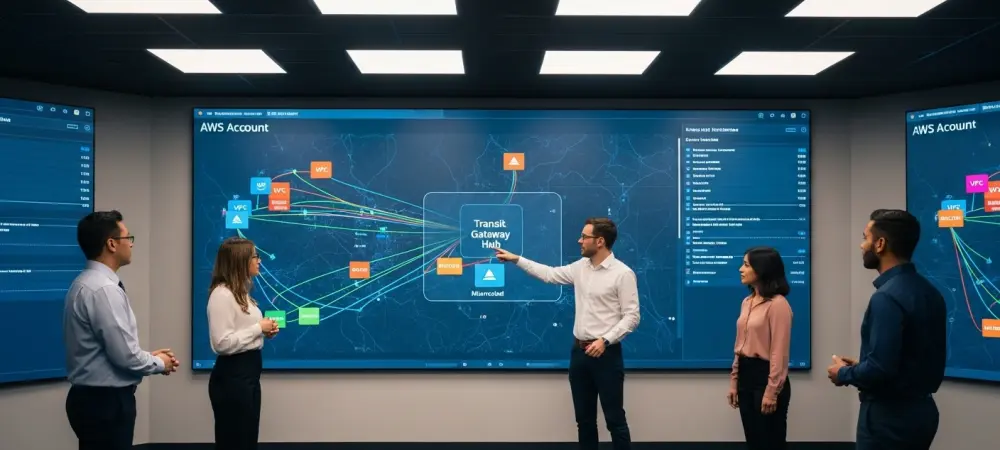
Complexity peaked with a multi-account TGW issue. Traffic between a workload VPC and a shared-services VPC dropped, while other spokes remained unaffected. The agent mapped TGW attachments and route tables across accounts, then surfaced the attachment that had been associated to the wrong route table during a migration. The mitigation plan called for re-associating the correct TGW route table on the specific attachment, minimizing blast radius and preserving ongoing flows elsewhere.
Field Notes: Quotes, Rationale, and Judgment
Network work often hinges on a few telling truths. “Security groups silently drop packets that do not match any rule.” “The endpoint still exists… but there is nothing to handle the traffic.” “Three layers of policy have to agree… If any one denies, you get Access Denied.” These lines, echoed across incident reviews, compress hard-won experience into heuristics that speed up diagnosis when paired with automation.
Design choices supported reliability as much as feature depth. SNS sat between CloudWatch and Lambda because delayed or throttled executions happen, and retries save incidents. Fan-out meant teams could integrate chat, email, and ticketing alongside DevOps Agent without reworking alarm definitions. Signed webhooks protected the handoff, with HMAC SHA-256 ensuring the payload had not been tampered with in transit, and Secrets Manager keeping credentials current without code edits.
Human judgment still mattered. Mitigation plans were presented as ready-to-run steps, not auto-applied patches. Many organizations required review-and-apply workflows to keep change control intact, and the agent fit that pattern. During cascading failures, correlation logic helped merge duplicate alarms—buffering events for a short window and grouping by application or component prevented parallel investigations of the same root cause, keeping responders focused.
Inside The Lab: How the Demo Proved It Out
The demonstration stack deployed from a single CloudFormation template: the ALB, EC2 in private subnets, RDS, NAT Gateway, S3 Gateway Endpoint, and a Bedrock Interface Endpoint. A simple status page rendered probe states in near real time, making it plain which dependency failed, when it failed, and how that failure propagated. Because each check owned a dedicated metric and alarm, the signal stayed clean.
Connecting the alerting pipeline took only a few standard steps. The webhook credentials lived in Secrets Manager, the Lambda signed and posted incidents with HMAC SHA-256, and the agent validated before beginning its runbook. A test event confirmed end-to-end delivery and generated a synthetic investigation named for easy traceability. From then on, every alarm traveled the same route from metric to insight. Instrumentation played a quiet but decisive role. Probes ran at different intervals—fast for the database, moderate for S3, slower for Bedrock—so diagnosis could rely on staggered signals rather than a single burst. That cadence improved time-to-clarity without crowding logs, and it established a rhythm that ops teams could recognize under stress.
The Enterprise Angle: Scaling Across Accounts and Regions
Enterprises needed a pattern that survived growth. With cross-account publishing to a central SNS topic, alarms from many AWS accounts converged on a single pipeline. The agent’s visibility scaled with multi-account and multi-region permissions, enabling it to map TGW topologies, shared services, and account-local components into one view that made policy and routing errors stand out.
Telemetry, CI/CD metadata, and internal knowledge systems enriched the picture further. When the agent pulled traces and metrics from integrated observability platforms, it aligned performance regressions with configuration timelines. When it read recent deployment events, it tested temporal correlations before assuming causation. With Model Context Protocol connections to internal runbooks or APIs, it could fetch platform-specific details during an investigation without hard-coding that logic.
This approach made automation practical without forcing a rip-and-replace. Existing CloudWatch alarms and SNS topics remained intact; the webhook Lambda joined as an additional subscriber. Teams preserved current on-call and incident channels while gaining an automated investigator that worked alongside humans instead of replacing them.
The Playbook: Making It Work in Production
A practical rollout followed a few steps. First came targeted metrics for each dependency, with CloudWatch alarms tuned to detect genuine degradation rather than brief jitter. Then the SNS-to-Lambda bridge carried alerts reliably, with dead-letter queues ensuring no signal was lost. Finally, the webhook handoff—signed and validated—handed the baton to the agent, which returned findings teams could test and apply.
Noise reduction mattered as much as detection. A short buffer window in a data store like DynamoDB grouped near-simultaneous alarms from the same app into one investigation, and a deduplication key prevented duplicate runs when multiple checks reflected the same broken route. The goal was fewer, richer incidents rather than many shallow ones.
Runbooks rounded out the loop. The mitigation plans the agent produced mirrored stored CLI or CloudFormation snippets, so responders could review, apply, and record changes with confidence. That consistency cut recovery time, reduced variance between teams, and improved post-incident learning.
Conclusion: From Paging Fatigue to Predictable Recovery
The case for automation was built on evidence, not slogans. The agent drew a straight line from an alarm to a root cause across SG rules, NAT routes, S3 endpoint policies, Interface Endpoint subnet associations, and TGW route table mix-ups. It compressed hours of manual correlation into minutes, then framed a fix that respected change control.
Teams that adopted this pattern faced incidents with clearer hypotheses, stronger guardrails, and faster, safer mitigations. The pipeline had demonstrated reliability under throttling and fan-out needs, the signing step had safeguarded handoffs, and the dependency maps had reduced guesswork when every minute counted. The next step was simple: treat alarms as triggers for investigations that assembled the right evidence in the right order, then apply a reviewed, predictable change. Over time, that practice had turned late-night pages from open-ended hunts into measured, testable recoveries.