

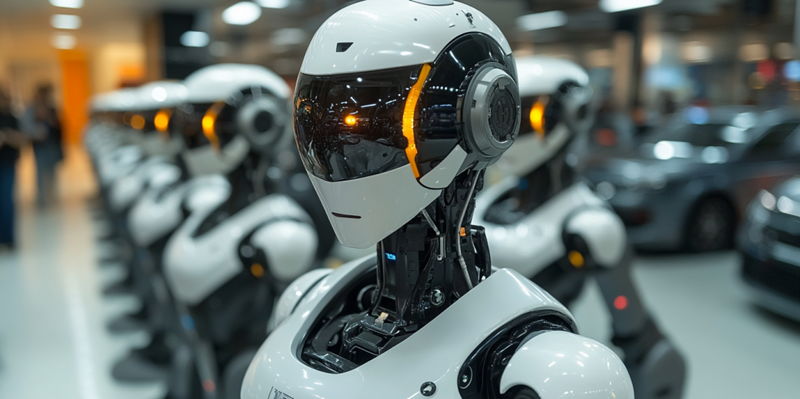
The automation of production lines has become a crucial aspect of advancing the manufacturing industry, particularly in the automotive sector. In a groundbreaking achievement, the BYD manufacturing facility in Changsha has implemented a fully automated logistics solution, marking a historic moment for industrial automation in China. This significant development saw the introduction of humanoid robots to load driverless transporters, effectively addressing the persistent challenge of the "last ten meters" in logistics. This crucial distance between the warehouse and production lines has required extreme precision and reliability that has now been met with cutting-edge technology.
The Role of Walker S1 in Automation
Walker S1 Specifications and Capabilities
At the heart of this impressive automation feat is the bipedal robot "Walker S1" developed by Chinese manufacturer Ubtech. Standing at a height of 1.72 meters and weighing 76 kilograms, the Walker S1 is not only an engineering marvel but also a significant step forward for AI integration in robotics. The robot is equipped with sophisticated AI capabilities that enable it to lift, sort, and load boxes onto autonomous transport vehicles with remarkable efficiency. These autonomous vehicles then transport the cargo seamlessly to the production lines, resulting in a fully automated process that is synchronized through coordinated operations between humanoid robots, unmanned logistics vehicles, industrial mobile robots, and an intelligent Manufacturing Management System (MES).
The importance of the Walker S1’s precision and reliability cannot be overstated. This robot significantly enhances the automation process by eliminating the risks associated with human error, especially in critical logistics operations where precision is paramount. Furthermore, the Walker S1’s advanced AI allows for real-time problem-solving and adaptive learning, ensuring that it can deal with unforeseen complications that may arise during logistics operations. Its application at the BYD facility showcases the potential for significantly reducing operational costs and improving productivity by streamlining what was once a labor-intensive process.
Addressing the Labor Shortage Crisis
This leap in automation arrives at a crucial juncture, as China grapples with a labor shortage despite its vast population. The physical demands of repetitive logistics tasks have left a scarcity of willing workers, further exacerbated by graduates’ reluctance to take on such manual or potentially hazardous roles. The introduction of Walker S1 and similar humanoid robots presents a viable solution, potentially automating up to 70 percent of the labor required on production lines. This not only mitigates the labor shortage but also allows human workers to engage in more sophisticated tasks that necessitate a higher degree of skill, such as collaboration and tool management.
Moreover, the ability of these robots to take on physically demanding or dangerous tasks significantly mitigates the risks to human workers, thereby promoting a safer working environment. As the demand for such robots increases, it is expected that more industries will adopt this technology to address their labor challenges. The precision and tirelessness of robots like Walker S1 offer a practical solution to the multifaceted problems posed by labor shortages, helping industries maintain productivity and competitiveness in a rapidly evolving market.
Expanding Horizons for Humanoid Robots
Interest from Other Sectors
The innovation at BYD’s facility has sparked a wave of interest beyond the automotive sector, with electronics manufacturers like Apple’s supplier Foxconn and logistics service providers including SF Express exploring the integration of humanoid robots into their operations. The primary attraction lies in the ability of these robots to replace human workers for tasks that are physically strenuous or hazardous, aligning with the broader industrial trend towards increased automation and sophisticated robotics integration.
This broader adoption signifies a shift in industrial processes, where the focus is on enhancing efficiency and reducing human involvement in dangerous tasks. In the case of electronics manufacturing, the precision required in handling delicate components makes robots an ideal addition to the workforce. Robots like Walker S1 can perform repetitive and precise tasks tirelessly, reducing the potential for human error and increasing overall productivity. Similarly, in the logistics sector, the use of robots can drastically reduce the time and labor involved in sorting and transporting goods, which traditionally required significant human effort.
Transforming Industrial Operations
The automation of production lines is now a pivotal element propelling advancements in the manufacturing sector, particularly for automotive companies. A remarkable milestone has been achieved at the BYD manufacturing plant in Changsha, which has revolutionized industrial automation in China by introducing a fully automated logistics solution. This landmark development incorporates humanoid robots to load driverless transporters, effectively solving the longstanding challenge of the "last ten meters" in logistics. This critical segment, spanning the distance from the warehouse to the production lines, has always been a stumbling block due to the high level of precision and reliability required. The implementation of cutting-edge technology in this phase has now achieved the necessary accuracy and dependability. This innovative approach marks a historic moment, showcasing how automated solutions can enhance efficiency and performance in the manufacturing industry. As a result, the production process becomes more streamlined, ultimately leading to more consistent and high-quality outcomes.