

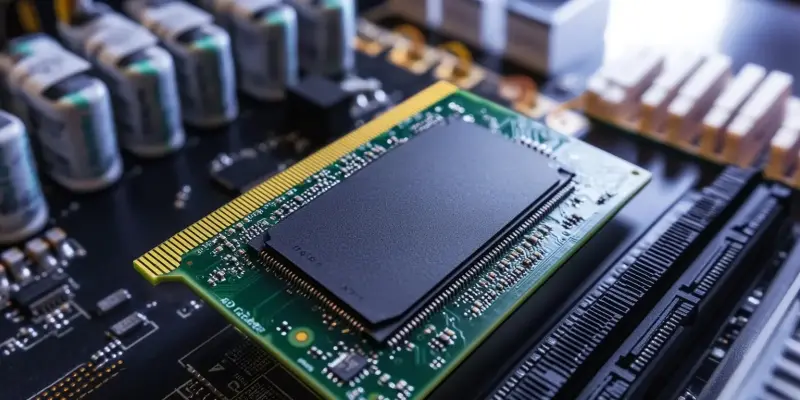
In the ever-evolving world of technology, achieving high memory capacity without compromising speed has been a persistent challenge for both manufacturers and users. This struggle is particularly evident when utilizing all four memory slots on a motherboard, which typically results in reduced operating speeds. However, a significant breakthrough has emerged, thanks to a collaboration between ASUS and Corsair. They have introduced a game-changing solution with their new 4 x 24GB memory kits, which promise to deliver a remarkable balance of speed and capacity. This breakthrough is expected to significantly impact high-performance computing needs, including AI applications, advanced gaming, and intensive multitasking.
High Capacity Meets High Speed
Balancing Capacity and Speed in Multiple-DIMM Configurations
Traditionally, achieving high memory capacities required a compromise in speed, particularly when using more than two sticks of RAM. The difficulty with multiple-DIMM configurations stems from the increased electrical load and signal interference each additional module creates. This typically necessitates a reduction in memory operating speeds to maintain system stability. However, the collaboration between ASUS and Corsair has effectively tackled this issue, marking a monumental shift in the industry.
By introducing two new 4 x 24GB memory kits, ASUS has become the first brand to support such high-capacity modules at a 7000 MT/s speed, as validated in their Qualified Vendor List (QVL). This configuration allows users to achieve a total of 96GB of DDR5 RAM without sacrificing speed, a feat previously deemed unattainable. The inclusion of XMP (Extreme Memory Profile) support has made this possible, simplifying the process of attaining high-speed performance with considerable memory capacity. This development is particularly beneficial for those engaged in demanding content creation, advanced gaming scenarios, or AI applications where both speed and capacity are critical.
Collaborative Engineering for Enhanced Performance
The breakthrough in memory configuration has been realized through meticulous engineering and collaboration between ASUS and Corsair. This partnership aimed to address the long-standing challenges associated with high-capacity memory configurations, ensuring that users could benefit from top-tier performance without needing complex overclocking setups. The key to this success lies in the optimization of the XMP profiles specifically tuned for ASUS Z890 and B860 motherboards.
User-friendly implementation has been a cornerstone of this advancement. Enthusiasts and professionals alike can activate the XMP profile through the motherboard’s BIOS, enabling the high-speed performance of the 4 x 24GB memory kits with ease. Additionally, ASUS’s rigorous testing and validation process for these memory kits ensures compatibility and stable operation across a range of applications. This marks a significant step towards accessible high-performance computing, breaking down barriers that previously hindered users from maximizing their systems’ potential.
Advantages for Demanding Applications
Suited for Advanced AI and High-Performance Gaming
The introduction of these new memory kits holds substantial promise for various high-performance needs. AI applications, for instance, demand extensive memory capacity and speed to handle large datasets and complex algorithms efficiently. With the new 96GB DDR5 RAM kits operating at 7000 MT/s, users working on machine learning, data analysis, and other AI-related tasks can expect significant performance improvements without facing the typical bottlenecks of reduced memory speeds.
Advanced gaming is another area where these memory kits shine. Modern games are increasingly resource-intensive, requiring not only powerful GPUs but also high-speed and high-capacity RAM to ensure smooth gameplay and quick load times. The ability to maintain 7000 MT/s speed with nearly 100GB of memory offers gamers an unparalleled experience, allowing them to run multiple game instances, high-definition textures, and complex simulations without a hitch. This balance of speed and capacity is also beneficial for content creators engaged in video editing, 3D rendering, and other performance-intensive tasks, enabling them to work more efficiently and effectively.
Future-Proofing High-Performance Systems
In the dynamic realm of technology, achieving high memory capacity without sacrificing speed remains a consistent challenge for both manufacturers and users. This issue becomes particularly prominent when all four memory slots on a motherboard are in use, usually leading to slower operating speeds. However, a substantial breakthrough has been made through a collaboration between ASUS and Corsair. These two industry giants have unveiled a revolutionary solution with their new 4 x 24GB memory kits. These kits are designed to provide a remarkable balance between speed and capacity, marking a significant advancement in the field. This innovation is poised to substantially impact high-performance computing needs. It is expected to benefit a wide range of applications, including artificial intelligence, advanced gaming, and intensive multitasking. With this new technology, users no longer have to compromise on speed to achieve higher memory capacities, making it a game-changer in various high-demand scenarios.