

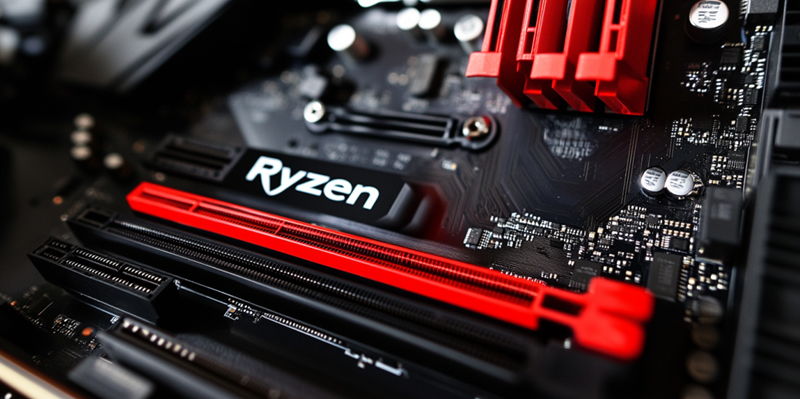
In a surprising turn of events, recent leaks from Gigabyte have put AMD’s yet-to-be-released Ryzen 9950X3D processor under the spotlight, hinting at the significant gaming performance enhancements it might bring. This flagship model, part of AMD’s Zen 5 family, is expected to make its official debut at the CES 2025 event, causing a flurry of excitement and speculation within the tech community. A pivotal element contributing to the buzz is Gigabyte’s claim about an ‘X3D turbo mode,’ which allegedly can boost the 16-core CPU’s performance by up to 18%. Such an improvement is purportedly achieved by implementing various tuning measures, including the disabling of simultaneous multithreading (SMT) and one of the Core Chiplet Dies (CCD). These strategic adjustments aim to enhance gaming performance, where fewer active cores might lead to better optimization.
The hype surrounding the Ryzen 9950X3D is partly due to its potential resemblance to its predecessor, the Ryzen 7950X3D. This older model has been noted for its dual 8-core chiplets, where only one contains the innovative 3D V-Cache technology. This setup has been crucial in improving gaming and high-performance computing tasks by allowing quicker data access. Gigabyte’s reference to the new processor seems to corroborate earlier rumors and industry speculation, unearthing more facts about the much-anticipated Zen 5 lineup. With AMD expected to launch the Ryzen 9950X3D along with the Ryzen 9900X3D (a 12-core variant) at CES 2025, followed closely by the Ryzen 9800X3D (an 8-core variant) slated for a November release, the excitement is building rapidly.
Gigabyte’s X3D Turbo Mode: A Game Changer?
A standout feature of the Ryzen 9950X3D, according to Gigabyte’s revelations, is the ‘X3D turbo mode,’ which is believed to bring about notable performance boosts. Turbo mode’s mechanism revolves around refining core usage by selectively disabling specific functionalities that may not necessarily be beneficial for certain gaming scenarios. Disabling SMT and one CCD, for instance, can result in fewer active cores but often leads to better game optimization, translating into higher frame rates and smoother gameplay. This fine-tuning approach seeks to exploit the architectural enhancements of Zen 5 to its maximum potential, making it a highly anticipated aspect of the Ryzen 9950X3D’s market appeal.
Tech enthusiasts are keen to see if Gigabyte’s turbo mode can indeed make a significant difference in gaming performance when compared to existing AMD models. The notion of boosting a processor’s efficiency by customizing its core activity is not entirely new, but Gigabyte’s implementation appears remarkably sophisticated. If successful, this turbo mode could position the Ryzen 9950X3D as a leader not just in raw performance numbers but in practical, real-world gaming experiences. As the gaming industry demands increasingly higher performance benchmarks, such innovations could reshape user expectations and set new standards for future processor technologies.
AMD’s Potential Market Impact
With the official introduction of the Ryzen 9950X3D and its counterparts on the horizon, AMD is poised to make a substantial impact on the CPU market. Historically, AMD has been locked in a fierce competition with Intel, each trying to outpace the other in terms of processing power and efficiency. The Ryzen 9950X3D, backed by innovative features like the X3D turbo mode, could provide AMD with a strategic advantage in capturing the gaming and high-performance computing segments. One of the most compelling aspects of this development is how AMD addresses performance inefficiencies that previously led some users to opt for lower core count models for better gaming performance, such as preferring the 7800X3D over higher-end variants.
By potentially offering more intelligent turbo modes and tuning options, AMD is setting a new precedent that could reduce the appeal of lower-end models. Such advancements could also shift market dynamics, prompting users to reconsider their processor choices and expectations. Past trends have often indicated a preference for processors with fewer cores in gaming contexts, primarily due to better optimization. However, the Ryzen 9950X3D aims to change that narrative, showcasing that higher core counts could also deliver unparalleled gaming experiences with the right technology driving them.
Future Prospects and Conclusion
In a surprising twist, leaks from Gigabyte have shed light on AMD’s upcoming Ryzen 9950X3D processor, hinting at notable gaming performance enhancements. This top-tier model, part of AMD’s Zen 5 family, is anticipated to debut at CES 2025, stirring excitement and speculation in the tech community. Gigabyte claims an ‘X3D turbo mode’ could boost the 16-core CPU’s performance by up to 18%, a feat achieved through tuning measures like disabling simultaneous multithreading (SMT) and one of the Core Chiplet Dies (CCD). These tweaks aim to optimize gaming performance by activating fewer cores.
The buzz around the Ryzen 9950X3D is partly due to its potential similarity to its predecessor, the Ryzen 7950X3D, which featured dual 8-core chiplets, one with 3D V-Cache technology, enhancing gaming and high-performance computing by allowing faster data access. Gigabyte’s comments align with earlier rumors and speculation about the Zen 5 lineup. AMD is expected to release the Ryzen 9950X3D along with the Ryzen 9900X3D, a 12-core variant, at CES 2025, with the 8-core Ryzen 9800X3D slated for a November release, thus building anticipation.