

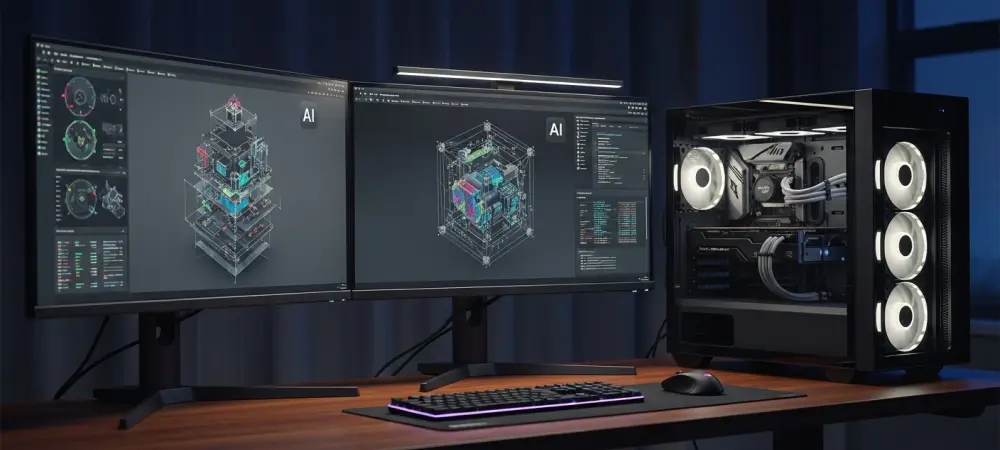
The relentless pursuit of computational speed has finally moved beyond the traditional boundaries of raw megahertz to embrace the intricate world of memory hierarchy. As modern software demands more than just rapid cycles, the industry has pivoted toward a cache-centric model where the proximity of data to the processor determines the true ceiling of performance. This shift marks a departure from the historical focus on core counts alone, signaling a new age where architectural efficiency dictates market leadership. The Ryzen 9 9950X3D2 serves as the primary catalyst for this transition, introducing a dual-CCD 3D V-Cache configuration that breaks previous design conventions. By equipping both chiplets with stacked memory, AMD has effectively bridged the gap between consumer gaming hardware and high-end workstations. This strategic move positions 16-core flagship processors as the new standard for users who require a singular machine capable of handling diverse, data-heavy workloads without compromise.
Decoding the Market Shift Toward High-Bandwidth Desktop Solutions
Emerging Drivers in Hybrid Performance and AI-Driven Workloads
A new generation of prosumers is driving a massive surge in the demand for hardware that balances elite gaming capabilities with professional-grade output. The integration of 208MB of total cache is not merely a luxury for enthusiasts; it is a functional requirement for accelerating AI model execution and complex game engine compilation. This massive buffer allows for a level of data throughput that traditional designs cannot match, catering to developers who need real-time responsiveness.
Furthermore, the rise of localized AI processing means that the desktop is once again becoming a primary site for heavy lifting. High-bandwidth data processing has evolved from a niche server requirement into a standard expectation for premium consumer hardware. As software developers optimize their code for larger on-die memory pools, the distinction between professional tools and enthusiast equipment continues to blur, creating a unified market for high-performance silicon.
Quantifying the Impact of Dual 3D V-Cache on Global Hardware Projections
The shift toward dual-cache stacking is already yielding measurable results, with benchmarks showing a 13% performance boost in AI simulations and significantly faster rendering in V-Ray. These figures provide a tangible justification for the premium pricing of high-end desktop (HEDT) components. As Zen 5 technology stabilizes, industry analysts project a steady growth trajectory for the high-end CPU segment, fueled by a user base that prioritizes time-saving architectural advantages.
Competitive dynamics have also played a crucial role in consolidating this market position. With the reported cancellation of rival flagship products, the window for dominance has opened wider for innovative designs. This lack of direct competition allows for a more aggressive rollout of advanced chiplet technologies, ensuring that the latest silicon remains the preferred choice for those looking to future-proof their digital infrastructure.
Navigating Technical Hurdles in Thermal Management and Architectural Complexity
Moving to a dual-cache layout brings significant engineering challenges, particularly regarding the 200-watt Thermal Design Power (TDP) limit. Managing the heat generated by two layers of stacked memory requires sophisticated cooling solutions that go beyond standard consumer expectations. This increased thermal envelope necessitates a rethink of system integration, pushing the limits of what air and liquid coolers can effectively dissipate under sustained load.
Architectural trade-offs are also visible in the clock speed adjustments required to maintain stability. The 5.6 GHz boost ceiling represents a calculated balance between memory density and frequency, ensuring that the processor remains reliable despite the complexity of multi-chiplet stacking. Optimizing software to recognize and utilize this unique layout remains a priority, as operating systems must learn to allocate tasks to the most efficient cache pool dynamically.
Compliance and Standards in the Era of High-Wattage Enthusiast Hardware
As power requirements rise, international energy efficiency standards are beginning to influence the design of enthusiast-grade components more heavily. Regulatory bodies are increasingly focused on the idle and peak power consumption of high-wattage hardware, forcing manufacturers to innovate in power delivery systems. This has a direct impact on motherboard design, where robust voltage regulator modules must meet stringent safety and efficiency benchmarks.
Security also becomes a concern when dealing with massive, high-speed on-die buffers. Ensuring that sensitive data remains protected within these large cache pools is vital for hardware compliance in a professional environment. Meanwhile, industry standards for multi-chiplet interconnects are evolving to ensure that system stability remains high even as the complexity of the internal processor bus increases to accommodate higher data transfer rates.
The Future of High-End Desktop Platforms and Next-Generation Interconnects
The trajectory of 3D-stacked memory suggests that the next decade of computing will be defined by how efficiently data moves between processing units and memory layers. We may soon see the expansion of high-bandwidth memory (HBM) into the consumer chip space, further disrupting the traditional boundaries of desktop performance. Such innovations will likely influence software development cycles, as creators begin to design applications that specifically leverage massive on-chip storage.
Global economic conditions and supply chain resilience will determine how quickly these premium technologies are adopted on a mass scale. While the enthusiast market is eager for innovation, the long-term success of dual-cache designs depends on the ability to maintain consistent manufacturing yields. As silicon fabrication becomes more complex, the industry must find ways to produce these sophisticated multi-layer chips at a scale that satisfies global demand without sacrificing quality.
Synthesizing the Impact of Dual V-Cache on the Modern Computing Landscape
The introduction of the dual-cache design proved to be a defining moment for the high-end computing sector, establishing a new baseline for what a flagship processor should achieve. It moved the conversation away from simple frequency increments and toward a more holistic view of system throughput. Organizations and investors should have recognized that the value of architectural innovation now far outweighs the benefits of marginal clock speed gains in a professional context. This shift underscored the importance of hardware that could adapt to the emerging needs of localized AI and high-fidelity content creation. As the industry moved forward, the focus turned toward refining these multi-layer structures to improve efficiency and accessibility for a wider range of users.