

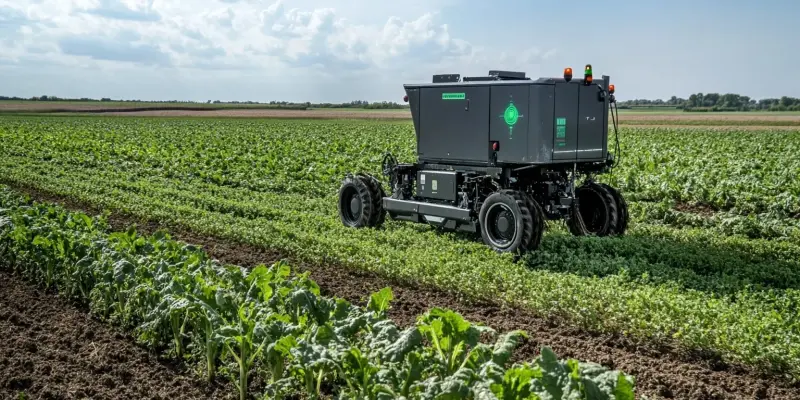
The forestry industry is on the brink of a revolution as innovative AI-powered technology emerges to transform traditional weed control methods in nurseries. A groundbreaking project from the University of Idaho Coeur d’Alene, in collaboration with the U.S. Department of Agriculture (USDA), has developed an autonomous robot designed to eradicate weeds using electric zaps. This machine promises to not only enhance the efficiency of weed removal but also contribute significantly to environmental sustainability by reducing reliance on chemical herbicides and labor-intensive manual methods.
Technological Innovation in Weed Control
AI-Driven Weed Detection and Elimination
The heart of this technological marvel lies in its ability to leverage artificial intelligence to detect and eliminate weeds by zapping them with electricity. Armed with advanced AI algorithms, the autonomous robot can accurately identify and target weeds as small as half an inch in diameter. Measuring three feet wide and equipped with wheels for mobility, this robot navigates through forestry nurseries with precision, ensuring that it targets only the unwanted plants without harming the valuable seedlings.
The process is initiated as the robot scans the nursery with its onboard sensors, collecting data to differentiate between the weeds and beneficial plants. The AI system then processes this data in real-time, enabling the robot to make precise decisions about which plants to eliminate. The electrical zapping mechanism delivers a controlled charge that effectively destroys the invasive weeds, preventing them from competing with tree seedlings for vital nutrients in the soil. This method not only eliminates the need for harmful chemical herbicides but also minimizes disturbance to the soil, promoting healthier plant growth.
Enhancements and Testing Phases
Following a successful demonstration at the U.S. Forest Service’s Coeur d’Alene tree seedling nursery, the research team identified areas for further development to enhance the robot’s performance. Plans are underway to develop a weather-resistant casing that would enable the robot to operate in various environmental conditions, ensuring year-round functionality. Additionally, enhancements are being made to the electrical components to increase efficiency and longevity, further cementing the robot’s reliability in the field.
One of the critical aspects under continuous improvement is the AI’s weed identification accuracy. The research team is committed to refining the algorithms to ensure that the robot’s decision-making process becomes even more effective over time. Data collection and rigorous testing will continue into the next year to address any discrepancies and optimize the robot’s performance. By validating the robot’s effectiveness in different nursery conditions, the team aims to establish a robust system that can be scaled and implemented across various forestry nurseries.
Sustainable Agriculture and Economic Impacts
Project Evergreen and Economic Benefits
Dubbed Project Evergreen, this initiative received $139,000 in USDA funding, highlighting the government’s commitment to sustainable practices in agriculture. The AI-powered weeder is poised to deliver significant economic benefits by reducing labor costs associated with manual weed control. Currently, the U.S. Forest Service spends an estimated $500,000 annually on manual weed control across its six nurseries. By incorporating this autonomous weeder, the labor-intensive and time-consuming task of manual weeding can be drastically reduced, leading to substantial cost savings.
Moreover, the reduction in labor costs is complemented by a decrease in chemical pesticide use. By minimizing dependence on herbicides, the project not only cuts costs but also mitigates the environmental impact associated with chemical runoff and soil degradation. Consequently, the survival rate of seedlings is expected to improve as they gain better access to soil nutrients, fostering healthier and more robust tree growth. These improvements align with broader environmental and economic goals, presenting a win-win scenario for both forestry management and conservation efforts.
Aligning with National Reforestation Goals
This project aligns seamlessly with the broader objectives of the REPLANT Act, part of the 2021 Infrastructure Investment and Jobs Act. The act mandates the reforestation of 4 million acres and the planting of over 1.2 billion trees within a decade, underscoring a national commitment to enhancing forest cover and combating climate change. By integrating the AI-powered weeder, the initiative supports these ambitious goals, providing an efficient and sustainable solution to one of the critical challenges in nursery management.
Furthermore, the partnership between the University of Idaho and the USDA enriches the academic institution’s research capabilities by providing real-world applications for intelligent robotics. It presents students with hands-on experience in cutting-edge technology, fostering expertise that will be invaluable in advancing agricultural and ecological innovation. The AI weeder’s development stands as a testament to the potential of technological advancements in driving sustainable practices and achieving long-term environmental goals.
Conclusion
The forestry industry is about to undergo a major transformation thanks to cutting-edge AI technology poised to revolutionize traditional weed control in nurseries. A pioneering initiative by the University of Idaho Coeur d’Alene, in partnership with the U.S. Department of Agriculture (USDA), has introduced an autonomous robot capable of eliminating weeds using electric zaps. This innovative machine promises to increase the efficiency of weed removal significantly while also promoting environmental sustainability. By relying less on chemical herbicides and reducing the need for labor-intensive manual methods, this robot could revolutionize how weeds are managed in nursery settings. This advancement marks a significant step forward in forestry practices, potentially setting a new standard for future weed control technologies. As the industry embraces these innovations, the potential for enhanced environmental conservation and operational efficiency becomes increasingly promising.