

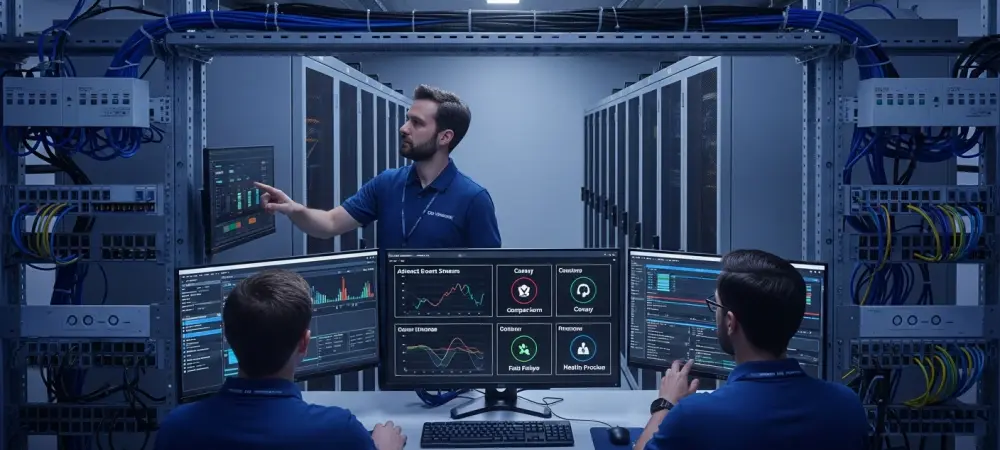
Freight schedules ripple through factories, distribution centers, and ports, so a five-minute slip on one line can cascade into hours of idle equipment and missed handoffs across an entire corridor. That fragility exposed the limits of the legacy software that still underpins many railroads—monolithic stacks with long release cycles, coarse-grained failover, and little elasticity when a sudden surge in events hits. The shift underway is not cosmetic. It aligns core operations with cloud-native foundations that absorb volatility while surfacing sharper, earlier signals to dispatchers and planners. In this context, the engineering work of Rahul Ganta at Wabtec illustrates what modernization looks like in practice: decomposed services, stronger reliability patterns, and AI models embedded where they can steer real decisions, not just decorate dashboards after the fact.
From Monoliths to Cloud-Native Foundations
The old pattern—one large application with tightly bound modules and shared databases—constrained scale and obscured ownership boundaries, making a single fault feel like a system-wide incident. Microservices invert that risk profile. Services for train movement, crew management, movement authorities, and consist tracking can be split, each with its own datastore, health probes, and deployment cadence. Containers standardize builds, while Kubernetes controls placement, autoscaling, and rolling updates. In Ganta’s programs, these mechanics translate into pragmatic choices: gRPC for low-latency internal calls, REST where broader interoperability is needed, and service meshes to apply retries and circuit breaking uniformly without rewriting business logic. Crucially, resilience becomes explicit rather than aspirational. Readiness and liveness probes gate traffic during rollouts, while chaos testing validates that failover and backpressure behave as designed under duress. Data is sharded to avoid hot partitions when telemetry spikes, and stateful workloads—like movement authorization logs—run with persistent volumes and snapshot policies tuned to recovery point objectives. Observability moves from piecemeal logs to a coherent stack: OpenTelemetry traces flow into Jaeger, metrics land in Prometheus with alerting rules, and curated Grafana boards give dispatch supervisors the context to separate a transient slowdown from a real fault. With these pieces in place, teams deliver frequent, low-risk changes that would have halted a monolith.
Event-Driven, Real-Time Control at Scale
Rail operations are fundamentally concurrent. Event-driven designs absorb this concurrency by modeling the network as streams. Apache Kafka or Redpanda carry high-volume topics for train states, occupancy, and asset health, while consumer groups fan out processing without collisions. Container orchestration scales consumers based on lag, compressing end-to-end latency when storm fronts or yard peaks flood the system. That elasticity matters because stale events are nearly as risky as no data at all during a capacity crunch.
The control plane cannot rely on streams alone. Some actions are interactive and time-critical: clearing a signal, issuing a movement authority, or querying the live location of a high-priority consist. Here, synchronous APIs pair with the bus. Ganta’s teams fuse gRPC services for deterministic, low-latency commands with asynchronous propagation for state changes, ensuring that an immediate decision updates every dependent system moments later. Idempotency keys and exactly-once processing semantics guard against duplicated moves after transient outages. Dead-letter queues capture anomalies for offline triage rather than dropping data silently. The net effect is a nervous system that coordinates hundreds of simultaneous movements without forcing every decision through the same bottleneck.
Embedded Predictive Intelligence
Forecasts that once sat in monthly PDF reports now sit inside the dispatch loop. Delay prediction models trained on historical dwell times, crew constraints, track geometry, and live telemetry identify when a particular train is trending late enough to disrupt a connection downstream. In practice, that may trigger automatic padding for a tight meet, suggest a reroute around an emerging bottleneck, or reprioritize a yard pull-in to preserve an outbound slot. Feature stores keep signals consistent across training and inference, while model registries—such as MLflow—tie each prediction to a versioned artifact. This traceability allows operations teams to audit why a call was made if a plan deviates from expectation.
The engineering details determine whether intelligence actually changes outcomes. Real-time feature pipelines pull from Kafka topics and time-align signals, while online model servers respond within service-level objectives that match operational needs—tens of milliseconds for command decisions, seconds for schedule recalculations. Canary deployments compare incumbent and candidate models on shadow traffic before promotion, avoiding abrupt shifts. When confidence drops below a threshold, fallbacks hand control to rules that reflect established operating practices. This posture, visible in Ganta’s work, treats AI as a lever within a broader control architecture: predictions steer actions when reliable, but human oversight and deterministic safeguards remain in the loop.
Engineering Discipline and Responsible AI
Large-scale change stalls without disciplined process. System design reviews codify patterns for retries, bulkheads, and data partitioning so new services do not reinvent the wheel. Continuous delivery pipelines gate releases with unit tests, contract tests, and soak tests that simulate rush-hour loads. Mentoring builds institutional memory: engineers learn why a certain timeout was chosen or how to shape traffic during a rolling upgrade on a single-track subdivision. The result is a culture that can absorb new tools—including AI-assisted development—without letting novelty erode reliability. Code suggestions may speed scaffolding, but security scans, pair reviews, and provenance checks anchor quality. Responsible AI principles close the loop. Models carry documented scopes, known limitations, and escalation paths when predictions conflict with safety rules. Interfaces expose rationale hints—feature contributions or counterfactuals—so operators understand whether a forecast hinges on transient weather or chronic congestion. Audit logs and immutable event stores map each decision to model versions and inputs, enabling post-incident analysis that satisfies both engineering rigor and regulatory scrutiny. Recognition of Ganta’s work at DASGRI 2026 reflected this orientation: progress paired with accountability. For railroads planning next steps, the practical path looked clear—treat AI as augmentative, keep humans decisively in control, and design for failure before it happens.