

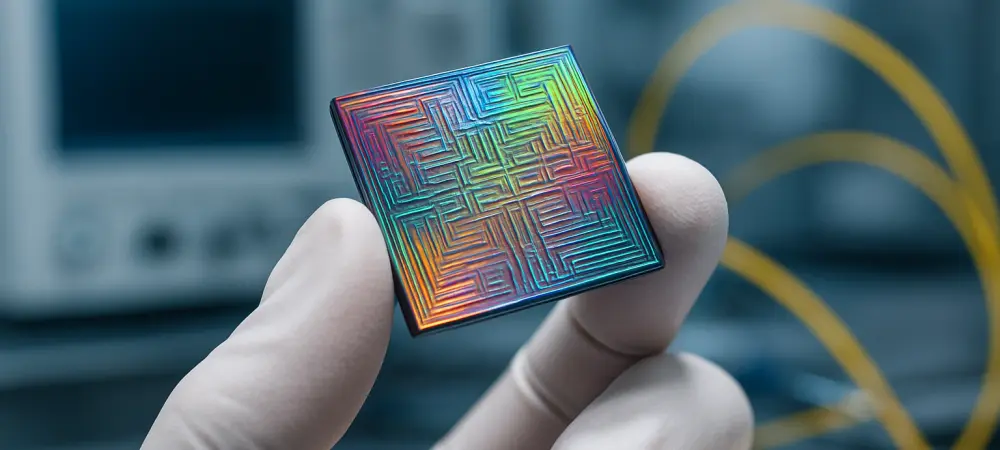
The transition of photonic technology from laboratory-scale experiments to field-ready hardware represents a critical milestone for the future of global telecommunications. As the digital landscape undergoes a radical transformation toward ultra-high-speed connectivity, the limitations of traditional electronic oscillators have become increasingly apparent. Researchers at Loughborough University’s Emergent Photonics Research Center have pioneered a solution that addresses these bottlenecks through the creation of a miniature “rainbow on a chip.” This device, which is essentially a microresonator that produces a frequency comb, provides a revolutionary way to generate and stabilize high-frequency signals. By generating a series of equally spaced, ultra-stable spectral lines, the chip acts as an optical ruler that can bridge the gap between light waves and the radio frequencies required for next-generation 6G networks. This innovation allows for the creation of multiple data channels with unprecedented precision, ensuring that the integrity of high-bandwidth signals is maintained even over long distances.
Technological Innovation and the Path to 6G
Stability Through Hybrid Engineering: Achieving Signal Lock
The Loughborough research team, led by Dr. Luke Peters and Dr. Antonio Cutrona, addressed the inherent instability of traditional microcombs by engineering a unique hybrid system. Standard microcombs are notoriously temperamental, often requiring extremely precise conditions to maintain their “soliton” state—a specific type of stable light pulse. To solve this, the scientists integrated a chip-based microresonator with an external optical fiber loop, creating a nested feedback mechanism. This configuration allows laser light to circulate through both components, which naturally stabilizes the resulting optical signals. The fiber loop acts as a buffer and a stabilizer, ensuring that the light pulses do not collapse or drift when the system experiences external noise. This breakthrough moved the technology beyond the fragile setups usually found in physics labs, providing a platform that can operate reliably in varied conditions. This hybrid architecture is a significant departure from previous designs, offering a level of robustness necessary for commercial deployment.
Building on this foundation of stability, the hybrid engineering approach also tackles the problem of physical disturbances, such as vibrations or temperature shifts. In a real-world setting, communication hardware must function inside cell towers or satellite stations where environmental factors are unpredictable. The internal feedback loop within the Loughborough device ensures that even if the physical structure is slightly jolted, the light frequency remains locked. This level of resilience is achieved by leveraging the way light interacts with the microresonator’s geometry and the fiber’s delay. This synergy creates a self-correcting system that maintains its operational state without human intervention. As a result, the device can provide a consistent and pure source of frequencies for hundreds of hours, a feat that was previously difficult to achieve in such a small form factor. By merging fiber optics with silicon-chip technology, the researchers have effectively created a bridge between the reliability of established telecom infrastructure and the high performance of next-generation photonics.
Overcoming the Bandwidth Crisis: Millimeter Wave Precision
As current wireless networks approach their maximum capacity, the push for higher frequencies has become a primary objective for the industry. Millimeter waves, which operate at frequencies far above those used in 4G and 5G, offer the vast bandwidth needed for the data-intensive applications of the coming years. However, generating these high-frequency signals with the required precision is a daunting technical challenge. The “rainbow on a chip” solves this by acting as a high-fidelity frequency source that can be easily converted into the millimeter-wave domain. Each “tooth” of the light comb serves as a reference point for a separate communication channel, allowing for the simultaneous transmission of massive amounts of data. This capability is essential for 6G, where the expectation is to deliver speeds up to 100 times faster than current standards. By utilizing the optical comb as a master clock for radio signals, engineers can eliminate the jitter and noise that typically plague high-frequency wireless communications, paving the way for seamless data transfer.
Furthermore, the precision offered by the microcomb technology allows for a much more efficient use of the electromagnetic spectrum. In traditional systems, wide guard bands are often required between channels to prevent interference, which wastes valuable spectrum. Because the frequencies generated by the Loughborough chip are so tightly controlled and stable, these guard bands can be significantly narrowed. This leads to a higher spectral efficiency, allowing more users and devices to operate within the same frequency range without compromising performance. The ability to preserve this precision during the conversion from light to radio waves is a key differentiator of this research. It ensures that the benefits of optical stability are fully realized in the wireless domain. As the demand for low-latency services, such as remote surgery and autonomous vehicle coordination, continues to grow, the reliability of these high-frequency channels will become the backbone of modern society. This technology provides the necessary infrastructure to handle the next surge in global data consumption effectively.
Expanding Horizons in Quantum and Timing
Precision Timing and Quantum Metrology: Atomic Accuracy
The implications of the microcomb extend far beyond telecommunications, reaching into the realm of quantum metrology and precision timing. In collaboration with the National Physical Laboratory, the researchers have demonstrated that this chip-scale device can provide the kind of timing accuracy previously reserved for massive atomic clocks. Quantum systems, such as quantum computers and secure communication networks, require synchronization at the level of femtoseconds to function correctly. A slight deviation in timing can lead to errors in quantum bit operations or the failure of encrypted keys. The Loughborough device provides a stable and portable frequency reference that can be integrated directly into quantum hardware. This eliminates the need for bulky, expensive timing equipment and allows for the decentralization of quantum networks. By providing a “master clock” on a chip, this technology facilitates the development of distributed quantum computing environments, where multiple processors must work in perfect unison across a connected fiber network.
This advancement in precision timing also has direct benefits for satellite-based navigation and terrestrial positioning systems. Current GPS technology relies on atomic clocks on satellites, but these signals can be degraded or spoofed on the ground. Integrating microcomb technology into local receivers and base stations provides an independent, high-precision time source that can maintain accuracy even when satellite signals are unavailable. This level of synchronization is vital for the coordination of autonomous logistics networks and industrial Internet of Things sensors. Furthermore, in the field of quantum sensing, the ability to generate stable light frequencies allows for the detection of minute changes in gravity or magnetic fields with extreme sensitivity. These sensors are used for everything from mineral exploration to monitoring tectonic activity. By miniaturizing the optical source, the researchers have made these advanced scientific tools more accessible and portable. The synergy between high-speed 6G networks and quantum-level timing creates a new paradigm for secure, hyper-accurate global positioning.
Engineering Challenges: Miniaturization and Deployment
Despite the remarkable performance of the central chip, the transition to widespread commercial use requires overcoming the challenge of the surrounding support hardware. Currently, the auxiliary components, such as the lasers and electronic control systems, still occupy a significant amount of space on a laboratory bench. The roadmap for the period from 2026 to 2028 focuses on the total miniaturization of these elements to fit within a compact “shoebox” volume. This reduction in size is not merely about physical footprint; it is also about power efficiency. For the technology to be viable in 6G handsets or portable quantum sensors, it must operate on battery power without excessive heat generation. Engineers are working on integrating the laser sources directly onto the silicon platform and developing low-power CMOS circuits to manage the feedback loops. Achieving this level of integration will mark the shift from a scientific curiosity to a practical component that can be mass-produced in existing semiconductor fabrication plants.
The development of the microcomb technology eventually reached a point where its deployment in extreme environments became a tangible reality. By the conclusion of the testing phases, the device had proved its resilience against the thermal fluctuations and mechanical stresses typical of deep-space missions and high-altitude satellite orbits. The past achievements in stabilizing the “rainbow on a chip” allowed for the implementation of high-fidelity spectroscopy in remote regions, providing scientists with new data on cosmic molecular structures. In the telecommunications sector, the focus transitioned to establishing industry-wide standards for the integration of these photonic components into 6G infrastructure. This past success provided a robust foundation for a new era of connectivity characterized by unprecedented bandwidth and timing precision. The strategic move toward modular and scalable photonic chips ensured that the technology was not confined to a single application but could be adapted for diverse industrial needs. This progress finally bridged the gap between advanced physics and everyday utility, setting the stage for the next decade of digital evolution across the globe.