

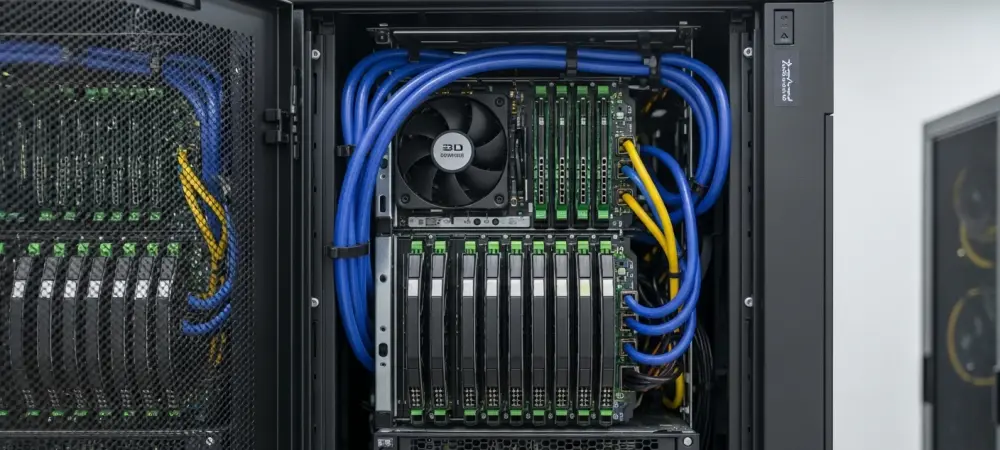
The global race for artificial intelligence supremacy has officially moved from the horizontal plane of traditional circuit boards to the vertical heights of stacked architecture. While the industry has spent decades shrinking transistors to fit more logic onto a flat surface, the physical limits of horizontal scaling are finally being reached. Broadcom is now pivoting the entire competitive landscape upward by bonding multiple chips into vertical towers, a move designed to bypass the traditional bottlenecks that limit how fast data moves between processors. This transition from “flat” chips to “stacked” silicon represents a fundamental change in how the hardware powering the modern world is constructed.
As developers push for increasingly complex models, the distance data must travel becomes a literal barrier to progress. By stacking components, Broadcom effectively shortens the “commute” for electrons, allowing for near-instantaneous communication between memory and processing layers. This architectural shift is not merely an incremental update; it is a reinvention of the silicon floor plan that challenges the dominance of traditional high-performance computing leaders.
Solving the Power-Performance Paradox in Modern Data Centers
The rapid expansion of artificial intelligence has placed an unsustainable demand on global energy grids, creating a scenario where raw computational power often outstrips the available cooling and electrical infrastructure. Conventional chip designs struggle to balance the massive data transfer speeds required for large language models with the need for energy efficiency. Broadcom’s pursuit of 3D architecture addresses this directly, aiming to provide the horsepower necessary for AI workloads while significantly reducing the energy required to move information across the silicon.
By localizing data movement within a vertical stack, engineers can eliminate the power-hungry drivers usually required to push signals across a wide motherboard. This reduction in thermal output allows data centers to pack more computing density into the same physical footprint without risking hardware failure due to overheating. Consequently, this efficiency becomes a primary selling point for hyperscalers who are currently grappling with the rising costs of electricity and specialized cooling systems.
Technical Breakthroughs in Hybrid 2-Nanometer Stacking
Broadcom’s strategy centers on the precise integration of different process nodes, such as fusing a cutting-edge 2-nanometer layer with a 5-nanometer layer into a single functional unit. This “stacked silicon” approach eliminates the latency typically found when data travels between separate chips on a motherboard. By partnering with companies like Fujitsu for engineering samples and planning a ramp-up to one million shipped units by 2027, the company is moving beyond theoretical designs into large-scale industrial application.
Looking further ahead, engineers are already testing aggressive configurations that stack up to eight pairs of chips, signaling a future where vertical density defines market leadership. These hybrid stacks allow for a “best of both worlds” scenario where the most critical logic uses the most expensive 2nm process, while secondary functions reside on more cost-effective layers. This modularity ensures that the resulting hardware is not only faster but also more economically viable to produce at scale.
The Financial and Industrial Impact of Custom Silicon Partnerships
The shift toward 3D technology has already catalyzed a massive financial windfall, with Broadcom’s AI-related chip revenue doubling year-over-year to $8.2 billion in the most recent quarter. Unlike competitors who sell standardized, off-the-shelf components, Broadcom operates as a physical design partner for tech giants like Google and OpenAI. This model allows companies to take their internal architectural blueprints and transform them into high-performance, fabrication-ready layouts. This collaborative approach turns Broadcom into an essential gatekeeper for the bespoke hardware required to run the next generation of massive computational ecosystems. By providing the underlying 3D fabric, the company secured its position as an indispensable link in the supply chain for proprietary AI accelerators. This business model creates deep ecosystem lock-in, as customers become reliant on Broadcom’s unique ability to translate abstract code into complex, three-dimensional physical reality.
Transitioning From Generic Hardware to Bespoke Architecture
For enterprises looking to maintain a competitive edge in the AI era, the strategy is shifting from purchasing general-purpose chips to developing specialized, energy-efficient infrastructure. Organizations must prioritize bandwidth efficiency by selecting hardware that minimizes data travel distance. By leveraging Broadcom’s design expertise, firms moved toward a custom silicon framework that allowed for greater flexibility in chip design. This approach involved identifying specific workload bottlenecks—such as memory access or thermal constraints—and utilizing 3D stacking to solve those specific issues at the physical layer.
Future infrastructure planners recognized that sustainable growth required a move away from the “one-size-fits-all” processor. Instead, the focus turned toward creating vertically integrated systems where every layer of the chip served a specific algorithmic purpose. This evolution ensured that as AI models continued to grow in complexity, the underlying hardware remained capable of handling the load without requiring an impossible expansion of power resources. Organizations that adopted these vertical integration strategies found themselves better positioned to scale their operations as the digital landscape became increasingly three-dimensional.