

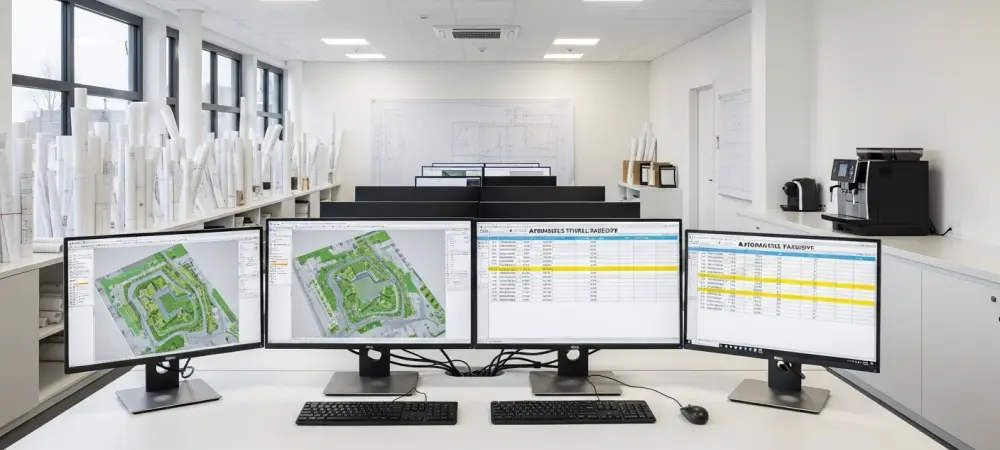
In the razor-thin margin environment of modern construction, the accuracy of a preliminary takeoff often dictates the ultimate financial success or failure of a multi-million dollar project. Traditional methods of estimating materials and labor requirements have long been plagued by human error and the exhausting manual effort of interpreting complex blueprints. The recent launch of Bobyard 2.0 represents a significant shift in how contractors approach this pre-construction phase by integrating advanced artificial intelligence into the core estimating workflow. This upgraded platform addresses the fundamental bottleneck of data entry, allowing specialized estimators to focus on strategic pricing rather than the tedious task of measuring every line and curve on a digital drawing. By automating the extraction of quantities directly from architectural plans, the software ensures that professional teams can maintain a high degree of precision while drastically reducing the time spent on administrative overhead. This evolution in construction technology highlights a movement toward smarter tools that bridge the gap between static plans and dynamic field realities.
Streamlining Precision Through Advanced Measurement Systems
The centerpiece of this technical update is the implementation of a “measure first, price later” model which fundamentally alters the sequence of the bidding process. A standout technical improvement within this framework is the Multi-Measure feature, a tool designed to eliminate the redundancy often found in traditional estimation software. Instead of requiring a user to draw separate shapes for area, perimeter, and volume calculations, the system generates all three data points from a single input. This optimization is particularly beneficial for contractors who manage multifaceted projects where a single surface might require different types of material estimations, such as sub-base volume and finished surface area. Furthermore, the introduction of a sophisticated Legend Manager and Text Count utility allows for the rapid identification of symbols across dozens of blueprint pages. These tools convert text labels and icons into organized numerical data sets instantly, ensuring that no specific fixture or material requirement is overlooked during the high-pressure environment of a deadline-driven bidding cycle.
Beyond basic measurement, the software introduces the AI Workbench, a centralized environment that emphasizes the growing industry standard of human-in-the-loop verification. This approach acknowledges that while artificial intelligence can process massive amounts of visual data, the nuanced judgment of an experienced estimator remains irreplaceable for final decision-making. The Review Workflow within the workbench provides a transparent layer where users can inspect AI-generated outputs, making manual adjustments where project-specific anomalies may exist. This synergy between machine speed and human expertise prevents the “black box” syndrome often associated with automated systems, building trust in the resulting data. Additionally, the platform integrates an Estimate Table that directly connects takeoff quantities to pricing structures without the need for external spreadsheet exports. By maintaining all data within a single environment, the software reduces the risk of transcription errors that frequently occur when moving information between disparate applications. This internal cohesion streamlines the transition from raw architectural data to a finalized, professional bid.
Driving Operational Efficiency and Strategic Growth
The practical implications of these advancements are best measured by the drastic improvement in operational throughput for construction and landscaping firms. Industry data suggests that the new platform automates approximately 70 percent of the takeoff process, which translates into a 65 percent reduction in the total time required to prepare a comprehensive bid. For a typical estimating department, this efficiency gain allows for the submission of three to five times more bids compared to traditional manual workflows. This increased capacity is not merely about speed; it enables companies to be more selective and aggressive in their pursuit of high-value contracts. Michael Ding, the chief executive officer of the company, emphasized that the development of these features was a direct response to customer demand for the elimination of repetitive “busywork” that stifles professional growth. By reclaiming hours previously lost to manual counting, firms can reallocate their intellectual capital toward refining project strategy and strengthening client relationships. This shift from manual labor to data oversight marks a professionalization of the estimating role.
The arrival of this upgraded platform coincided with a significant 35 million dollar Series A funding round, signaling strong institutional confidence in the future of construction-specific artificial intelligence. While the initial release targeted the landscaping sector, the software successfully expanded its reach to encompass broader construction trades shortly after its debut. Experts within the industry noted that the ability to cut takeoff times in half provided a substantial competitive advantage in a market where the speed of response often determined which firm secured a contract. As firms looked toward the coming years from 2026 to 2028, the focus shifted toward adopting unified digital environments that prioritized both accuracy and rapid scalability. The transition to AI-enhanced workbenches encouraged contractors to rethink their pre-construction strategies, moving away from isolated tools toward integrated systems. These developments suggested that the future of the industry would be defined by those who successfully balanced automated data processing with professional oversight. Ultimately, the rollout of this technology provided a clear path for organizations to modernize their operations, ensuring that precision remained a standard rather than a luxury in the increasingly complex landscape of global construction project management.